Melanie Micali, Raphaël François Lemerle, Anja Tiede, Anna Fontcuberta i Morral and Esther Alarcón-Lladó
{"title":"Optimizing carrier collection in solar cells through nanoscale junction design","authors":"Melanie Micali, Raphaël François Lemerle, Anja Tiede, Anna Fontcuberta i Morral and Esther Alarcón-Lladó","doi":"10.1039/D5YA00251F","DOIUrl":null,"url":null,"abstract":"<p >A key challenge in thin-film photovoltaics is achieving selective carrier collection that minimizes recombination losses while maintaining efficient charge extraction. This study presents a theoretical analysis of how reducing junction contact area can enhance the open-circuit voltage (<em>V</em><small><sub>OC</sub></small>) and the power conversion efficiency (PCE) in thin-film solar cells. Using a zinc-phosphide (Zn<small><sub>3</sub></small>P<small><sub>2</sub></small>) -based heterojunction as a model, we simulate the effect of geometrically minimizing contact <em>via</em> silicon-dioxide (SiO<small><sub>2</sub></small>) layers with patterned holes. The smaller the contact area, the lower the reverse saturation current, which results in a significant increase in the <em>V</em><small><sub>OC</sub></small> up to 100 mV. However, the reduced contact area also increases the series resistance, thereby limiting the gain in PCE. This approach is especially effective with non-absorbing highly-doped transport layers, such as titanium-dioxide (TiO<small><sub>2</sub></small>) (PCE gain up to 1.45%). This work underscores the importance of balancing reduced recombination with parasitic resistance and current crowding for optimal performance.</p>","PeriodicalId":72913,"journal":{"name":"Energy advances","volume":" 4","pages":" 427-433"},"PeriodicalIF":4.3000,"publicationDate":"2026-03-19","publicationTypes":"Journal Article","fieldsOfStudy":null,"isOpenAccess":false,"openAccessPdf":"https://www.ncbi.nlm.nih.gov/pmc/articles/PMC13001637/pdf/","citationCount":"0","resultStr":null,"platform":"Semanticscholar","paperid":null,"PeriodicalName":"Energy advances","FirstCategoryId":"1085","ListUrlMain":"https://pubs.rsc.org/en/content/articlelanding/2026/ya/d5ya00251f","RegionNum":0,"RegionCategory":null,"ArticlePicture":[],"TitleCN":null,"AbstractTextCN":null,"PMCID":null,"EPubDate":"","PubModel":"","JCR":"Q2","JCRName":"CHEMISTRY, PHYSICAL","Score":null,"Total":0}
引用次数: 0
Abstract
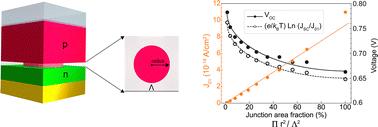
A key challenge in thin-film photovoltaics is achieving selective carrier collection that minimizes recombination losses while maintaining efficient charge extraction. This study presents a theoretical analysis of how reducing junction contact area can enhance the open-circuit voltage (VOC) and the power conversion efficiency (PCE) in thin-film solar cells. Using a zinc-phosphide (Zn3P2) -based heterojunction as a model, we simulate the effect of geometrically minimizing contact via silicon-dioxide (SiO2) layers with patterned holes. The smaller the contact area, the lower the reverse saturation current, which results in a significant increase in the VOC up to 100 mV. However, the reduced contact area also increases the series resistance, thereby limiting the gain in PCE. This approach is especially effective with non-absorbing highly-doped transport layers, such as titanium-dioxide (TiO2) (PCE gain up to 1.45%). This work underscores the importance of balancing reduced recombination with parasitic resistance and current crowding for optimal performance.


 求助内容:
求助内容: 应助结果提醒方式:

 京公网安备 11010802042870号


