{"title":"Upcycling Industrial Polyphenylsulfone Waste into a High-Performance, Non-fluorinated Photothermal Membrane for Sustainable Desalination.","authors":"Weerapong Bootluck, Michaela Olisha Lobregas, M Rafli Habibillah, Ratthapol Rangkupan, Yu-Ming Tu, Sarawut Rimdusit, Chalida Klaysom","doi":"10.1021/acsenvironau.5c00231","DOIUrl":null,"url":null,"abstract":"<p><p>Photothermal membrane distillation (PMD) offers a sustainable pathway for freshwater production, yet its progress depends on developing high-performance membranes made from environmentally benign materials. To address the growing concern over the environmental persistence of fluorinated polymers, this study utilizes non-fluorinated, postindustrial polyphenylsulfone (w-PPSU) waste as a sustainable polymer source for fabricating photothermal membranes. Electrospun w-PPSU nanofibers were surface-modified with magnetite/black titania (Fe<sub>3</sub>O<sub>4</sub>/b-TiO<sub>2</sub>) nanocomposites synthesized at varying b-TiO<sub>2</sub> concentrations and subsequently sealed with a thin hydrophobic polydimethylsiloxane (PDMS) coating. The best-performing membrane (M-F/bT-50) demonstrated rapid solar-driven heating, elevating its surface temperature to 91.1 °C within 120 s under 1 kWm<sup>-2</sup> irradiation. In desalination tests at a minimal temperature difference (Δ<i>T</i> = 15 °C), this membrane achieved a water flux of 3.27 Lm<sup>-2</sup>h<sup>-1</sup>, a salt rejection of 99.74%, and a photothermal conversion efficiency of 69.87%. Furthermore, the membrane maintained performance over multiple acidic cleaning cycles, demonstrating high flux recovery and regenerability. This work not only introduces an effective material system for efficient desalination but also establishes a viable pathway for valorizing industrial polymer waste into advanced, environmentally responsible technologies, contributing directly to the principles of a circular economy.</p>","PeriodicalId":29801,"journal":{"name":"ACS Environmental Au","volume":"6 2","pages":"322-334"},"PeriodicalIF":7.7000,"publicationDate":"2026-01-15","publicationTypes":"Journal Article","fieldsOfStudy":null,"isOpenAccess":false,"openAccessPdf":"https://www.ncbi.nlm.nih.gov/pmc/articles/PMC13003361/pdf/","citationCount":"0","resultStr":null,"platform":"Semanticscholar","paperid":null,"PeriodicalName":"ACS Environmental Au","FirstCategoryId":"1085","ListUrlMain":"https://doi.org/10.1021/acsenvironau.5c00231","RegionNum":0,"RegionCategory":null,"ArticlePicture":[],"TitleCN":null,"AbstractTextCN":null,"PMCID":null,"EPubDate":"2026/3/18 0:00:00","PubModel":"eCollection","JCR":"Q1","JCRName":"ENGINEERING, ENVIRONMENTAL","Score":null,"Total":0}
引用次数: 0
Abstract
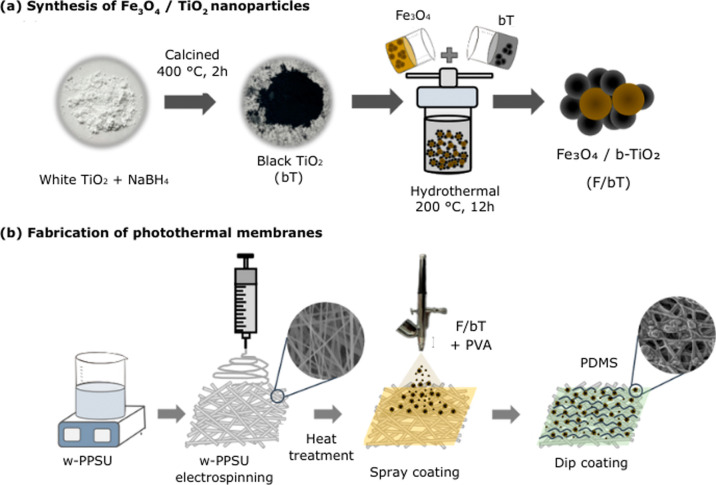
Photothermal membrane distillation (PMD) offers a sustainable pathway for freshwater production, yet its progress depends on developing high-performance membranes made from environmentally benign materials. To address the growing concern over the environmental persistence of fluorinated polymers, this study utilizes non-fluorinated, postindustrial polyphenylsulfone (w-PPSU) waste as a sustainable polymer source for fabricating photothermal membranes. Electrospun w-PPSU nanofibers were surface-modified with magnetite/black titania (Fe3O4/b-TiO2) nanocomposites synthesized at varying b-TiO2 concentrations and subsequently sealed with a thin hydrophobic polydimethylsiloxane (PDMS) coating. The best-performing membrane (M-F/bT-50) demonstrated rapid solar-driven heating, elevating its surface temperature to 91.1 °C within 120 s under 1 kWm-2 irradiation. In desalination tests at a minimal temperature difference (ΔT = 15 °C), this membrane achieved a water flux of 3.27 Lm-2h-1, a salt rejection of 99.74%, and a photothermal conversion efficiency of 69.87%. Furthermore, the membrane maintained performance over multiple acidic cleaning cycles, demonstrating high flux recovery and regenerability. This work not only introduces an effective material system for efficient desalination but also establishes a viable pathway for valorizing industrial polymer waste into advanced, environmentally responsible technologies, contributing directly to the principles of a circular economy.
期刊介绍:
ACS Environmental Au is an open access journal which publishes experimental research and theoretical results in all aspects of environmental science and technology both pure and applied. Short letters comprehensive articles reviews and perspectives are welcome in the following areas:Alternative EnergyAnthropogenic Impacts on Atmosphere Soil or WaterBiogeochemical CyclingBiomass or Wastes as ResourcesContaminants in Aquatic and Terrestrial EnvironmentsEnvironmental Data ScienceEcotoxicology and Public HealthEnergy and ClimateEnvironmental Modeling Processes and Measurement Methods and TechnologiesEnvironmental Nanotechnology and BiotechnologyGreen ChemistryGreen Manufacturing and EngineeringRisk assessment Regulatory Frameworks and Life-Cycle AssessmentsTreatment and Resource Recovery and Waste Management




 求助内容:
求助内容: 应助结果提醒方式:

 京公网安备 11010802042870号


