Sheza Malik, Renisha Redij, Dushyant Singh Dahiya, Chengu Niu, Douglas G Adler
{"title":"Machine learning in predicting treatment response and remission in inflammatory bowel disease: a systematic review.","authors":"Sheza Malik, Renisha Redij, Dushyant Singh Dahiya, Chengu Niu, Douglas G Adler","doi":"10.20524/aog.2026.1041","DOIUrl":null,"url":null,"abstract":"<p><strong>Background: </strong>The heterogeneity of inflammatory bowel disease (IBD) and its unpredictable course have always been a challenge for gastroenterologists, with regard to predicting the disease response using endoscopic techniques. Machine learning (ML) models have shown some early promise in predicting treatment response in IBD patients.</p><p><strong>Methods: </strong>We conducted a systematic review of studies investigating the application of ML to predict treatment response and remission in IBD patients. We used the CHARMS checklist for data extraction. Bias was assessed with the PROBAST tool.</p><p><strong>Results: </strong>We included in our review 6 studies that evaluated numbers of IBD patients ranging from 67 to 3004. ML models demonstrated low to moderate predictive accuracy for treatment response and remission (area under the receiver operating characteristic curve: 0.489-0.811; sensitivity: 0.46-0.96; specificity: 0.56-0.98). The studies that utilized ML models with more input variables performed better. Furthermore, only 2 studies performed external validation, and half of the studies demonstrated a substantial risk of bias due to missing data/overfitting, and variability in outcome definition.</p><p><strong>Conclusions: </strong>ML models show considerable promise in predicting treatment outcomes and remission in IBD. However, given the substantial bias in studies so far, future studies should use a standardized methodology, external validation, and an interpretable broader input variable.</p>","PeriodicalId":7978,"journal":{"name":"Annals of Gastroenterology","volume":"39 2","pages":"247-253"},"PeriodicalIF":2.7000,"publicationDate":"2026-03-01","publicationTypes":"Journal Article","fieldsOfStudy":null,"isOpenAccess":false,"openAccessPdf":"https://www.ncbi.nlm.nih.gov/pmc/articles/PMC13004820/pdf/","citationCount":"0","resultStr":null,"platform":"Semanticscholar","paperid":null,"PeriodicalName":"Annals of Gastroenterology","FirstCategoryId":"1085","ListUrlMain":"https://doi.org/10.20524/aog.2026.1041","RegionNum":0,"RegionCategory":null,"ArticlePicture":[],"TitleCN":null,"AbstractTextCN":null,"PMCID":null,"EPubDate":"2026/2/12 0:00:00","PubModel":"Epub","JCR":"Q3","JCRName":"GASTROENTEROLOGY & HEPATOLOGY","Score":null,"Total":0}
引用次数: 0
Abstract
Background: The heterogeneity of inflammatory bowel disease (IBD) and its unpredictable course have always been a challenge for gastroenterologists, with regard to predicting the disease response using endoscopic techniques. Machine learning (ML) models have shown some early promise in predicting treatment response in IBD patients.
Methods: We conducted a systematic review of studies investigating the application of ML to predict treatment response and remission in IBD patients. We used the CHARMS checklist for data extraction. Bias was assessed with the PROBAST tool.
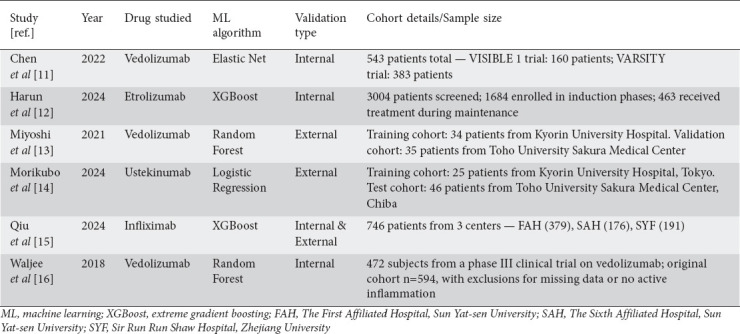
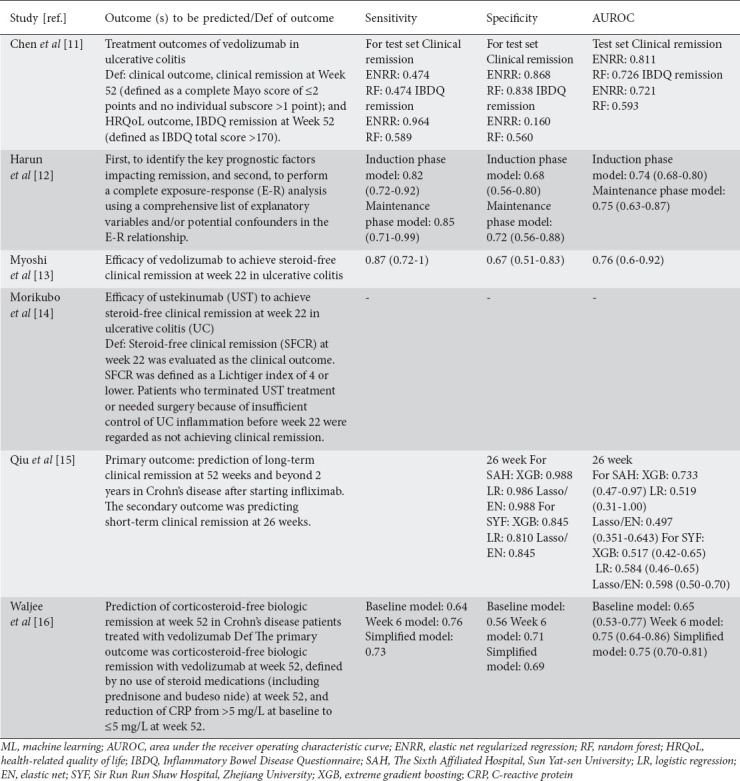
Results: We included in our review 6 studies that evaluated numbers of IBD patients ranging from 67 to 3004. ML models demonstrated low to moderate predictive accuracy for treatment response and remission (area under the receiver operating characteristic curve: 0.489-0.811; sensitivity: 0.46-0.96; specificity: 0.56-0.98). The studies that utilized ML models with more input variables performed better. Furthermore, only 2 studies performed external validation, and half of the studies demonstrated a substantial risk of bias due to missing data/overfitting, and variability in outcome definition.
Conclusions: ML models show considerable promise in predicting treatment outcomes and remission in IBD. However, given the substantial bias in studies so far, future studies should use a standardized methodology, external validation, and an interpretable broader input variable.



 求助内容:
求助内容: 应助结果提醒方式:

 京公网安备 11010802042870号


