
Light-driven reversible ring contraction and expansion to modulate strain, conformation, and reactivity
IF 19.6
1区 化学
Q1 CHEMISTRY, MULTIDISCIPLINARY
引用次数: 0
Abstract
Chemists utilize cyclic constraints in molecules to control conformation, shape, and reactivity. The strain introduced in the (macro)cycles is released during reactions and drives transformations ranging from strain-promoted in vivo ligation to ring-opening metathesis polymerization. However, in each case, the ring size needs careful optimization and cannot be (re)adjusted. For remote optical modulation of strain, we designed looped diarylethene photoswitches that undergo reversible ring contraction/expansion upon electrocyclic ring closure/opening. Investigating a homologous series, we discovered that the long-wavelength absorption of the closed isomer serves as a diagnostic tool for stored molecular strain. By incorporating an internal allene reactive group in the loop, we enhanced its reactivity in a [3+2] dipolar cycloaddition with ethyl diazoacetate under visible light. Quantum chemical calculations helped rationalize the experimentally observed size-dependent photochemistry and reactivity of the macrocycles. Our approach opens opportunities for optical spatiotemporal reactivity control in life and materials science applications.
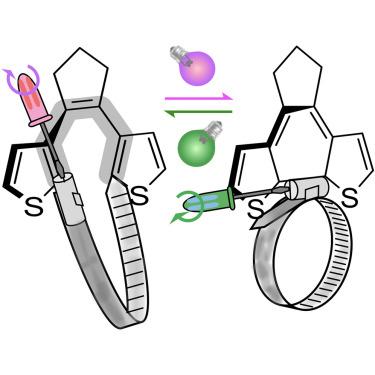
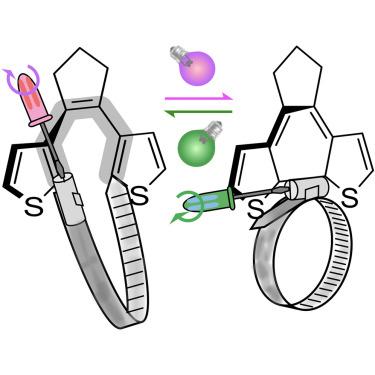
光驱动可逆环收缩和膨胀调节应变,构象和反应性
化学家利用分子中的循环约束来控制构象、形状和反应性。在(宏观)循环中引入的菌株在反应过程中被释放,并驱动从菌株促进的体内连接到开环复分解聚合的转化。然而,在每种情况下,环的大小需要仔细优化,不能(重新)调整。为了实现应变的远程光学调制,我们设计了环路二乙烯光开关,该开关在电环闭合/打开时进行可逆的环收缩/膨胀。研究同源序列,我们发现封闭异构体的长波吸收可作为存储分子菌株的诊断工具。通过在环中加入一个内部的烯反应基团,我们在可见光下增强了它与重氮乙酸乙酯[3+2]偶极环加成的反应活性。量子化学计算有助于使实验观察到的依赖尺寸的光化学和大环的反应性合理化。我们的方法为生命和材料科学应用中的光学时空反应性控制提供了机会。
本文章由计算机程序翻译,如有差异,请以英文原文为准。
求助全文
约1分钟内获得全文
求助全文
来源期刊
Chem
Environmental Science-Environmental Chemistry
CiteScore
32.40
自引率
1.30%
发文量
281
期刊介绍:
Chem, affiliated with Cell as its sister journal, serves as a platform for groundbreaking research and illustrates how fundamental inquiries in chemistry and its related fields can contribute to addressing future global challenges. It was established in 2016, and is currently edited by Robert Eagling.
 求助内容:
求助内容: 应助结果提醒方式:

 京公网安备 11010802042870号


