Michelle M Gagnon, Alexandra Brilz, Courtney Cameron, Krista Baerg
{"title":"Parental Validation and Invalidation in Parent-Adolescent Discussion of Worry and Pain.","authors":"Michelle M Gagnon, Alexandra Brilz, Courtney Cameron, Krista Baerg","doi":"10.1080/24740527.2026.2622315","DOIUrl":null,"url":null,"abstract":"<p><strong>Background: </strong>Parental responses to an adolescent's pain impact pain-related variables, yet limited research has focused on parent-adolescent pain communication. Additionally, patterns have rarely been examined through comparisons of dyads where the adolescent has chronic pain versus those without.</p><p><strong>Aims: </strong>To examine the impact of parental validation and invalidation on adolescent pain-related variables (i.e. functional disability, pain catastrophizing, pain intensity).</p><p><strong>Methods: </strong>Parent-adolescent dyads, including adolescents with chronic pain (CP; <i>n</i> = 32) and with no chronic pain (NCP; <i>n</i> = 61), completed questionnaires and two discussion tasks: a worry discussion and a pain discussion. Parental responses were coded using the Validating and Invalidating Behaviors Coding Scale.</p><p><strong>Results: </strong>Parental invalidation was significantly greater in the worry task compared to the pain task (<i>F</i>(1, 91) = 4.16, <i>p</i> =.04). In the pain task, greater parental validation predicted higher adolescent functional disability (<i>β</i> = 0.32, <i>p</i> =.02), with significantly stronger effects in the CP group. Validation also predicted adolescent pain catastrophizing (worry: <i>β</i> =.35, <i>p</i> =.02; pain: <i>β</i> = 0.30, <i>p</i> =.03), with significantly greater effects in the CP group. In the worry task, validation showed both linear (<i>β</i> = -0.34, <i>p</i> =.03) and curvilinear (<i>β</i> = -0.25, <i>p</i> =.005) relationships with changes in adolescent pain intensity.</p><p><strong>Conclusions: </strong>Chronic pain status and discussion content are associated with adolescent-reported variables during parent-adolescent interactions. Greater attention to intra- and interpersonal variables is needed to understand how pain communication unfolds between parents and adolescents.</p>","PeriodicalId":53214,"journal":{"name":"Canadian Journal of Pain-Revue Canadienne de la Douleur","volume":"10 1","pages":"2622315"},"PeriodicalIF":2.1000,"publicationDate":"2026-03-17","publicationTypes":"Journal Article","fieldsOfStudy":null,"isOpenAccess":false,"openAccessPdf":"https://www.ncbi.nlm.nih.gov/pmc/articles/PMC12998012/pdf/","citationCount":"0","resultStr":null,"platform":"Semanticscholar","paperid":null,"PeriodicalName":"Canadian Journal of Pain-Revue Canadienne de la Douleur","FirstCategoryId":"1085","ListUrlMain":"https://doi.org/10.1080/24740527.2026.2622315","RegionNum":0,"RegionCategory":null,"ArticlePicture":[],"TitleCN":null,"AbstractTextCN":null,"PMCID":null,"EPubDate":"2026/1/1 0:00:00","PubModel":"eCollection","JCR":"Q3","JCRName":"CLINICAL NEUROLOGY","Score":null,"Total":0}
引用次数: 0
Abstract
Background: Parental responses to an adolescent's pain impact pain-related variables, yet limited research has focused on parent-adolescent pain communication. Additionally, patterns have rarely been examined through comparisons of dyads where the adolescent has chronic pain versus those without.
Aims: To examine the impact of parental validation and invalidation on adolescent pain-related variables (i.e. functional disability, pain catastrophizing, pain intensity).
Methods: Parent-adolescent dyads, including adolescents with chronic pain (CP; n = 32) and with no chronic pain (NCP; n = 61), completed questionnaires and two discussion tasks: a worry discussion and a pain discussion. Parental responses were coded using the Validating and Invalidating Behaviors Coding Scale.
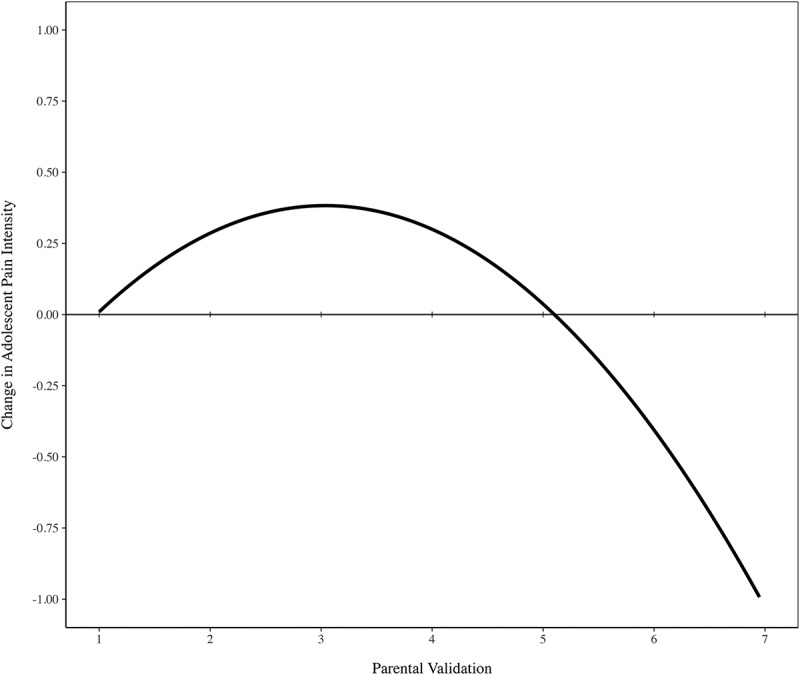
Results: Parental invalidation was significantly greater in the worry task compared to the pain task (F(1, 91) = 4.16, p =.04). In the pain task, greater parental validation predicted higher adolescent functional disability (β = 0.32, p =.02), with significantly stronger effects in the CP group. Validation also predicted adolescent pain catastrophizing (worry: β =.35, p =.02; pain: β = 0.30, p =.03), with significantly greater effects in the CP group. In the worry task, validation showed both linear (β = -0.34, p =.03) and curvilinear (β = -0.25, p =.005) relationships with changes in adolescent pain intensity.
Conclusions: Chronic pain status and discussion content are associated with adolescent-reported variables during parent-adolescent interactions. Greater attention to intra- and interpersonal variables is needed to understand how pain communication unfolds between parents and adolescents.
背景:父母对青少年疼痛的反应影响疼痛相关变量,但有限的研究集中在父母-青少年疼痛沟通。此外,很少通过比较青少年有慢性疼痛和没有慢性疼痛的二联体来检查模式。目的:探讨父母确认和父母无效对青少年疼痛相关变量(即功能障碍、疼痛灾难化、疼痛强度)的影响。方法:有慢性疼痛的青少年(CP, n = 32)和无慢性疼痛的青少年(NCP, n = 61),分别完成问卷调查和忧虑讨论和疼痛讨论两项讨论任务。使用验证和无效行为编码量表对父母的反应进行编码。结果:父母失效在焦虑任务中显著高于痛苦任务(F(1,91) = 4.16, p = 0.04)。在疼痛任务中,更高的父母验证预示着更高的青少年功能障碍(β = 0.32, p = 0.02),在CP组中显著更强。验证还预测青少年疼痛灾难化(担忧:β = 0.35, p = 0.02;疼痛:β = 0.30, p = 0.03), CP组的影响显著更大。在焦虑任务中,验证显示青少年疼痛强度的变化与线性关系(β = -0.34, p =.03)和曲线关系(β = -0.25, p =.005)。结论:慢性疼痛状态和讨论内容与亲子互动中青少年报告的变量相关。更多的关注内部和人际变量是需要了解如何痛苦沟通展开父母和青少年之间。


 求助内容:
求助内容: 应助结果提醒方式:

 京公网安备 11010802042870号


