{"title":"Automatic assessment of lung involvement in systemic sclerosis using deep learning.","authors":"Matin Esnaashari, Roya Arian, Ali Hajihashemi, Narges Saeedizadeh, Somayeh Hajiahmadi, Somayeh Sadeghi, Azin Shayganfar, Rahele Kafieh","doi":"10.4103/jrms.jrms_994_25","DOIUrl":null,"url":null,"abstract":"<p><strong>Background: </strong>Systemic sclerosis (SSc) is a relatively uncommon connective tissue disorder, commonly manifesting as interstitial lung disease (ILD) and affecting both the lung parenchyma and the modification of the space between endothelium and epithelium. Imaging modalities like computed tomography (CT) scans are essential for diagnosing and revealing specific abnormal findings (ILD patterns) in SSc, such as reticulation and Ground-glass opacity (GGO). To enhance diagnostic precision and minimize human error, we leverage deep learning (DL) techniques.</p><p><strong>Materials and methods: </strong>In our study, we collected and annotated a new public dataset from 22 individuals, encompassing 2190 lung CT scan slices. After preprocessing and exclusion of slices without abnormalities, 1777 slices from 17 patients were used for model training and validation, and 413 slices from five patients were reserved for independent testing. We use a specialized U-net model to segment these patterns, categorizing them into reticulation or GGO, and employ an automated algorithm to outline lung areas in each CT slice. The model's objective is to quantify the patient's lung involvement in SSc by calculating the total identified GGO and reticulation areas across all slices and normalizing this by the total lung surface area.</p><p><strong>Results: </strong>The U-net model shows promising results in segmenting both reticulation and a combination of GGO and reticulation, as indicated by Dice coefficients of 87.22% and 86.20%, respectively. Furthermore, the automated algorithm effectively outlines the lung region in each slice, enabling accurate measurement of lung involvement in SSc patients.</p><p><strong>Conclusion: </strong>In conclusion, using DL using the U-Net model and an automated algorithm has shown promising results in accurately segmenting and quantifying lung involvement in Scleroderma patients using CT scans.</p>","PeriodicalId":50062,"journal":{"name":"Journal of Research in Medical Sciences","volume":"31 ","pages":"10"},"PeriodicalIF":1.5000,"publicationDate":"2026-02-26","publicationTypes":"Journal Article","fieldsOfStudy":null,"isOpenAccess":false,"openAccessPdf":"https://www.ncbi.nlm.nih.gov/pmc/articles/PMC12998934/pdf/","citationCount":"0","resultStr":null,"platform":"Semanticscholar","paperid":null,"PeriodicalName":"Journal of Research in Medical Sciences","FirstCategoryId":"3","ListUrlMain":"https://doi.org/10.4103/jrms.jrms_994_25","RegionNum":4,"RegionCategory":"医学","ArticlePicture":[],"TitleCN":null,"AbstractTextCN":null,"PMCID":null,"EPubDate":"2026/1/1 0:00:00","PubModel":"eCollection","JCR":"Q2","JCRName":"MEDICINE, GENERAL & INTERNAL","Score":null,"Total":0}
引用次数: 0
Abstract
Background: Systemic sclerosis (SSc) is a relatively uncommon connective tissue disorder, commonly manifesting as interstitial lung disease (ILD) and affecting both the lung parenchyma and the modification of the space between endothelium and epithelium. Imaging modalities like computed tomography (CT) scans are essential for diagnosing and revealing specific abnormal findings (ILD patterns) in SSc, such as reticulation and Ground-glass opacity (GGO). To enhance diagnostic precision and minimize human error, we leverage deep learning (DL) techniques.
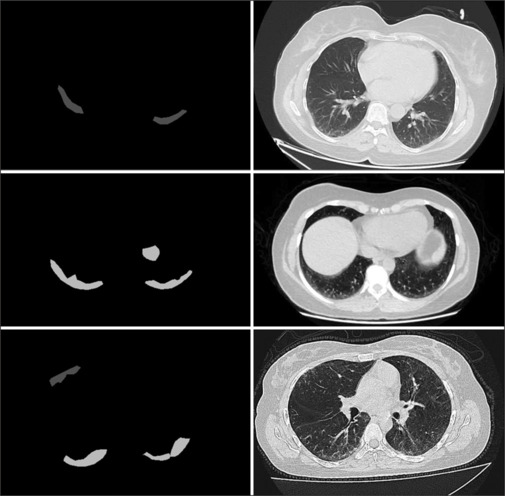
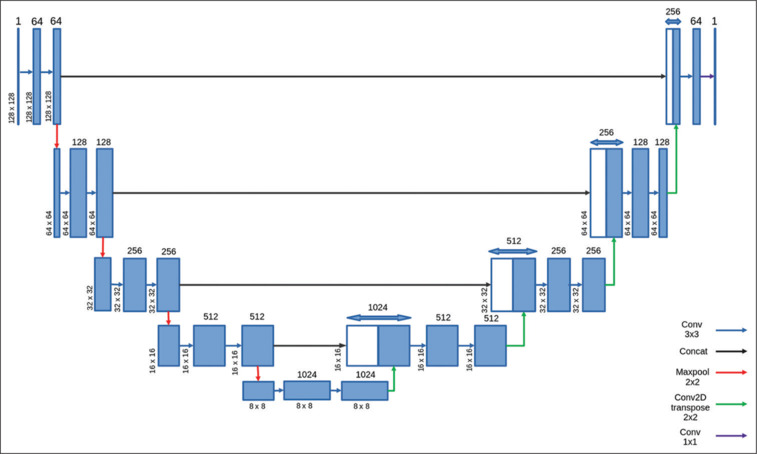
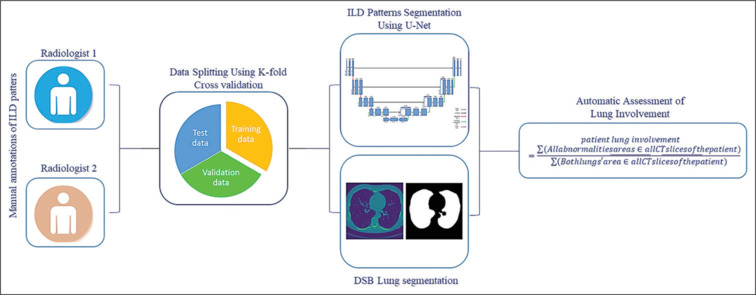
Materials and methods: In our study, we collected and annotated a new public dataset from 22 individuals, encompassing 2190 lung CT scan slices. After preprocessing and exclusion of slices without abnormalities, 1777 slices from 17 patients were used for model training and validation, and 413 slices from five patients were reserved for independent testing. We use a specialized U-net model to segment these patterns, categorizing them into reticulation or GGO, and employ an automated algorithm to outline lung areas in each CT slice. The model's objective is to quantify the patient's lung involvement in SSc by calculating the total identified GGO and reticulation areas across all slices and normalizing this by the total lung surface area.
Results: The U-net model shows promising results in segmenting both reticulation and a combination of GGO and reticulation, as indicated by Dice coefficients of 87.22% and 86.20%, respectively. Furthermore, the automated algorithm effectively outlines the lung region in each slice, enabling accurate measurement of lung involvement in SSc patients.
Conclusion: In conclusion, using DL using the U-Net model and an automated algorithm has shown promising results in accurately segmenting and quantifying lung involvement in Scleroderma patients using CT scans.
期刊介绍:
Journal of Research in Medical Sciences, a publication of Isfahan University of Medical Sciences, is a peer-reviewed online continuous journal with print on demand compilation of issues published. The journal’s full text is available online at http://www.jmsjournal.net. The journal allows free access (Open Access) to its contents and permits authors to self-archive final accepted version of the articles on any OAI-compliant institutional / subject-based repository.

 求助内容:
求助内容: 应助结果提醒方式:

 京公网安备 11010802042870号


