{"title":"Trends in the prevalence of Gidoh at Japan Racing Association Training Centers in 2020.","authors":"Atsutoshi Kuwano, Kanichi Kusano, Hiroshi Mita, Norihisa Tamura, Hirotaka Tokushige, Mai Iimori, Shinjiro Kurimoto, Masato Kawabata, Masato Ueno, Yuji Okada, Kazuhiro Kamiya, Kazuhisa Tanaka","doi":"10.1294/jes.37.21","DOIUrl":null,"url":null,"abstract":"<p><p>Pathological hoof-wall cavities unrelated to nailing (so called \"Gidoh\" in Japan) often occur in the feet of horses. In 2001, in facilities managed by the Japan Racing Association (JRA), Gidoh was found to occur most frequently in the toe of the fore-hoof, with no gender predilection, and was more prevalent in older horses. However, it remains unclear whether this trend has continued in recent years, which pathological type of Gidoh predominates, and whether there are differences in prevalence among seasons. Therefore, in spring (April) and autumn (October) of 2020, we surveyed all racehorses stabled at the JRA training centers (TCs) regarding age, gender, lesion location, disease type, lesion severity, and prevalence of Gidoh. We reaffirmed that this foot problem occurred most frequently in horses aged 6 years or older, with no gender predilection. It occurred preferentially in the toe of the fore-hoof. White-line-fissure-type Gidoh was predominant, and about 80% of cases were mild. The prevalence was significantly lower in October than in April (<i>P</i>=0.02). The recent trend in the prevalence of Gidoh at the JRA TCs was similar to that in the 2001 survey, suggesting that routine hoof management at the JRA facilities has been stable for the past 19 years. In addition, the new finding of a lack of a difference in prevalence between the two JRA TCs indicated that hoof-care techniques at the two TCs have become more closely aligned over the past 19 years.</p>","PeriodicalId":35701,"journal":{"name":"Journal of Equine Science","volume":"37 1","pages":"21-26"},"PeriodicalIF":0.0000,"publicationDate":"2026-03-01","publicationTypes":"Journal Article","fieldsOfStudy":null,"isOpenAccess":false,"openAccessPdf":"https://www.ncbi.nlm.nih.gov/pmc/articles/PMC12995548/pdf/","citationCount":"0","resultStr":null,"platform":"Semanticscholar","paperid":null,"PeriodicalName":"Journal of Equine Science","FirstCategoryId":"1085","ListUrlMain":"https://doi.org/10.1294/jes.37.21","RegionNum":0,"RegionCategory":null,"ArticlePicture":[],"TitleCN":null,"AbstractTextCN":null,"PMCID":null,"EPubDate":"2026/3/14 0:00:00","PubModel":"Epub","JCR":"Q3","JCRName":"Veterinary","Score":null,"Total":0}
引用次数: 0
Abstract
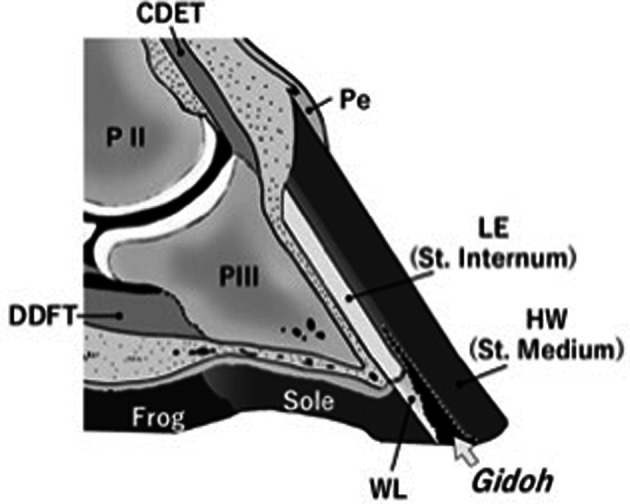
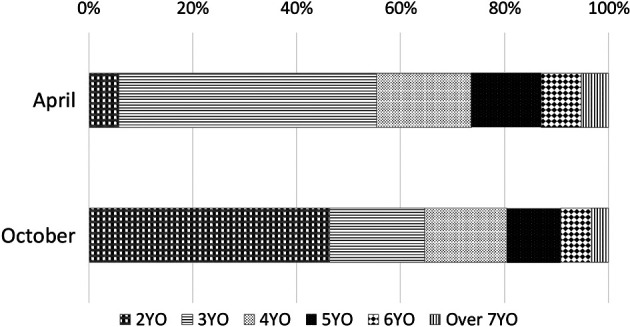
Pathological hoof-wall cavities unrelated to nailing (so called "Gidoh" in Japan) often occur in the feet of horses. In 2001, in facilities managed by the Japan Racing Association (JRA), Gidoh was found to occur most frequently in the toe of the fore-hoof, with no gender predilection, and was more prevalent in older horses. However, it remains unclear whether this trend has continued in recent years, which pathological type of Gidoh predominates, and whether there are differences in prevalence among seasons. Therefore, in spring (April) and autumn (October) of 2020, we surveyed all racehorses stabled at the JRA training centers (TCs) regarding age, gender, lesion location, disease type, lesion severity, and prevalence of Gidoh. We reaffirmed that this foot problem occurred most frequently in horses aged 6 years or older, with no gender predilection. It occurred preferentially in the toe of the fore-hoof. White-line-fissure-type Gidoh was predominant, and about 80% of cases were mild. The prevalence was significantly lower in October than in April (P=0.02). The recent trend in the prevalence of Gidoh at the JRA TCs was similar to that in the 2001 survey, suggesting that routine hoof management at the JRA facilities has been stable for the past 19 years. In addition, the new finding of a lack of a difference in prevalence between the two JRA TCs indicated that hoof-care techniques at the two TCs have become more closely aligned over the past 19 years.



 求助内容:
求助内容: 应助结果提醒方式:

 京公网安备 11010802042870号


