Siti Subaidah, Desy Sugiani, Daniar Kusumawati, Joko Sumarwan, Indah Mastuti, Muhammad Marzuqi, Bejo Slamet, Suko Ismi, Tridjoko, Warih Hardanu, Lisa Ruliaty, Ketut Mahardika, Andi Parengrengi, Darmawan Setia Budi
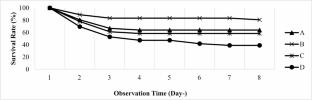
{"title":"Effect of Sargassum polycystum Enrichment in Feed on Immune Response and Survival Rate of Litopenaeus vannamei Against Vibrio harveyi Infection","authors":"Siti Subaidah, Desy Sugiani, Daniar Kusumawati, Joko Sumarwan, Indah Mastuti, Muhammad Marzuqi, Bejo Slamet, Suko Ismi, Tridjoko, Warih Hardanu, Lisa Ruliaty, Ketut Mahardika, Andi Parengrengi, Darmawan Setia Budi","doi":"10.1007/s10126-026-10599-1","DOIUrl":null,"url":null,"abstract":"<div>\n \n <p>Prior studies on <i>Sargasum</i> sp. as an immunostimulant were mostly focused on injection and immersion methods. Moreover, large-scale aquaculture requires practical applications to minimize stress caused by handling. The objective of this research was to investigate the effect of feed enrichment with extract of <i>Sargassum polycystum</i> on the immune response and survival rate of <i>Litopenaeus vannamei</i>. This study used <i>S. polycystum</i> which is a brown seaweed that contains bioactive compounds such as flavonoids and phenolics, was added to shrimp feed at varying concentrations (5, 10, and 15 g/kg). Immune parameters, including Total Hemocyte Count (THC), Differential Hemocyte Count (DHC), and immune gene expression (lectin and proPO) were analysed before and after the challenge test using <i>Vibrio harveyi</i>. The results showed that <i>S. polycystum</i> extract significantly increased THC, DHC, and immune gene expression compared to the control group, indicating an increase in immune defense. However, the enrichment did not significantly affect on shrimp growth. Post challenge test, the highest survival rate (80.56%) obtained in shrimp were fed with 10 g/kg <i>S. polycystum</i> extract. The results showed that dietary supplementation with extract of <i>S. polycystum</i> enhanced the immune system of <i>L. vannamei</i> and providing a preventive approach against pathogen infection.</p>\n </div>","PeriodicalId":690,"journal":{"name":"Marine Biotechnology","volume":"28 2","pages":""},"PeriodicalIF":2.8000,"publicationDate":"2026-03-19","publicationTypes":"Journal Article","fieldsOfStudy":null,"isOpenAccess":false,"openAccessPdf":"","citationCount":"0","resultStr":null,"platform":"Semanticscholar","paperid":null,"PeriodicalName":"Marine Biotechnology","FirstCategoryId":"99","ListUrlMain":"https://link.springer.com/article/10.1007/s10126-026-10599-1","RegionNum":3,"RegionCategory":"生物学","ArticlePicture":[],"TitleCN":null,"AbstractTextCN":null,"PMCID":null,"EPubDate":"","PubModel":"","JCR":"Q3","JCRName":"BIOTECHNOLOGY & APPLIED MICROBIOLOGY","Score":null,"Total":0}
引用次数: 0
Abstract
Prior studies on Sargasum sp. as an immunostimulant were mostly focused on injection and immersion methods. Moreover, large-scale aquaculture requires practical applications to minimize stress caused by handling. The objective of this research was to investigate the effect of feed enrichment with extract of Sargassum polycystum on the immune response and survival rate of Litopenaeus vannamei. This study used S. polycystum which is a brown seaweed that contains bioactive compounds such as flavonoids and phenolics, was added to shrimp feed at varying concentrations (5, 10, and 15 g/kg). Immune parameters, including Total Hemocyte Count (THC), Differential Hemocyte Count (DHC), and immune gene expression (lectin and proPO) were analysed before and after the challenge test using Vibrio harveyi. The results showed that S. polycystum extract significantly increased THC, DHC, and immune gene expression compared to the control group, indicating an increase in immune defense. However, the enrichment did not significantly affect on shrimp growth. Post challenge test, the highest survival rate (80.56%) obtained in shrimp were fed with 10 g/kg S. polycystum extract. The results showed that dietary supplementation with extract of S. polycystum enhanced the immune system of L. vannamei and providing a preventive approach against pathogen infection.
期刊介绍:
Marine Biotechnology welcomes high-quality research papers presenting novel data on the biotechnology of aquatic organisms. The journal publishes high quality papers in the areas of molecular biology, genomics, proteomics, cell biology, and biochemistry, and particularly encourages submissions of papers related to genome biology such as linkage mapping, large-scale gene discoveries, QTL analysis, physical mapping, and comparative and functional genome analysis. Papers on technological development and marine natural products should demonstrate innovation and novel applications.

 求助内容:
求助内容: 应助结果提醒方式:

 京公网安备 11010802042870号


