Nima Vaziri, Babak Alikiaii, Shadi Farsaei, Sarah Mousavi
{"title":"Peripheral perfusion-guided versus routine fluid therapy in sepsis: A randomized controlled pilot trial.","authors":"Nima Vaziri, Babak Alikiaii, Shadi Farsaei, Sarah Mousavi","doi":"10.4103/jrms.jrms_974_25","DOIUrl":null,"url":null,"abstract":"<p><strong>Background: </strong>Sepsis remains a leading cause of morbidity and mortality among critically ill patients. Fluid resuscitation is essential, but conventional protocols often lack individualized assessment of tissue perfusion, risking underresuscitation or fluid overload. The peripheral perfusion index (PPI), derived from pulse oximetry, offers a practical, noninvasive way to dynamically guide fluid therapy and may improve outcomes. The objective of the study was to evaluate whether PPI-guided targeted fluid therapy improves clinical and microvascular outcomes in septic intensive care unit patients compared with conventional fluid therapy.</p><p><strong>Materials and methods: </strong>In a prospective, randomized trial, 60 septic adults were assigned to standard fluid therapy or PPI-guided resuscitation. The primary outcome was microvascular perfusion improvement within 72 h. The secondary outcomes included 7-day mortality, acute kidney injury (AKI), fluid balance, lactate clearance, and renal biomarkers (including cystatin C).</p><p><strong>Results: </strong>PPI-guided therapy significantly improved microvascular perfusion (<i>P</i> = 0.001) and reduced cystatin C levels by day 7 (<i>P</i> = 0.0001), suggesting renal protection. Although there were fewer deaths at 7 days and less AKI in the intervention group, these differences did not reach statistical significance. Trends favored lactate clearance and more favorable fluid balance with PPI guidance.</p><p><strong>Conclusion: </strong>PPI-guided fluid therapy is a feasible, low-cost approach to individualized resuscitation in septic patients, associated with short-term improvements in microvascular perfusion and renal biomarkers. The observed physiological benefits warrant confirmation in larger multicenter trials to determine any impact on long-term clinical outcomes.</p>","PeriodicalId":50062,"journal":{"name":"Journal of Research in Medical Sciences","volume":"31 ","pages":"9"},"PeriodicalIF":1.7000,"publicationDate":"2026-02-26","publicationTypes":"Journal Article","fieldsOfStudy":null,"isOpenAccess":false,"openAccessPdf":"https://www.ncbi.nlm.nih.gov/pmc/articles/PMC12994866/pdf/","citationCount":"0","resultStr":null,"platform":"Semanticscholar","paperid":null,"PeriodicalName":"Journal of Research in Medical Sciences","FirstCategoryId":"3","ListUrlMain":"https://doi.org/10.4103/jrms.jrms_974_25","RegionNum":4,"RegionCategory":"医学","ArticlePicture":[],"TitleCN":null,"AbstractTextCN":null,"PMCID":null,"EPubDate":"2026/1/1 0:00:00","PubModel":"eCollection","JCR":"Q2","JCRName":"MEDICINE, GENERAL & INTERNAL","Score":null,"Total":0}
引用次数: 0
Abstract
Background: Sepsis remains a leading cause of morbidity and mortality among critically ill patients. Fluid resuscitation is essential, but conventional protocols often lack individualized assessment of tissue perfusion, risking underresuscitation or fluid overload. The peripheral perfusion index (PPI), derived from pulse oximetry, offers a practical, noninvasive way to dynamically guide fluid therapy and may improve outcomes. The objective of the study was to evaluate whether PPI-guided targeted fluid therapy improves clinical and microvascular outcomes in septic intensive care unit patients compared with conventional fluid therapy.
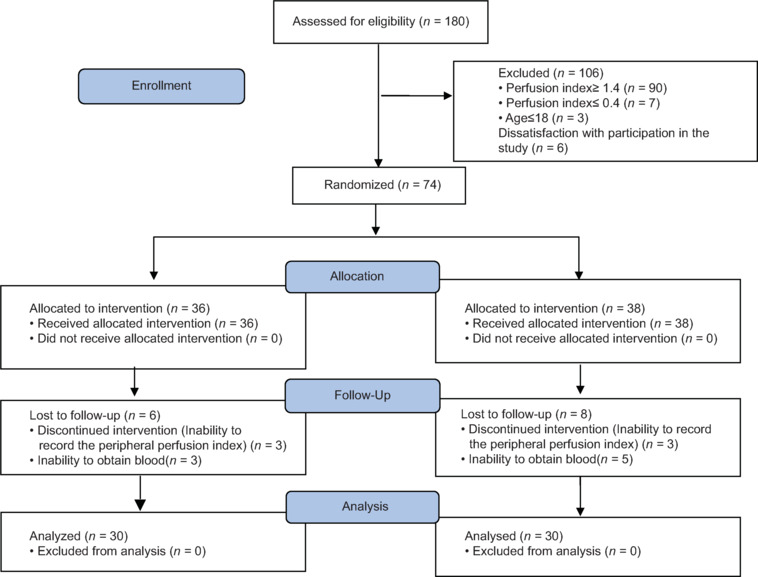
Materials and methods: In a prospective, randomized trial, 60 septic adults were assigned to standard fluid therapy or PPI-guided resuscitation. The primary outcome was microvascular perfusion improvement within 72 h. The secondary outcomes included 7-day mortality, acute kidney injury (AKI), fluid balance, lactate clearance, and renal biomarkers (including cystatin C).
Results: PPI-guided therapy significantly improved microvascular perfusion (P = 0.001) and reduced cystatin C levels by day 7 (P = 0.0001), suggesting renal protection. Although there were fewer deaths at 7 days and less AKI in the intervention group, these differences did not reach statistical significance. Trends favored lactate clearance and more favorable fluid balance with PPI guidance.
Conclusion: PPI-guided fluid therapy is a feasible, low-cost approach to individualized resuscitation in septic patients, associated with short-term improvements in microvascular perfusion and renal biomarkers. The observed physiological benefits warrant confirmation in larger multicenter trials to determine any impact on long-term clinical outcomes.
期刊介绍:
Journal of Research in Medical Sciences, a publication of Isfahan University of Medical Sciences, is a peer-reviewed online continuous journal with print on demand compilation of issues published. The journal’s full text is available online at http://www.jmsjournal.net. The journal allows free access (Open Access) to its contents and permits authors to self-archive final accepted version of the articles on any OAI-compliant institutional / subject-based repository.

 求助内容:
求助内容: 应助结果提醒方式:

 京公网安备 11010802042870号


