{"title":"Gyrus Rectus Herniation Following Transsphenoidal Pituitary Adenoma Surgery: A Rare Case Report.","authors":"Yusuf Emrullahoğlu, Mustafa Deniz, Şükrü Oral","doi":"10.1055/a-2816-7110","DOIUrl":null,"url":null,"abstract":"<p><strong>Background: </strong>The gyrus rectus (GR) is located at the base of the anterior cranial fossa, above the prechiasmatic optic nerves and optic chiasm. Herniation of the GR has been reported secondary to idiopathic causes or space-occupying lesions of the frontal lobe. However, GR herniation following transsphenoidal pituitary surgery has not been described previously.</p><p><strong>Case description: </strong>A 51-year-old woman with no comorbidities other than diabetes presented with visual disturbance in the right eye. Imaging revealed a non-functioning pituitary macroadenoma compressing the optic chiasm from below. The patient underwent microscopic transsphenoidal resection of the pituitary adenoma, achieving total removal. Early postoperative recovery was uneventful. Six-month follow-up MRI demonstrated inferior herniation of the GR into the sellar cavity, compressing the optic nerves superiorly. Visual complaints partially improved without further progression.</p><p><strong>Conclusion: </strong>This case represents the first reported instance of GR herniation following transsphenoidal pituitary surgery. Awareness of this rare complication is essential when evaluating persistent or new-onset visual symptoms postoperatively.</p>","PeriodicalId":44256,"journal":{"name":"Journal of Neurological Surgery Reports","volume":"87 1","pages":"e51-e53"},"PeriodicalIF":0.7000,"publicationDate":"2026-03-17","publicationTypes":"Journal Article","fieldsOfStudy":null,"isOpenAccess":false,"openAccessPdf":"https://www.ncbi.nlm.nih.gov/pmc/articles/PMC12995446/pdf/","citationCount":"0","resultStr":null,"platform":"Semanticscholar","paperid":null,"PeriodicalName":"Journal of Neurological Surgery Reports","FirstCategoryId":"1085","ListUrlMain":"https://doi.org/10.1055/a-2816-7110","RegionNum":0,"RegionCategory":null,"ArticlePicture":[],"TitleCN":null,"AbstractTextCN":null,"PMCID":null,"EPubDate":"2026/1/1 0:00:00","PubModel":"eCollection","JCR":"Q4","JCRName":"CLINICAL NEUROLOGY","Score":null,"Total":0}
引用次数: 0
Abstract
Background: The gyrus rectus (GR) is located at the base of the anterior cranial fossa, above the prechiasmatic optic nerves and optic chiasm. Herniation of the GR has been reported secondary to idiopathic causes or space-occupying lesions of the frontal lobe. However, GR herniation following transsphenoidal pituitary surgery has not been described previously.
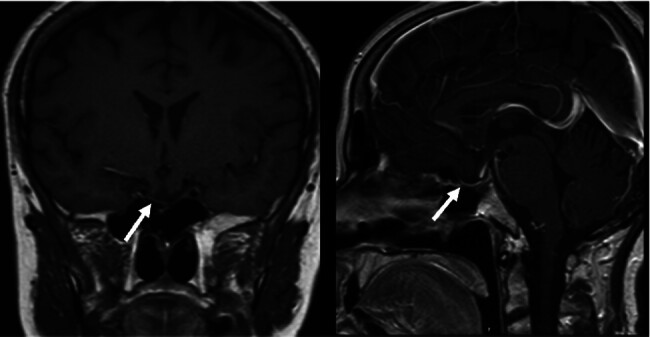
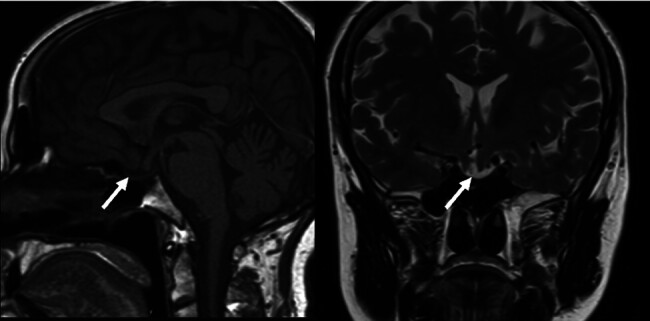
Case description: A 51-year-old woman with no comorbidities other than diabetes presented with visual disturbance in the right eye. Imaging revealed a non-functioning pituitary macroadenoma compressing the optic chiasm from below. The patient underwent microscopic transsphenoidal resection of the pituitary adenoma, achieving total removal. Early postoperative recovery was uneventful. Six-month follow-up MRI demonstrated inferior herniation of the GR into the sellar cavity, compressing the optic nerves superiorly. Visual complaints partially improved without further progression.
Conclusion: This case represents the first reported instance of GR herniation following transsphenoidal pituitary surgery. Awareness of this rare complication is essential when evaluating persistent or new-onset visual symptoms postoperatively.



 求助内容:
求助内容: 应助结果提醒方式:

 京公网安备 11010802042870号


