
Superlattice electrocatalysis matching microbial metabolism for sustainable CO2-to-bioproduct conversion

IF 19.6 1区 化学 Q1 CHEMISTRY, MULTIDISCIPLINARY
Chem Pub Date : 2026-03-19 DOI:10.1016/j.chempr.2026.102955
Miao Liu, Yanfeng Shi, Hao Shi, Peilin Huang, Lupeng Wang, Zhujun Fu, Tianming Wu, Yuanhong Xu
{"title":"Superlattice electrocatalysis matching microbial metabolism for sustainable CO2-to-bioproduct conversion","authors":"Miao Liu, Yanfeng Shi, Hao Shi, Peilin Huang, Lupeng Wang, Zhujun Fu, Tianming Wu, Yuanhong Xu","doi":"10.1016/j.chempr.2026.102955","DOIUrl":null,"url":null,"abstract":"The integrated electrochemical-microbial system (iEMS) is a promising strategy for converting CO<sub>2</sub> into high-value bioproducts. However, the mismatch in the carbon species and flux between electrocatalysis and microbial metabolism hinders its overall efficiency. Herein, we develop a scalable Ag/Cu metal superlattice (MSL@Ag/Cu) electrocatalyst with a periodic electric-potential gradient, which enables the selective and stable production of microbe-biased ethanol substrate and maintains carbon flux for the iEMS. The directional Ag/Cu configuration causes a spatial confinement effect, which enriches and holds the key intermediates for sustainable C–C coupling. MSL@Ag/Cu achieves a high Faradaic efficiency of ethanol (&gt;61.1%) and maintains this efficiency for over 220 h at 200 mA cm<sup>−2</sup> in an industrial electrolyzer. This long-term ethanol yield (160 mmol L<sup>−1</sup>) with indispensable carbon flux of <em>Saccharomyces cerevisiae</em> enables the breakthrough conversion of CO<sub>2</sub> to bioproducts. Techno-economic analysis indicates that the iEMS generates a profit of $15.5 million per year, which is 15-fold that of traditional electrocatalytic synthesis.","PeriodicalId":268,"journal":{"name":"Chem","volume":"33 1","pages":""},"PeriodicalIF":19.6000,"publicationDate":"2026-03-19","publicationTypes":"Journal Article","fieldsOfStudy":null,"isOpenAccess":false,"openAccessPdf":"","citationCount":"0","resultStr":null,"platform":"Semanticscholar","paperid":null,"PeriodicalName":"Chem","FirstCategoryId":"92","ListUrlMain":"https://doi.org/10.1016/j.chempr.2026.102955","RegionNum":1,"RegionCategory":"化学","ArticlePicture":[],"TitleCN":null,"AbstractTextCN":null,"PMCID":null,"EPubDate":"","PubModel":"","JCR":"Q1","JCRName":"CHEMISTRY, MULTIDISCIPLINARY","Score":null,"Total":0}
引用次数: 0

Abstract

The integrated electrochemical-microbial system (iEMS) is a promising strategy for converting CO2 into high-value bioproducts. However, the mismatch in the carbon species and flux between electrocatalysis and microbial metabolism hinders its overall efficiency. Herein, we develop a scalable Ag/Cu metal superlattice (MSL@Ag/Cu) electrocatalyst with a periodic electric-potential gradient, which enables the selective and stable production of microbe-biased ethanol substrate and maintains carbon flux for the iEMS. The directional Ag/Cu configuration causes a spatial confinement effect, which enriches and holds the key intermediates for sustainable C–C coupling. MSL@Ag/Cu achieves a high Faradaic efficiency of ethanol (>61.1%) and maintains this efficiency for over 220 h at 200 mA cm−2 in an industrial electrolyzer. This long-term ethanol yield (160 mmol L−1) with indispensable carbon flux of Saccharomyces cerevisiae enables the breakthrough conversion of CO2 to bioproducts. Techno-economic analysis indicates that the iEMS generates a profit of $15.5 million per year, which is 15-fold that of traditional electrocatalytic synthesis.
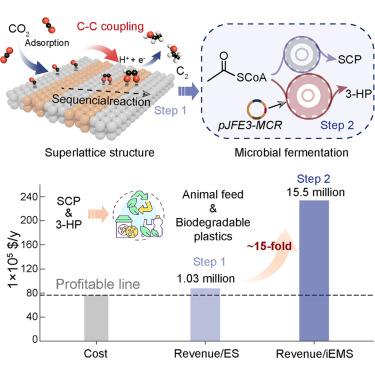
Abstract Image

超晶格电催化与微生物代谢相匹配,实现二氧化碳到生物产品的可持续转化
集成电化学-微生物系统(iEMS)是将二氧化碳转化为高价值生物产品的一种很有前途的策略。然而,电催化与微生物代谢之间的碳种类和通量的不匹配阻碍了其整体效率。在此,我们开发了一种具有周期性电势梯度的可扩展银/铜金属超晶格(MSL@Ag/Cu)电催化剂,该催化剂能够选择性和稳定地生产微生物偏向的乙醇底物,并保持iEMS的碳通量。Ag/Cu的定向构型产生了空间约束效应,丰富并保持了碳-碳持续耦合的关键中间体。MSL@Ag/Cu实现了乙醇的高法拉第效率(>61.1%),并在工业电解槽中在200毫安厘米−2下保持该效率超过220小时。这种长期的乙醇产量(160 mmol L−1)与酿酒酵母必不可少的碳通量,使二氧化碳转化为生物产品的突破。技术经济分析表明,iEMS每年产生1550万美元的利润,是传统电催化合成的15倍。
本文章由计算机程序翻译,如有差异,请以英文原文为准。
求助全文
约1分钟内获得全文 求助全文
来源期刊
Chem
Chem Environmental Science-Environmental Chemistry
CiteScore
32.40
自引率
1.30%
发文量
281
期刊介绍: Chem, affiliated with Cell as its sister journal, serves as a platform for groundbreaking research and illustrates how fundamental inquiries in chemistry and its related fields can contribute to addressing future global challenges. It was established in 2016, and is currently edited by Robert Eagling.

×
引用
GB/T 7714-2015
复制
MLA
复制
APA
复制
导出至
BibTeX EndNote RefMan NoteFirst NoteExpress
×
提示
您的信息不完整,为了账户安全,请先补充。
现在去补充
×
提示
您因"违规操作"
具体请查看互助需知
我知道了
×
提示
确定
请完成安全验证×
copy
已复制链接
快去分享给好友吧!
我知道了
右上角分享
点击右上角分享
0
联系我们:info@booksci.cn Book学术提供免费学术资源搜索服务,方便国内外学者检索中英文文献。致力于提供最便捷和优质的服务体验。 Copyright © 2023 布克学术 All rights reserved.
京ICP备2023020795号-1
ghs 京公网安备 11010802042870号
Book学术文献互助
Book学术文献互助群
群 号:604180095
Book学术官方微信
小红书


