
Organic scintillators for next-generation radiation detection: Principles of molecular design, mechanisms, and emerging applications

IF 17.5 1区 材料科学 Q1 MATERIALS SCIENCE, MULTIDISCIPLINARY
Matter Pub Date : 2026-05-06 Epub Date: 2026-03-17 DOI:10.1016/j.matt.2026.102715
Xu Li , Xin Luo , Chensen Li , Chong Zhang , Xiaoming Li , Jianxin Wang , Omar F. Mohammed , Bo Xu
{"title":"Organic scintillators for next-generation radiation detection: Principles of molecular design, mechanisms, and emerging applications","authors":"Xu Li ,&nbsp;Xin Luo ,&nbsp;Chensen Li ,&nbsp;Chong Zhang ,&nbsp;Xiaoming Li ,&nbsp;Jianxin Wang ,&nbsp;Omar F. Mohammed ,&nbsp;Bo Xu","doi":"10.1016/j.matt.2026.102715","DOIUrl":null,"url":null,"abstract":"<div><div>Organic scintillators have recently emerged as promising candidates for next-generation radiation detection because of their unique advantages, including environmental benignity, low cost, high optical transparency, and compatibility with flexible device fabrication. Unlike conventional inorganic scintillators, organic scintillators benefit from immense molecular diversity, which enables tunable optical and electronic properties tailored to specific performance demands. Despite rapid progress, the fundamental molecular design principles and luminescence mechanisms underlying their operation remain insufficiently understood. In this review, we systematically summarize recent advances in the molecular design of organic scintillators for emerging imaging applications. We provide a comprehensive analysis of the luminescence centers and their roles in exciton generation, migration, and utilization as well as detailed discussions on how molecular structure design strategies influence key performance parameters such as light yield, response time, imaging resolution, and operational stability. Finally, we present an outlook on future molecular design strategies aimed at achieving high-performance organic scintillators with a focus on bridging fundamental photophysical understanding and practical device optimization. This review establishes a framework for correlating molecular structure with scintillation properties, thereby paving the way toward efficient, stable, and processable organic scintillators for next-generation radiation detection and broader radiation detection technologies.</div></div>","PeriodicalId":388,"journal":{"name":"Matter","volume":"9 5","pages":"Article 102715"},"PeriodicalIF":17.5000,"publicationDate":"2026-05-06","publicationTypes":"Journal Article","fieldsOfStudy":null,"isOpenAccess":false,"openAccessPdf":"","citationCount":"0","resultStr":null,"platform":"Semanticscholar","paperid":null,"PeriodicalName":"Matter","FirstCategoryId":"88","ListUrlMain":"https://www.sciencedirect.com/science/article/pii/S2590238526000780","RegionNum":1,"RegionCategory":"材料科学","ArticlePicture":[],"TitleCN":null,"AbstractTextCN":null,"PMCID":null,"EPubDate":"2026/3/17 0:00:00","PubModel":"Epub","JCR":"Q1","JCRName":"MATERIALS SCIENCE, MULTIDISCIPLINARY","Score":null,"Total":0}
引用次数: 0

Abstract

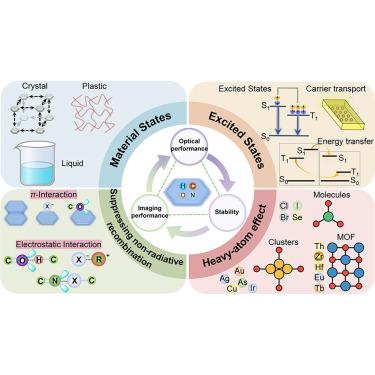
Organic scintillators have recently emerged as promising candidates for next-generation radiation detection because of their unique advantages, including environmental benignity, low cost, high optical transparency, and compatibility with flexible device fabrication. Unlike conventional inorganic scintillators, organic scintillators benefit from immense molecular diversity, which enables tunable optical and electronic properties tailored to specific performance demands. Despite rapid progress, the fundamental molecular design principles and luminescence mechanisms underlying their operation remain insufficiently understood. In this review, we systematically summarize recent advances in the molecular design of organic scintillators for emerging imaging applications. We provide a comprehensive analysis of the luminescence centers and their roles in exciton generation, migration, and utilization as well as detailed discussions on how molecular structure design strategies influence key performance parameters such as light yield, response time, imaging resolution, and operational stability. Finally, we present an outlook on future molecular design strategies aimed at achieving high-performance organic scintillators with a focus on bridging fundamental photophysical understanding and practical device optimization. This review establishes a framework for correlating molecular structure with scintillation properties, thereby paving the way toward efficient, stable, and processable organic scintillators for next-generation radiation detection and broader radiation detection technologies.
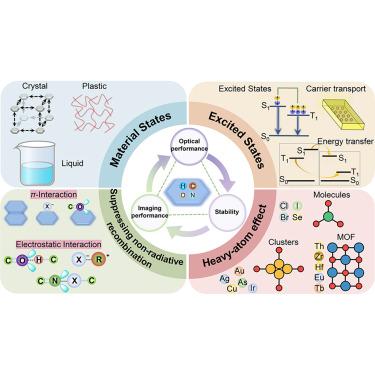
Abstract Image

Abstract Image

用于下一代辐射检测的有机闪烁体:分子设计原理,机制和新兴应用
有机闪烁体由于其独特的优势,包括环境友好、低成本、高光学透明度以及与柔性器件制造的兼容性,最近成为下一代辐射探测的有希望的候选者。与传统的无机闪烁体不同,有机闪烁体受益于巨大的分子多样性,这使得可调谐的光学和电子特性能够满足特定的性能需求。尽管进展迅速,但基本的分子设计原理和其运作背后的发光机制仍然不够清楚。在这篇综述中,我们系统地总结了用于新兴成像应用的有机闪烁体分子设计的最新进展。我们全面分析了发光中心及其在激子产生、迁移和利用中的作用,并详细讨论了分子结构设计策略如何影响关键性能参数,如光产率、响应时间、成像分辨率和操作稳定性。最后,我们展望了未来的分子设计策略,旨在实现高性能有机闪烁体,重点是桥接基本的光物理理解和实用的器件优化。本综述建立了分子结构与闪烁特性之间关系的框架,从而为下一代辐射探测和更广泛的辐射探测技术提供高效、稳定和可加工的有机闪烁体。
本文章由计算机程序翻译,如有差异,请以英文原文为准。
求助全文
约1分钟内获得全文 求助全文
来源期刊
Matter
Matter MATERIALS SCIENCE, MULTIDISCIPLINARY-
CiteScore
26.30
自引率
2.60%
发文量
367
期刊介绍: Matter, a monthly journal affiliated with Cell, spans the broad field of materials science from nano to macro levels,covering fundamentals to applications. Embracing groundbreaking technologies,it includes full-length research articles,reviews, perspectives,previews, opinions, personnel stories, and general editorial content. Matter aims to be the primary resource for researchers in academia and industry, inspiring the next generation of materials scientists.

×
引用
GB/T 7714-2015
复制
MLA
复制
APA
复制
导出至
BibTeX EndNote RefMan NoteFirst NoteExpress
×
提示
您的信息不完整,为了账户安全,请先补充。
现在去补充
×
提示
您因"违规操作"
具体请查看互助需知
我知道了
×
提示
确定
请完成安全验证×
copy
已复制链接
快去分享给好友吧!
我知道了
右上角分享
点击右上角分享
0
联系我们:info@booksci.cn Book学术提供免费学术资源搜索服务,方便国内外学者检索中英文文献。致力于提供最便捷和优质的服务体验。 Copyright © 2023 布克学术 All rights reserved.
京ICP备2023020795号-1
ghs 京公网安备 11010802042870号
Book学术文献互助
Book学术文献互助群
群 号:604180095
Book学术官方微信
小红书


