{"title":"Structural mechanisms for the recruitment of factor H by Streptococcus pyogenes.","authors":"Amit Kumar, Kuei-Chen Wang, Partho Ghosh","doi":"10.1016/j.str.2026.02.010","DOIUrl":null,"url":null,"abstract":"<p><p>The bacterial pathogen Streptococcus pyogenes (Strep A) recruits the complement regulator factor H (FH) to its surface using M proteins and FbaA. However, no conserved FH-binding sequence pattern is evident in these proteins. To address this, we determined the structures of M5 protein, M6 protein, and FbaA fragments complexed with FH domains 6 and 7. M5 and M6 proteins formed dimeric α-helical coiled coils, as expected, while FbaA formed a monomeric three-helix bundle preceded by a loop. Each Strep A protein had a different FH-binding mode, and distinct FH-binding sequence patterns were constructed for each based on substitution mutagenesis. About half of the known 250 Strep A strains were identified to have FH-binding patterns, with the majority due to FbaA as compared to M or M-like Enn proteins. Our structural and functional elucidation of the mechanism of FH recruitment is applicable to the precise investigation of its role in Strep A virulence.</p>","PeriodicalId":22168,"journal":{"name":"Structure","volume":" ","pages":"778-789.e4"},"PeriodicalIF":4.3000,"publicationDate":"2026-05-07","publicationTypes":"Journal Article","fieldsOfStudy":null,"isOpenAccess":false,"openAccessPdf":"https://www.ncbi.nlm.nih.gov/pmc/articles/PMC13002132/pdf/","citationCount":"0","resultStr":null,"platform":"Semanticscholar","paperid":null,"PeriodicalName":"Structure","FirstCategoryId":"99","ListUrlMain":"https://doi.org/10.1016/j.str.2026.02.010","RegionNum":2,"RegionCategory":"生物学","ArticlePicture":[],"TitleCN":null,"AbstractTextCN":null,"PMCID":null,"EPubDate":"2026/3/16 0:00:00","PubModel":"Epub","JCR":"Q2","JCRName":"BIOCHEMISTRY & MOLECULAR BIOLOGY","Score":null,"Total":0}
引用次数: 0
Abstract
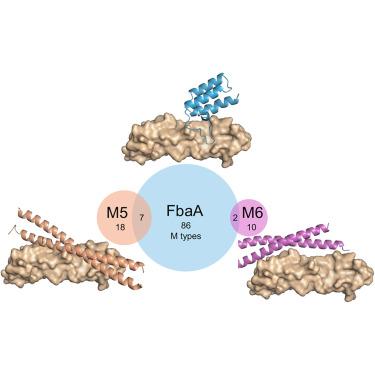
The bacterial pathogen Streptococcus pyogenes (Strep A) recruits the complement regulator factor H (FH) to its surface using M proteins and FbaA. However, no conserved FH-binding sequence pattern is evident in these proteins. To address this, we determined the structures of M5 protein, M6 protein, and FbaA fragments complexed with FH domains 6 and 7. M5 and M6 proteins formed dimeric α-helical coiled coils, as expected, while FbaA formed a monomeric three-helix bundle preceded by a loop. Each Strep A protein had a different FH-binding mode, and distinct FH-binding sequence patterns were constructed for each based on substitution mutagenesis. About half of the known 250 Strep A strains were identified to have FH-binding patterns, with the majority due to FbaA as compared to M or M-like Enn proteins. Our structural and functional elucidation of the mechanism of FH recruitment is applicable to the precise investigation of its role in Strep A virulence.
期刊介绍:
Structure aims to publish papers of exceptional interest in the field of structural biology. The journal strives to be essential reading for structural biologists, as well as biologists and biochemists that are interested in macromolecular structure and function. Structure strongly encourages the submission of manuscripts that present structural and molecular insights into biological function and mechanism. Other reports that address fundamental questions in structural biology, such as structure-based examinations of protein evolution, folding, and/or design, will also be considered. We will consider the application of any method, experimental or computational, at high or low resolution, to conduct structural investigations, as long as the method is appropriate for the biological, functional, and mechanistic question(s) being addressed. Likewise, reports describing single-molecule analysis of biological mechanisms are welcome.
In general, the editors encourage submission of experimental structural studies that are enriched by an analysis of structure-activity relationships and will not consider studies that solely report structural information unless the structure or analysis is of exceptional and broad interest. Studies reporting only homology models, de novo models, or molecular dynamics simulations are also discouraged unless the models are informed by or validated by novel experimental data; rationalization of a large body of existing experimental evidence and making testable predictions based on a model or simulation is often not considered sufficient.

 求助内容:
求助内容: 应助结果提醒方式:

 京公网安备 11010802042870号


