Bennett Allen, Cale Basaraba, Czarina N Behrends, Laura C Chambers, Brandon D L Marshall, Magdalena Cerdá
{"title":"Neighborhood impacts of overdose prevention centers on real estate prices in New York City.","authors":"Bennett Allen, Cale Basaraba, Czarina N Behrends, Laura C Chambers, Brandon D L Marshall, Magdalena Cerdá","doi":"10.1093/aje/kwag061","DOIUrl":null,"url":null,"abstract":"<p><p>Overdose prevention centers (OPCs) are associated with improved community health and decreased crime, but opponents argue that OPCs depress nearby property values. We estimated the association of the opening of the first two public recognized OPC in the United States with neighborhood residential rents and real estate sales in the East Harlem and Washington Heights neighborhoods of New York City (NYC). Using augmented synthetic controls, we analyzed quarterly and semiannual rental listings and annual and semiannual sales within 300- and 500-m buffers around the OPCs. Donor units were buffers around syringe service programs without OPCs and opioid treatment programs. Primary outcomes were median quarterly rental listing price and median annual sales price. Overall, we found no changes in neighborhood rental or sales prices. For quarterly rentals at 300 m, we estimated (ATT, 95% CI) $145 (-$780, $1070) in East Harlem and -$505 (-$1279, $269) in Washington Heights. For annual sales at 500 m, we estimated -$542 993 (-$1 228 024, $142038) in East Harlem and $1 121 706 (-$431 285, $2674697) in Washington Heights. Conformal inference identified no detectable time-point effects. Overall, OPC implementation in NYC was not associated with changes in rents or sales, suggesting these facilities may not generate appreciable effects on local housing values.</p>","PeriodicalId":7472,"journal":{"name":"American journal of epidemiology","volume":" ","pages":"2399-2407"},"PeriodicalIF":4.1000,"publicationDate":"2026-09-03","publicationTypes":"Journal Article","fieldsOfStudy":null,"isOpenAccess":false,"openAccessPdf":"https://www.ncbi.nlm.nih.gov/pmc/articles/PMC13537846/pdf/","citationCount":"0","resultStr":null,"platform":"Semanticscholar","paperid":null,"PeriodicalName":"American journal of epidemiology","FirstCategoryId":"3","ListUrlMain":"https://doi.org/10.1093/aje/kwag061","RegionNum":2,"RegionCategory":"医学","ArticlePicture":[],"TitleCN":null,"AbstractTextCN":null,"PMCID":null,"EPubDate":"","PubModel":"","JCR":"Q1","JCRName":"PUBLIC, ENVIRONMENTAL & OCCUPATIONAL HEALTH","Score":null,"Total":0}
引用次数: 0
Abstract
Overdose prevention centers (OPCs) are associated with improved community health and decreased crime, but opponents argue that OPCs depress nearby property values. We estimated the association of the opening of the first two public recognized OPC in the United States with neighborhood residential rents and real estate sales in the East Harlem and Washington Heights neighborhoods of New York City (NYC). Using augmented synthetic controls, we analyzed quarterly and semiannual rental listings and annual and semiannual sales within 300- and 500-m buffers around the OPCs. Donor units were buffers around syringe service programs without OPCs and opioid treatment programs. Primary outcomes were median quarterly rental listing price and median annual sales price. Overall, we found no changes in neighborhood rental or sales prices. For quarterly rentals at 300 m, we estimated (ATT, 95% CI) $145 (-$780, $1070) in East Harlem and -$505 (-$1279, $269) in Washington Heights. For annual sales at 500 m, we estimated -$542 993 (-$1 228 024, $142038) in East Harlem and $1 121 706 (-$431 285, $2674697) in Washington Heights. Conformal inference identified no detectable time-point effects. Overall, OPC implementation in NYC was not associated with changes in rents or sales, suggesting these facilities may not generate appreciable effects on local housing values.
期刊介绍:
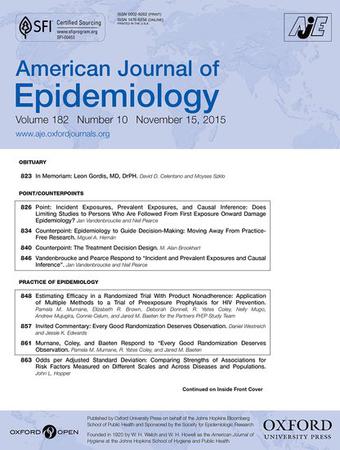
The American Journal of Epidemiology is the oldest and one of the premier epidemiologic journals devoted to the publication of empirical research findings, opinion pieces, and methodological developments in the field of epidemiologic research.
It is a peer-reviewed journal aimed at both fellow epidemiologists and those who use epidemiologic data, including public health workers and clinicians.

 求助内容:
 应助结果提醒方式:


 京公网安备 11010802042870号


