Ester Clarisse do Couto Lopes, Joshua P A Daoud, Alexandra Collisson, Ariadni Georgiannakis, Joshua Killilea, Cédric M John, Dimitrios Paraskevopoulos, Christopher A R Chapman
{"title":"Closing the loop on glioblastoma: A roadmap toward developing bioelectronics for continuous monitoring of tumor state.","authors":"Ester Clarisse do Couto Lopes, Joshua P A Daoud, Alexandra Collisson, Ariadni Georgiannakis, Joshua Killilea, Cédric M John, Dimitrios Paraskevopoulos, Christopher A R Chapman","doi":"10.1063/5.0312207","DOIUrl":null,"url":null,"abstract":"<p><p>Closed-loop bioelectronic devices offer a promising platform for responsive treatment to heterogeneous disease states. Glioblastoma, an aggressive form of brain cancer, has recently emerged as a focus of bioelectronic medicine through delivery of electrotherapies. This perspective article posits that true progress in the management of this extremely heterogeneous disease requires the integration of continuous monitoring from the tumor microenvironment as well as on-device analytics to enact closed-loop control. Four promising candidate biological changes present in the glioblastoma microenvironment are highlighted (local field potentials, bioimpedance, local pH, biomarkers) alongside the bioelectronic sensors that can enable the development of multifunctional bioelectronic devices to monitor the changes. Finally, three key principles (patient involvement, data analytics, and device fabrication) governing the successful implementation of closed-loop sensors are proposed to create a roadmap for academics and industry partners to successfully develop multimodal devices for the treatment of glioblastoma.</p>","PeriodicalId":46288,"journal":{"name":"APL Bioengineering","volume":"10 1","pages":"010902"},"PeriodicalIF":4.1000,"publicationDate":"2026-03-12","publicationTypes":"Journal Article","fieldsOfStudy":null,"isOpenAccess":false,"openAccessPdf":"https://www.ncbi.nlm.nih.gov/pmc/articles/PMC12988838/pdf/","citationCount":"0","resultStr":null,"platform":"Semanticscholar","paperid":null,"PeriodicalName":"APL Bioengineering","FirstCategoryId":"5","ListUrlMain":"https://doi.org/10.1063/5.0312207","RegionNum":3,"RegionCategory":"医学","ArticlePicture":[],"TitleCN":null,"AbstractTextCN":null,"PMCID":null,"EPubDate":"2026/3/1 0:00:00","PubModel":"eCollection","JCR":"Q1","JCRName":"ENGINEERING, BIOMEDICAL","Score":null,"Total":0}
引用次数: 0
Abstract
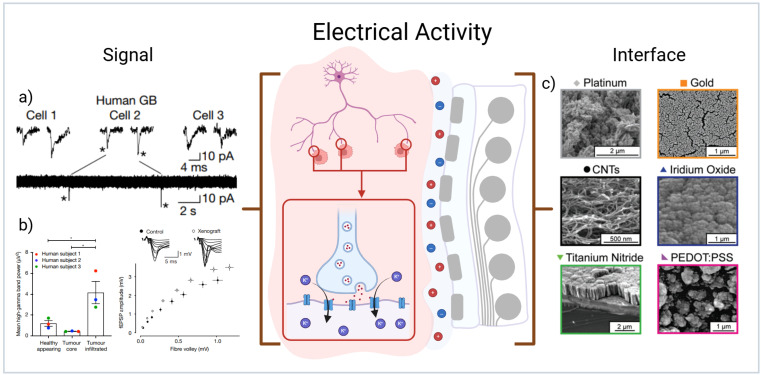
Closed-loop bioelectronic devices offer a promising platform for responsive treatment to heterogeneous disease states. Glioblastoma, an aggressive form of brain cancer, has recently emerged as a focus of bioelectronic medicine through delivery of electrotherapies. This perspective article posits that true progress in the management of this extremely heterogeneous disease requires the integration of continuous monitoring from the tumor microenvironment as well as on-device analytics to enact closed-loop control. Four promising candidate biological changes present in the glioblastoma microenvironment are highlighted (local field potentials, bioimpedance, local pH, biomarkers) alongside the bioelectronic sensors that can enable the development of multifunctional bioelectronic devices to monitor the changes. Finally, three key principles (patient involvement, data analytics, and device fabrication) governing the successful implementation of closed-loop sensors are proposed to create a roadmap for academics and industry partners to successfully develop multimodal devices for the treatment of glioblastoma.
期刊介绍:
APL Bioengineering is devoted to research at the intersection of biology, physics, and engineering. The journal publishes high-impact manuscripts specific to the understanding and advancement of physics and engineering of biological systems. APL Bioengineering is the new home for the bioengineering and biomedical research communities.
APL Bioengineering publishes original research articles, reviews, and perspectives. Topical coverage includes:
-Biofabrication and Bioprinting
-Biomedical Materials, Sensors, and Imaging
-Engineered Living Systems
-Cell and Tissue Engineering
-Regenerative Medicine
-Molecular, Cell, and Tissue Biomechanics
-Systems Biology and Computational Biology



 求助内容:
求助内容: 应助结果提醒方式:

 京公网安备 11010802042870号


