Debasree Bhadra, Jody A Rule, William M Lee, Mitchell R McGill
{"title":"Comparison of LDH activity and LDH-M to predict death in patients with acetaminophen-induced acute liver failure.","authors":"Debasree Bhadra, Jody A Rule, William M Lee, Mitchell R McGill","doi":"10.17179/excli2025-9174","DOIUrl":null,"url":null,"abstract":"<p><p>Liver transplantation is often the only life-saving intervention in acute liver failure (ALF), so it is critical to identify all ALF patients who need a transplant to survive. However, transplantable organs are scarce and recipients face significant life-threatening risks, so it is also important to avoid transplantation when possible. Thus, prognostics that can predict death in ALF with both high sensitivity and specificity are needed. We previously demonstrated total lactate dehydrogenase (LDH) activity may be useful for this purpose. However, LDH is a tetramer of LDH-M and LDH-H, and proteomics indicated only the liver enzyme - LDH-M - increases in non-survivors. LDH-H decreased. Because total LDH comprises both, it is possible that LDH-M could have even better prognostic performance. To test that, we compared total LDH and LDH-M in a subset of samples from our prior study of survivors and non-survivors of acetaminophen (APAP)-induced ALF. The model for end-stage liver disease (MELD) score and the MELD-LDH score were also calculated. Both total LDH and LDH-M values were greater in non-survivors than survivors, but there was no significant difference in prognostic metrics between them. Overall, total LDH performed similarly to or modestly better than both LDH-M and the MELD. The MELD-LDH score also performed somewhat better than the MELD. See also the graphical abstract(Fig. 1).</p>","PeriodicalId":12247,"journal":{"name":"EXCLI Journal","volume":"25 ","pages":"330-338"},"PeriodicalIF":4.9000,"publicationDate":"2026-02-04","publicationTypes":"Journal Article","fieldsOfStudy":null,"isOpenAccess":false,"openAccessPdf":"https://www.ncbi.nlm.nih.gov/pmc/articles/PMC12982867/pdf/","citationCount":"0","resultStr":null,"platform":"Semanticscholar","paperid":null,"PeriodicalName":"EXCLI Journal","FirstCategoryId":"99","ListUrlMain":"https://doi.org/10.17179/excli2025-9174","RegionNum":3,"RegionCategory":"生物学","ArticlePicture":[],"TitleCN":null,"AbstractTextCN":null,"PMCID":null,"EPubDate":"2026/1/1 0:00:00","PubModel":"eCollection","JCR":"Q1","JCRName":"BIOLOGY","Score":null,"Total":0}
引用次数: 0
Abstract
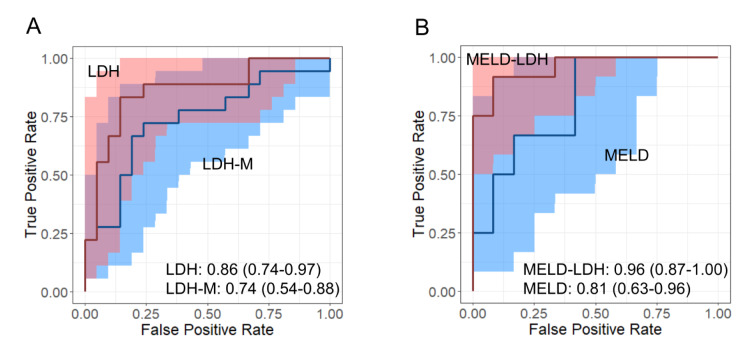
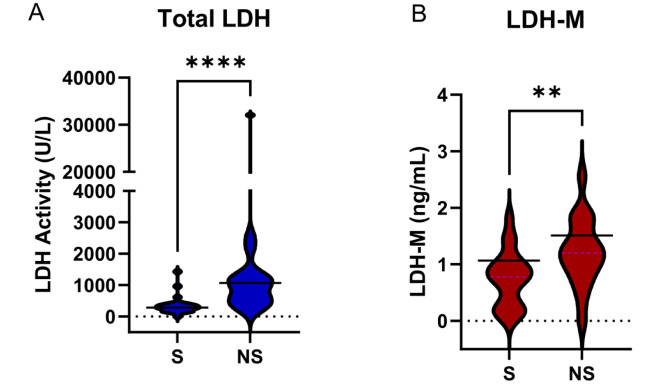
Liver transplantation is often the only life-saving intervention in acute liver failure (ALF), so it is critical to identify all ALF patients who need a transplant to survive. However, transplantable organs are scarce and recipients face significant life-threatening risks, so it is also important to avoid transplantation when possible. Thus, prognostics that can predict death in ALF with both high sensitivity and specificity are needed. We previously demonstrated total lactate dehydrogenase (LDH) activity may be useful for this purpose. However, LDH is a tetramer of LDH-M and LDH-H, and proteomics indicated only the liver enzyme - LDH-M - increases in non-survivors. LDH-H decreased. Because total LDH comprises both, it is possible that LDH-M could have even better prognostic performance. To test that, we compared total LDH and LDH-M in a subset of samples from our prior study of survivors and non-survivors of acetaminophen (APAP)-induced ALF. The model for end-stage liver disease (MELD) score and the MELD-LDH score were also calculated. Both total LDH and LDH-M values were greater in non-survivors than survivors, but there was no significant difference in prognostic metrics between them. Overall, total LDH performed similarly to or modestly better than both LDH-M and the MELD. The MELD-LDH score also performed somewhat better than the MELD. See also the graphical abstract(Fig. 1).
期刊介绍:
EXCLI Journal publishes original research reports, authoritative reviews and case reports of experimental and clinical sciences.
The journal is particularly keen to keep a broad view of science and technology, and therefore welcomes papers which bridge disciplines and may not suit the narrow specialism of other journals. Although the general emphasis is on biological sciences, studies from the following fields are explicitly encouraged (alphabetical order):
aging research, behavioral sciences, biochemistry, cell biology, chemistry including analytical chemistry, clinical and preclinical studies, drug development, environmental health, ergonomics, forensic medicine, genetics, hepatology and gastroenterology, immunology, neurosciences, occupational medicine, oncology and cancer research, pharmacology, proteomics, psychiatric research, psychology, systems biology, toxicology


 求助内容:
求助内容: 应助结果提醒方式:

 京公网安备 11010802042870号


