{"title":"Stability of house dust mite raw materials: Impact of storage conditions and lyophilization.","authors":"Teerapong Wangapai, Nitaya Indrawattana, Prapagorn Vongjareonsanti, Pichet Ruenchit, Dichapong Kanjanawasee, Thapani Srisai, Anchalee Tungtrongchitr, Nawannaporn Saelim","doi":"10.12932/AP-090425-2062","DOIUrl":null,"url":null,"abstract":"<p><strong>Background: </strong>Dermatophagoides pteronyssinus and D. farinae are major indoor allergens. Raw materials derived from these house dust mites (HDMs) are used to produce allergen extracts. The stability of these materials is influenced by storage form and conditions, which can affect protein integrity.</p><p><strong>Objective: </strong>To compare storage formats and conditions for maintaining physicochemical stability of HDM raw materials.</p><p><strong>Methods: </strong>Pure mite bodies (PMBs), prepared in fresh frozen and lyophilized forms, were stored at -80°C, -20°C, and 25°C. Over a 12-month period, samples were assessed for total protein and major allergens (Der p 1 and Der f 1) using ELISA. Protein integrity was analyzed by SDS-PAGE. Accelerated stability testing at 25°C for up to 14 days was also performed.</p><p><strong>Results: </strong>Storage at -80°C best preserved total protein and Group 1 allergen content over 12 months. At -20°C, moderate declines were observed, with D. farinae showing greater reductions than D. pteronyssinus. Lyophilized samples were generally more stable than fresh-frozen ones at -20C°. Accelerated testing at 25°C caused marked losses over 14 days.</p><p><strong>Conclusions: </strong>Ultra-low temperature storage (-80°C) remains optimal for preserving physicochemical stability of HDM raw materials. Lyophilization with -20°C storage is a promising, context-dependent option; however, in the absence of residual-moisture and immunological data, these findings should be interpreted as preliminary and limited to raw-material handling.</p>","PeriodicalId":8552,"journal":{"name":"Asian Pacific journal of allergy and immunology","volume":" ","pages":""},"PeriodicalIF":2.1000,"publicationDate":"2026-03-14","publicationTypes":"Journal Article","fieldsOfStudy":null,"isOpenAccess":false,"openAccessPdf":"","citationCount":"0","resultStr":null,"platform":"Semanticscholar","paperid":null,"PeriodicalName":"Asian Pacific journal of allergy and immunology","FirstCategoryId":"3","ListUrlMain":"https://doi.org/10.12932/AP-090425-2062","RegionNum":4,"RegionCategory":"医学","ArticlePicture":[],"TitleCN":null,"AbstractTextCN":null,"PMCID":null,"EPubDate":"","PubModel":"","JCR":"Q3","JCRName":"ALLERGY","Score":null,"Total":0}
引用次数: 0
Abstract
Background: Dermatophagoides pteronyssinus and D. farinae are major indoor allergens. Raw materials derived from these house dust mites (HDMs) are used to produce allergen extracts. The stability of these materials is influenced by storage form and conditions, which can affect protein integrity.
Objective: To compare storage formats and conditions for maintaining physicochemical stability of HDM raw materials.
Methods: Pure mite bodies (PMBs), prepared in fresh frozen and lyophilized forms, were stored at -80°C, -20°C, and 25°C. Over a 12-month period, samples were assessed for total protein and major allergens (Der p 1 and Der f 1) using ELISA. Protein integrity was analyzed by SDS-PAGE. Accelerated stability testing at 25°C for up to 14 days was also performed.
Results: Storage at -80°C best preserved total protein and Group 1 allergen content over 12 months. At -20°C, moderate declines were observed, with D. farinae showing greater reductions than D. pteronyssinus. Lyophilized samples were generally more stable than fresh-frozen ones at -20C°. Accelerated testing at 25°C caused marked losses over 14 days.
Conclusions: Ultra-low temperature storage (-80°C) remains optimal for preserving physicochemical stability of HDM raw materials. Lyophilization with -20°C storage is a promising, context-dependent option; however, in the absence of residual-moisture and immunological data, these findings should be interpreted as preliminary and limited to raw-material handling.
期刊介绍:
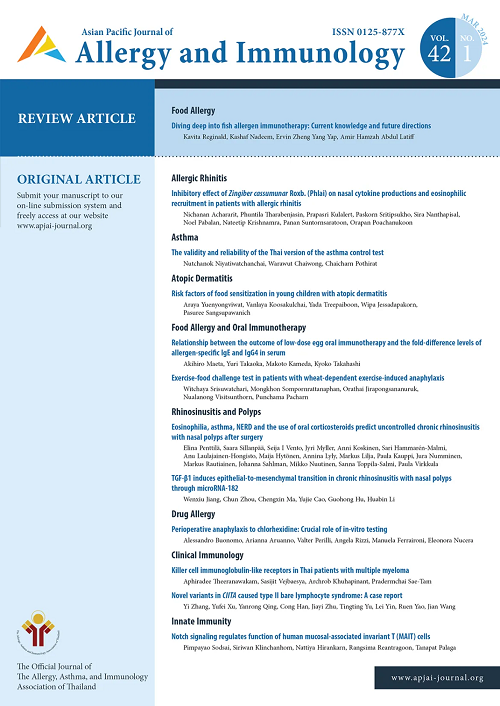
The Asian Pacific Journal of Allergy and Immunology (APJAI) is an online open access journal with the recent impact factor (2018) 1.747
APJAI published 4 times per annum (March, June, September, December). Four issues constitute one volume.
APJAI publishes original research articles of basic science, clinical science and reviews on various aspects of allergy and immunology. This journal is an official journal of and published by the Allergy, Asthma and Immunology Association, Thailand.
The scopes include mechanism, pathogenesis, host-pathogen interaction, host-environment interaction, allergic diseases, immune-mediated diseases, epidemiology, diagnosis, treatment and prevention, immunotherapy, and vaccine. All papers are published in English and are refereed to international standards.

 求助内容:
 应助结果提醒方式:


 京公网安备 11010802042870号


