Mohamed H Eldesouki, Mohammad Kloub, Abdul-Rahman I Abusalim, Mohammed Y Youssef, Mona T Ahmed, Khaled Elfert, Kanwarpreet Tandon
{"title":"Impact of tobacco use on inpatient outcomes in inflammatory bowel disease: a retrospective matched cohort study.","authors":"Mohamed H Eldesouki, Mohammad Kloub, Abdul-Rahman I Abusalim, Mohammed Y Youssef, Mona T Ahmed, Khaled Elfert, Kanwarpreet Tandon","doi":"10.21037/atm-25-141","DOIUrl":null,"url":null,"abstract":"<p><strong>Background: </strong>Tobacco plays a complex role in patients with inflammatory bowel disease (IBD). Its impact on inpatient outcomes of IBD needs additional study. We aimed to assess the impact of smoking on clinical outcomes in hospitalized patients with IBD.</p><p><strong>Methods: </strong>We conducted a retrospective cohort study using data from the National Inpatient Sample (NIS) spanning from 2016 to 2019. Patients with UC and CD were identified utilizing ICD-10 codes. Patients were stratified according to the smoking status in two groups. A propensity score matching was utilized to balance comorbidities between study groups. Study outcomes included rates of steroid use, surgeries, gastrointestinal (GI) bleeding, perianal abscess, and overall mortality. All outcomes were assessed during the index hospitalization. Statistical analysis was performed using Stata 17 software. Results were reported as adjusted odds ratios (aORs) with 95% confidence intervals (CIs).</p><p><strong>Results: </strong>A total of 413,208 patients were included in our study, 180,558 patients had UC, and 232,650 patients had CD. After propensity score matching, we had a total of 151,106 patients: 39,616 patients had UC, with a total of 19,808 in each group. The CD patients were 111,490, with a total of 55,745 patients in each group. For UC patients, smokers had lower odds of steroid use (aOR =0.69, 95% CI: 0.61-0.79, P=0.001), and all-cause mortality (aOR =0.54, 95% CI: 0.32-0.96, P=0.03). For CD patients, smokers had higher odds of steroid use (aOR =1.13, 95% CI: 1.03-1.25, P=0.009), perianal abscess (aOR =1.12, 95% CI: 1.10-1.36, P=0.02), and all-cause mortality (aOR =1.51, 95% CI: 1.27-1.84, P=0.04). All other outcomes were not significant between the study cohorts.</p><p><strong>Conclusions: </strong>Tobacco use in hospitalized patients with UC was associated with lower steroid use, while in patients with CD, it correlated with higher steroid use and increased odds of perianal abscesses. These findings highlight the complex impact of tobacco use on IBD outcomes.</p>","PeriodicalId":8216,"journal":{"name":"Annals of translational medicine","volume":"14 1","pages":"1"},"PeriodicalIF":0.0000,"publicationDate":"2026-02-28","publicationTypes":"Journal Article","fieldsOfStudy":null,"isOpenAccess":false,"openAccessPdf":"https://www.ncbi.nlm.nih.gov/pmc/articles/PMC12981989/pdf/","citationCount":"0","resultStr":null,"platform":"Semanticscholar","paperid":null,"PeriodicalName":"Annals of translational medicine","FirstCategoryId":"3","ListUrlMain":"https://doi.org/10.21037/atm-25-141","RegionNum":4,"RegionCategory":"医学","ArticlePicture":[],"TitleCN":null,"AbstractTextCN":null,"PMCID":null,"EPubDate":"2026/2/25 0:00:00","PubModel":"Epub","JCR":"","JCRName":"","Score":null,"Total":0}
引用次数: 0
Abstract
Background: Tobacco plays a complex role in patients with inflammatory bowel disease (IBD). Its impact on inpatient outcomes of IBD needs additional study. We aimed to assess the impact of smoking on clinical outcomes in hospitalized patients with IBD.
Methods: We conducted a retrospective cohort study using data from the National Inpatient Sample (NIS) spanning from 2016 to 2019. Patients with UC and CD were identified utilizing ICD-10 codes. Patients were stratified according to the smoking status in two groups. A propensity score matching was utilized to balance comorbidities between study groups. Study outcomes included rates of steroid use, surgeries, gastrointestinal (GI) bleeding, perianal abscess, and overall mortality. All outcomes were assessed during the index hospitalization. Statistical analysis was performed using Stata 17 software. Results were reported as adjusted odds ratios (aORs) with 95% confidence intervals (CIs).
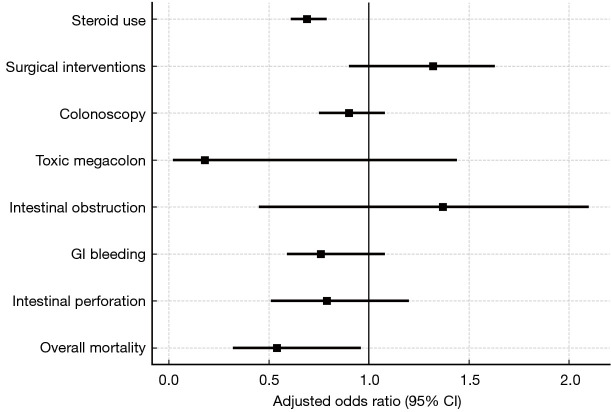
Results: A total of 413,208 patients were included in our study, 180,558 patients had UC, and 232,650 patients had CD. After propensity score matching, we had a total of 151,106 patients: 39,616 patients had UC, with a total of 19,808 in each group. The CD patients were 111,490, with a total of 55,745 patients in each group. For UC patients, smokers had lower odds of steroid use (aOR =0.69, 95% CI: 0.61-0.79, P=0.001), and all-cause mortality (aOR =0.54, 95% CI: 0.32-0.96, P=0.03). For CD patients, smokers had higher odds of steroid use (aOR =1.13, 95% CI: 1.03-1.25, P=0.009), perianal abscess (aOR =1.12, 95% CI: 1.10-1.36, P=0.02), and all-cause mortality (aOR =1.51, 95% CI: 1.27-1.84, P=0.04). All other outcomes were not significant between the study cohorts.
Conclusions: Tobacco use in hospitalized patients with UC was associated with lower steroid use, while in patients with CD, it correlated with higher steroid use and increased odds of perianal abscesses. These findings highlight the complex impact of tobacco use on IBD outcomes.
期刊介绍:
The Annals of Translational Medicine (Ann Transl Med; ATM; Print ISSN 2305-5839; Online ISSN 2305-5847) is an international, peer-reviewed Open Access journal featuring original and observational investigations in the broad fields of laboratory, clinical, and public health research, aiming to provide practical up-to-date information in significant research from all subspecialties of medicine and to broaden the readers’ vision and horizon from bench to bed and bed to bench. It is published quarterly (April 2013- Dec. 2013), monthly (Jan. 2014 - Feb. 2015), biweekly (March 2015-) and openly distributed worldwide. Annals of Translational Medicine is indexed in PubMed in Sept 2014 and in SCIE in 2018. Specific areas of interest include, but not limited to, multimodality therapy, epidemiology, biomarkers, imaging, biology, pathology, and technical advances related to medicine. Submissions describing preclinical research with potential for application to human disease, and studies describing research obtained from preliminary human experimentation with potential to further the understanding of biological mechanism underlying disease are encouraged. Also warmly welcome are studies describing public health research pertinent to clinic, disease diagnosis and prevention, or healthcare policy. With a focus on interdisciplinary academic cooperation, ATM aims to expedite the translation of scientific discovery into new or improved standards of management and health outcomes practice.


 求助内容:
求助内容: 应助结果提醒方式:

 京公网安备 11010802042870号


