{"title":"Green Synthesis of TMETN Using Ionic Liquid [Btem-SO3H][NO3] as a Nitrating Agent","authors":"Yijie Cai, , , Bingxi Song, , , Chaoyang Liu, , , Xingyu Wang, , , Long Liu*, , , Lei Chen*, , , Zongjie Li, , , Yingying Cao*, , and , Yanqiang Zhang, ","doi":"10.1021/acs.iecr.5c05149","DOIUrl":null,"url":null,"abstract":"<p >In this study, a novel sulfonic acid-functionalized ionic liquid <i>N</i>,<i>N</i>,<i>N</i>-triethyl-4-sulfobutan-1-aminium nitrate ([Btem-SO<sub>3</sub>H][NO<sub>3</sub>]) was synthesized as a nitrating agent. The cation and anion of [Btem-SO<sub>3</sub>H][NO<sub>3</sub>], respectively, provide an acidic environment and a nitro source, enabling green nitration of TMETN (Trimethylolethane trinitrate). It was found that [Btem-SO<sub>3</sub>H][NO<sub>3</sub>] exhibited good thermal stability up to 170 °C. The acidity of [Btem-SO<sub>3</sub>H][NO<sub>3</sub>] increases with a decrease in the water content. When the water content is lower than 9%, the nitration efficiency remains unchanged. The [Btem-SO<sub>3</sub>H][NO<sub>3</sub>] system exhibited a Δ<i>T</i><sub>ad</sub> of 57.62 °C and an MTSR of 30.54 °C, which are significantly lower than 88.15 and 36.96 °C of the fuming HNO<sub>3</sub> system. Under optimized conditions, a TMETN yield of 95% was achieved, and the ionic liquid maintained ideal activity after five recycling cycles, outperforming fuming nitric acid (89% yield, poor recyclability). Mechanism analysis showed that the reaction of [Btem-SO<sub>3</sub>H][NO<sub>3</sub>] with Ac<sub>2</sub>O to form acetyl nitrate (CH<sub>3</sub>COONO<sub>2</sub>) is a key step in the entire nitration reaction. These findings demonstrate that [Btem-SO<sub>3</sub>H][NO<sub>3</sub>] reduces waste acid emissions and improves thermal safety and reusability while maintaining high nitration efficiency, providing a promising strategy for replacing traditional nitric acid systems and achieving green and sustainable synthesis of nitrate esters.</p>","PeriodicalId":39,"journal":{"name":"Industrial & Engineering Chemistry Research","volume":"65 11","pages":"5821–5830"},"PeriodicalIF":3.9000,"publicationDate":"2026-03-25","publicationTypes":"Journal Article","fieldsOfStudy":null,"isOpenAccess":false,"openAccessPdf":"","citationCount":"0","resultStr":null,"platform":"Semanticscholar","paperid":null,"PeriodicalName":"Industrial & Engineering Chemistry Research","FirstCategoryId":"5","ListUrlMain":"https://pubs.acs.org/doi/10.1021/acs.iecr.5c05149","RegionNum":3,"RegionCategory":"工程技术","ArticlePicture":[],"TitleCN":null,"AbstractTextCN":null,"PMCID":null,"EPubDate":"2026/3/16 0:00:00","PubModel":"Epub","JCR":"Q2","JCRName":"ENGINEERING, CHEMICAL","Score":null,"Total":0}
引用次数: 0
Abstract
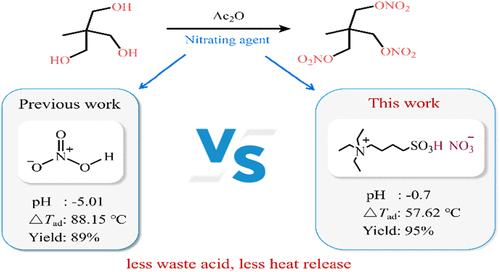
In this study, a novel sulfonic acid-functionalized ionic liquid N,N,N-triethyl-4-sulfobutan-1-aminium nitrate ([Btem-SO3H][NO3]) was synthesized as a nitrating agent. The cation and anion of [Btem-SO3H][NO3], respectively, provide an acidic environment and a nitro source, enabling green nitration of TMETN (Trimethylolethane trinitrate). It was found that [Btem-SO3H][NO3] exhibited good thermal stability up to 170 °C. The acidity of [Btem-SO3H][NO3] increases with a decrease in the water content. When the water content is lower than 9%, the nitration efficiency remains unchanged. The [Btem-SO3H][NO3] system exhibited a ΔTad of 57.62 °C and an MTSR of 30.54 °C, which are significantly lower than 88.15 and 36.96 °C of the fuming HNO3 system. Under optimized conditions, a TMETN yield of 95% was achieved, and the ionic liquid maintained ideal activity after five recycling cycles, outperforming fuming nitric acid (89% yield, poor recyclability). Mechanism analysis showed that the reaction of [Btem-SO3H][NO3] with Ac2O to form acetyl nitrate (CH3COONO2) is a key step in the entire nitration reaction. These findings demonstrate that [Btem-SO3H][NO3] reduces waste acid emissions and improves thermal safety and reusability while maintaining high nitration efficiency, providing a promising strategy for replacing traditional nitric acid systems and achieving green and sustainable synthesis of nitrate esters.
期刊介绍:
ndustrial & Engineering Chemistry, with variations in title and format, has been published since 1909 by the American Chemical Society. Industrial & Engineering Chemistry Research is a weekly publication that reports industrial and academic research in the broad fields of applied chemistry and chemical engineering with special focus on fundamentals, processes, and products.


 求助内容:
求助内容: 应助结果提醒方式:

 京公网安备 11010802042870号


