Mian Zou, Yanhui Zhou, Congcong Zhang, Guoshuai Yang
{"title":"DDX3 inhibits PTZ-induced ferroptosis in human neuronal SH-SY5Y cells via Wnt/β-catenin signaling.","authors":"Mian Zou, Yanhui Zhou, Congcong Zhang, Guoshuai Yang","doi":"10.1007/s11626-025-01138-8","DOIUrl":null,"url":null,"abstract":"<p><p>Ferroptosis is a novel form of programmed cell death characterized by the accumulation of lipid peroxides and associated with neuropathic diseases. However, the molecular mechanisms remain unclear. This study aimed to investigate the potential mechanism of DDX3 in pentylenetetrazole (PTZ)-induced ferroptosis in human neuronal SH-SY5Y cells. PTZ induced SH-SY5Y cells to simulate the neuropathic disease model in vitro. Western blot analysis was used to assess DDX3, β-catenin, β-catenin phosphorylated at Ser37/Thr41, GPX4, and ACSL4 expression. Nuclear accumulation of β-catenin was tested by IF. MMP-7, c-Myc, cyclin D1, LEF1, and Axin2 were detected by qRT-PCR. Cell viability was measured by CCK-8. Apoptosis was detected by flow cytometry. Total antioxidant status (TAS) and total oxidant status (TOS) levels were detected by biochemical kit. ROS production was detected by flow cytometry. Biochemical kits were used to detect MDA, 4-HNE, Fe<sup>2+</sup>, and GSH levels. Our results showed that DDX3 expression was decreased in PTZ-induced SH-SY5Y cells. DDX3 overexpression promoted PTZ-induced SH-SY5Y cell viability, inhibited apoptosis, promoted TAS and GSH expression, and inhibited TOS, MDA, 4-HNE, Fe<sup>2+</sup>, and ROS levels, indicating that DDX3 reduced PTZ-induced SH-SY5Y cell ferroptosis. DDX3 knockdown reduced total β-catenin protein, nuclear accumulation of β-catenin, Wnt target genes (MMP-7, c-Myc, cyclin D1, LEF1, and Axin2), and GPX4 expression in PTZ-induced SH-SY5Y cells, while increasing β-catenin phosphorylated at Ser37/Thr41 and ACSL4 expression. The effect of DDX3 overexpression on the above indexes was opposite to that of DDX3 knockdown. β-catenin overexpression and Wnt/β-catenin signaling activator CHIR99021 increased total β-catenin protein, nuclear accumulation of β-catenin, MMP-7, c-Myc, cyclin D1, LEF1, and Axin2 expression in PTZ-induced SH-SY5Y cells, while decreasing β-catenin phosphorylated at Ser37/Thr41expression and ACSL4 expression. In addition, β-catenin overexpression and CHIR99021 increased cell viability, reduced apoptosis, and upregulated TAS, GSH, and GPX4 expression, while decreasing TOS, MDA, 4-HNE, Fe<sup>2+</sup>, ROS, and ACSL4 levels. GPX4 knockdown and ACSL4 overexpression reversed β-catenin overexpression effects. Further results showed that DDX3 inhibited PTZ-induced SH-SY5Y cell ferroptosis by activating Wnt/β-catenin signaling. Our results suggested that DDX3 inhibited PTZ-induced ferroptosis in SH-SY5Y cells through activation of Wnt/β-catenin signaling. Our findings may provide new molecular targets for the treatment of neuropathic diseases.</p>","PeriodicalId":13340,"journal":{"name":"In Vitro Cellular & Developmental Biology. Animal","volume":" ","pages":"459-475"},"PeriodicalIF":1.7000,"publicationDate":"2026-04-01","publicationTypes":"Journal Article","fieldsOfStudy":null,"isOpenAccess":false,"openAccessPdf":"","citationCount":"0","resultStr":null,"platform":"Semanticscholar","paperid":null,"PeriodicalName":"In Vitro Cellular & Developmental Biology. Animal","FirstCategoryId":"99","ListUrlMain":"https://doi.org/10.1007/s11626-025-01138-8","RegionNum":4,"RegionCategory":"生物学","ArticlePicture":[],"TitleCN":null,"AbstractTextCN":null,"PMCID":null,"EPubDate":"2026/3/13 0:00:00","PubModel":"Epub","JCR":"Q4","JCRName":"CELL BIOLOGY","Score":null,"Total":0}
引用次数: 0
Abstract
Ferroptosis is a novel form of programmed cell death characterized by the accumulation of lipid peroxides and associated with neuropathic diseases. However, the molecular mechanisms remain unclear. This study aimed to investigate the potential mechanism of DDX3 in pentylenetetrazole (PTZ)-induced ferroptosis in human neuronal SH-SY5Y cells. PTZ induced SH-SY5Y cells to simulate the neuropathic disease model in vitro. Western blot analysis was used to assess DDX3, β-catenin, β-catenin phosphorylated at Ser37/Thr41, GPX4, and ACSL4 expression. Nuclear accumulation of β-catenin was tested by IF. MMP-7, c-Myc, cyclin D1, LEF1, and Axin2 were detected by qRT-PCR. Cell viability was measured by CCK-8. Apoptosis was detected by flow cytometry. Total antioxidant status (TAS) and total oxidant status (TOS) levels were detected by biochemical kit. ROS production was detected by flow cytometry. Biochemical kits were used to detect MDA, 4-HNE, Fe2+, and GSH levels. Our results showed that DDX3 expression was decreased in PTZ-induced SH-SY5Y cells. DDX3 overexpression promoted PTZ-induced SH-SY5Y cell viability, inhibited apoptosis, promoted TAS and GSH expression, and inhibited TOS, MDA, 4-HNE, Fe2+, and ROS levels, indicating that DDX3 reduced PTZ-induced SH-SY5Y cell ferroptosis. DDX3 knockdown reduced total β-catenin protein, nuclear accumulation of β-catenin, Wnt target genes (MMP-7, c-Myc, cyclin D1, LEF1, and Axin2), and GPX4 expression in PTZ-induced SH-SY5Y cells, while increasing β-catenin phosphorylated at Ser37/Thr41 and ACSL4 expression. The effect of DDX3 overexpression on the above indexes was opposite to that of DDX3 knockdown. β-catenin overexpression and Wnt/β-catenin signaling activator CHIR99021 increased total β-catenin protein, nuclear accumulation of β-catenin, MMP-7, c-Myc, cyclin D1, LEF1, and Axin2 expression in PTZ-induced SH-SY5Y cells, while decreasing β-catenin phosphorylated at Ser37/Thr41expression and ACSL4 expression. In addition, β-catenin overexpression and CHIR99021 increased cell viability, reduced apoptosis, and upregulated TAS, GSH, and GPX4 expression, while decreasing TOS, MDA, 4-HNE, Fe2+, ROS, and ACSL4 levels. GPX4 knockdown and ACSL4 overexpression reversed β-catenin overexpression effects. Further results showed that DDX3 inhibited PTZ-induced SH-SY5Y cell ferroptosis by activating Wnt/β-catenin signaling. Our results suggested that DDX3 inhibited PTZ-induced ferroptosis in SH-SY5Y cells through activation of Wnt/β-catenin signaling. Our findings may provide new molecular targets for the treatment of neuropathic diseases.
期刊介绍:
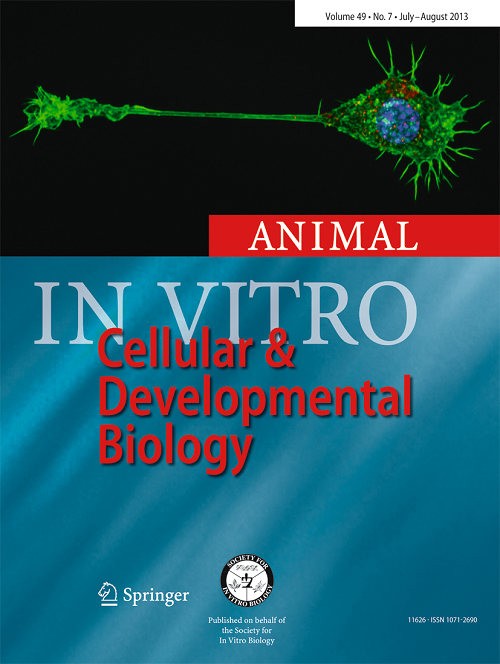
In Vitro Cellular & Developmental Biology - Animal is a journal of the Society for In Vitro Biology (SIVB). Original manuscripts reporting results of research in cellular, molecular, and developmental biology that employ or are relevant to organs, tissue, tumors, and cells in vitro will be considered for publication. Topics covered include:
Biotechnology;
Cell and Tissue Models;
Cell Growth/Differentiation/Apoptosis;
Cellular Pathology/Virology;
Cytokines/Growth Factors/Adhesion Factors;
Establishment of Cell Lines;
Signal Transduction;
Stem Cells;
Toxicology/Chemical Carcinogenesis;
Product Applications.

 求助内容:
求助内容: 应助结果提醒方式:

 京公网安备 11010802042870号


