
Effect of the addition of thiourethane oligomers to experimental silanes and resin cement on the bond strength to glass ceramic
JADA foundational science
Pub Date : 2026-01-01
Epub Date: 2026-03-12
DOI:10.1016/j.jfscie.2026.100070
引用次数: 0
Abstract
Background
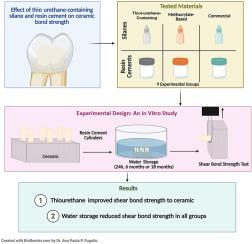
Despite advances in silane and resin cement formulations, the long-term stability of ceramic bonds remains susceptible to degradation, and strategies to enhance interfacial performance are still under investigation. This study aimed to evaluate the effect of incorporating thiourethane (TU) oligomers into silane or resin cement formulations on the microshear bond strength (μSBS) of ceramic restorations.
Methods
Experimental silanes and resin cements containing 0 or 20 wt% TU were formulated with dicyclohexylmethane-4,4′-diisocyanate and pentaerythritol-tetra-3-mercaptopropionate and applied to etched lithium disilicate ceramic plates. Nine combinations of silane and cement (10/group) were tested. μSBS was measured after 24 hours, 6 months, and 18 months of storage in water. Data were analyzed using 2-way analysis of variance and Tukey post hoc (α = 0.05).
Results
TU resin cement exhibited higher μSBS values than the commercial resin cement, particularly after 24 hours when combined with TU and methacrylate-based (MA) silanes, and after 6 months with the MA silane (P < .05). When using the commercial silane, there was no difference in μSBS among the resin cements (P > .05). However, the combinations of TU and MA silanes, along with TU and MA resin cements, exhibited significantly higher μSBS than other formulations (P < .05). All groups showed a significant reduction in μSBS over time (P < .05), with the TU resin cement maintaining higher values than the commercial resin cement.
Conclusions
The use of TU oligomers as silane or resin cement additives improves the μSBS of resin cement-ceramic interfaces, especially when TU silane is combined with TU resin cement (dicyclohexylmethane-4,4′-diisocyanate version). Water storage for 6 and 18 months significantly reduces μSBS across all groups.
实验硅烷和树脂水泥中加入硫脲低聚物对玻璃陶瓷粘结强度的影响
尽管硅烷和树脂水泥配方取得了进步,但陶瓷键的长期稳定性仍然容易降解,提高界面性能的策略仍在研究中。本研究旨在评价在硅烷或树脂水泥中掺入硫脲(TU)低聚物对陶瓷修复体微剪切结合强度(μSBS)的影响。方法分别用二环己基甲烷-4,4′-二异氰酸酯和季戊四醇-四-3-巯基丙酸酯配制成硅烷和树脂胶结剂,并应用于刻蚀二硅酸锂陶瓷板。测试了硅烷与水泥的9种组合(10个/组)。在水中贮藏24小时、6个月和18个月时测定μSBS。资料采用双因素方差分析和Tukey事后分析(α = 0.05)。结果stu树脂水泥的μSBS值高于市售树脂水泥,特别是与TU和MA基硅烷复合24 h和MA基硅烷复合6个月后(P < 0.05)。使用工业硅烷时,各树脂胶结剂的μSBS无显著差异(P > 0.05)。然而,TU和MA硅烷组合以及TU和MA树脂胶结剂的μSBS明显高于其他配方(P < 0.05)。随着时间的推移,所有组的μSBS都显著降低(P < 0.05), TU树脂水泥保持比市售树脂水泥更高的数值。结论使用TU低聚物作为硅烷或树脂水泥外加剂可改善树脂水泥-陶瓷界面的μSBS,特别是当TU硅烷与TU树脂水泥(二环己基甲烷-4,4′-二异氰酸酯版)复合时。6个月和18个月的水储存显著降低了各组的μSBS。
本文章由计算机程序翻译,如有差异,请以英文原文为准。
求助全文
约1分钟内获得全文
求助全文

 求助内容:
求助内容: 应助结果提醒方式:

 京公网安备 11010802042870号


