
BeefPOP: a physiologically based toxicokinetic model describing the fate of polychlorinated biphenyls in growing beef cattle
IF 10.2
1区 环境科学与生态学
Q1 ENVIRONMENTAL SCIENCES
Environment International
Pub Date : 2026-04-01
Epub Date: 2026-03-12
DOI:10.1016/j.envint.2026.110193
引用次数: 0
Abstract
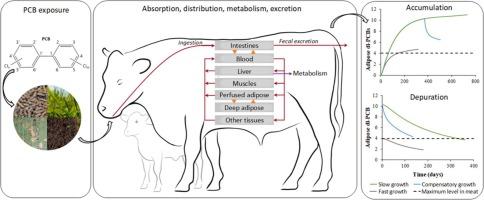
Polychlorinated biphenyls (PCBs) are persistent organic pollutants that bioaccumulate in livestock and threaten food safety. Understanding PCB kinetics in farm animals is essential for effective risk management. This study introduces BeefPOP, a mechanistic model that couples fugacity and physiologically based toxicokinetic concepts with animal feeding and physiology to simulate PCB kinetics in growing cattle. The model was optimized and evaluated using data from a toxicokinetic experiment involving Simmental cattle under controlled PCB exposure. BeefPOP demonstrated satisfactory predictive performance for adipose tissue PCB concentrations, with good accuracy (deviations below 1.4-fold of the biological observations and mean absolute percentage errors below 20%), and adequacy (R2 > 0.79). Predictions for muscle and liver were slightly less satisfactory. Eighteen prospective scenarios were simulated, considering two cattle categories (Angus crossed Hereford steers and Charolais bulls), three growth itineraries (slow, fast, and compensatory growth), and three sources of PCB exposure (wall paint, contaminated feedstuff, and soil). Prospective simulations showed that PCB concentrations in adipose tissue were mostly influenced by growth rate, followed by cattle category and source of exposure. The highest bioconcentration factor was found in slow-growing Charolais bulls under wall paint exposure. Fast-growing early maturing cattle (i.e., Angus crossed Hereford steers) diluted PCBs more effectively due to shorter raising periods and higher lipid accretion. Such use of the model underscores the complex interplay between contaminant properties, growth physiology, and farming practices on PCB toxicokinetics. BeefPOP can support food safety risk management by predicting the fate of lipophilic contaminants in growing cattle under diverse farming scenarios.
BeefPOP:一个基于生理学的毒物动力学模型,描述了多氯联苯在饲养肉牛中的命运
多氯联苯(PCBs)是一种持久性有机污染物,可在牲畜体内生物积累,威胁食品安全。了解多氯联苯在农场动物中的动力学对有效的风险管理至关重要。本研究引入了BeefPOP,这是一个机制模型,将逃逸和基于生理的毒物动力学概念与动物饲养和生理学结合起来,模拟生长牛体内的多氯联苯动力学。利用西门塔尔牛在受控多氯联苯暴露下的毒性动力学实验数据,对该模型进行了优化和评估。BeefPOP对脂肪组织多氯联苯浓度的预测表现令人满意,具有良好的准确性(偏差低于生物学观察值的1.4倍,平均绝对百分比误差低于20%)和充分性(R2 > 0.79)。对肌肉和肝脏的预测略不令人满意。模拟了18种可能的情景,考虑了两种牛类(安格斯杂交赫里福德阉牛和夏洛莱公牛)、三种生长路线(慢生长、快速生长和补偿性生长)和三种多氯联苯暴露源(墙漆、受污染的饲料和土壤)。前瞻性模拟表明,脂肪组织中的多氯联苯浓度主要受生长速度的影响,其次是牛的种类和暴露源。在墙漆暴露下,生长缓慢的夏洛莱公牛的生物浓度因子最高。快速生长的早熟牛(即安格斯杂交赫里福德阉牛)由于饲养期较短和脂质增加较高,更有效地稀释了多氯联苯。这种模型的使用强调了污染物特性、生长生理学和农业实践对多氯联苯毒性动力学之间复杂的相互作用。BeefPOP可以通过预测不同养殖情景下养牛中亲脂污染物的命运来支持食品安全风险管理。
本文章由计算机程序翻译,如有差异,请以英文原文为准。
求助全文
约1分钟内获得全文
求助全文
来源期刊
Environment International
环境科学-环境科学
CiteScore
21.90
自引率
3.40%
发文量
734
审稿时长
2.8 months
期刊介绍:
Environmental Health publishes manuscripts focusing on critical aspects of environmental and occupational medicine, including studies in toxicology and epidemiology, to illuminate the human health implications of exposure to environmental hazards. The journal adopts an open-access model and practices open peer review.
It caters to scientists and practitioners across all environmental science domains, directly or indirectly impacting human health and well-being. With a commitment to enhancing the prevention of environmentally-related health risks, Environmental Health serves as a public health journal for the community and scientists engaged in matters of public health significance concerning the environment.
 求助内容:
求助内容: 应助结果提醒方式:

 京公网安备 11010802042870号


