Rui Wang, Patrick J Heagerty, Kwun Chuen Gary Chan, Pradeep Suri
{"title":"Estimating controlled direct treatment effects on pain intensity using structural mean models.","authors":"Rui Wang, Patrick J Heagerty, Kwun Chuen Gary Chan, Pradeep Suri","doi":"10.1097/PR9.0000000000001409","DOIUrl":null,"url":null,"abstract":"<p><strong>Introduction: </strong>Without valid inclusion of concurrent analgesic use, the primary analyses of pain intensity in pain randomized controlled trials (RCTs) may produce diminished estimated treatment effects.</p><p><strong>Methods: </strong>We used contemporary causal inference methods to reanalyze RCT data examining the effect of epidural steroid injection (ESI) as an example of a pain treatment. Specifically, we define an \"attributable to ESI estimand,\" which is the controlled direct effect of ESI. We used a simple composite pain intensity outcome, the QPAC<sub>1.5,</sub> and structural mean models (SMM) to estimate the target estimand. Compared with traditional methods such as strict intention to treat analysis (strict ITT), SMMs can account for analgesic use without assuming no unmeasured confounding between the analgesic use and the outcome. We estimated treatment effects of ESI on leg pain intensity using the numeric rating scale with strict ITT, 3 SMM estimating methods (estimating equations, g-estimation, and generalized method of moments), and the QPAC<sub>1.5</sub>.</p><p><strong>Results: </strong>The treatment effect of ESI on leg pain intensity using strict ITT was -0.751 numeric rating scale points (95% confidence interval [CI]: -1.287 to -0.214). Estimates for the attributable to ESI estimand were -0.864 (95% CI: -3.207 to 1.478) for estimating equations, -0.935 (95% CI: -1.779 to 0.090) for g-estimation, -0.653 (95% CI: -1.218 to -0.089) for generalized method of moments, and -0.930 (95% CI: -1.508 to -0.352) for the QPAC1.5.</p><p><strong>Discussion: </strong>We illustrate how contemporary causal inference methods and alternative estimands can be used to account for concurrent analgesic use in pain RCTs in a manner that may result in larger treatment effects.</p>","PeriodicalId":52189,"journal":{"name":"Pain Reports","volume":"11 2","pages":"e1409"},"PeriodicalIF":3.1000,"publicationDate":"2026-03-10","publicationTypes":"Journal Article","fieldsOfStudy":null,"isOpenAccess":false,"openAccessPdf":"https://www.ncbi.nlm.nih.gov/pmc/articles/PMC12978825/pdf/","citationCount":"0","resultStr":null,"platform":"Semanticscholar","paperid":null,"PeriodicalName":"Pain Reports","FirstCategoryId":"1085","ListUrlMain":"https://doi.org/10.1097/PR9.0000000000001409","RegionNum":0,"RegionCategory":null,"ArticlePicture":[],"TitleCN":null,"AbstractTextCN":null,"PMCID":null,"EPubDate":"2026/4/1 0:00:00","PubModel":"eCollection","JCR":"Q2","JCRName":"NEUROSCIENCES","Score":null,"Total":0}
引用次数: 0
Abstract
Introduction: Without valid inclusion of concurrent analgesic use, the primary analyses of pain intensity in pain randomized controlled trials (RCTs) may produce diminished estimated treatment effects.
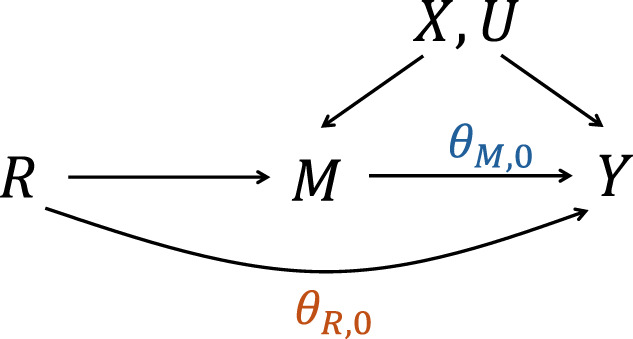
Methods: We used contemporary causal inference methods to reanalyze RCT data examining the effect of epidural steroid injection (ESI) as an example of a pain treatment. Specifically, we define an "attributable to ESI estimand," which is the controlled direct effect of ESI. We used a simple composite pain intensity outcome, the QPAC1.5, and structural mean models (SMM) to estimate the target estimand. Compared with traditional methods such as strict intention to treat analysis (strict ITT), SMMs can account for analgesic use without assuming no unmeasured confounding between the analgesic use and the outcome. We estimated treatment effects of ESI on leg pain intensity using the numeric rating scale with strict ITT, 3 SMM estimating methods (estimating equations, g-estimation, and generalized method of moments), and the QPAC1.5.
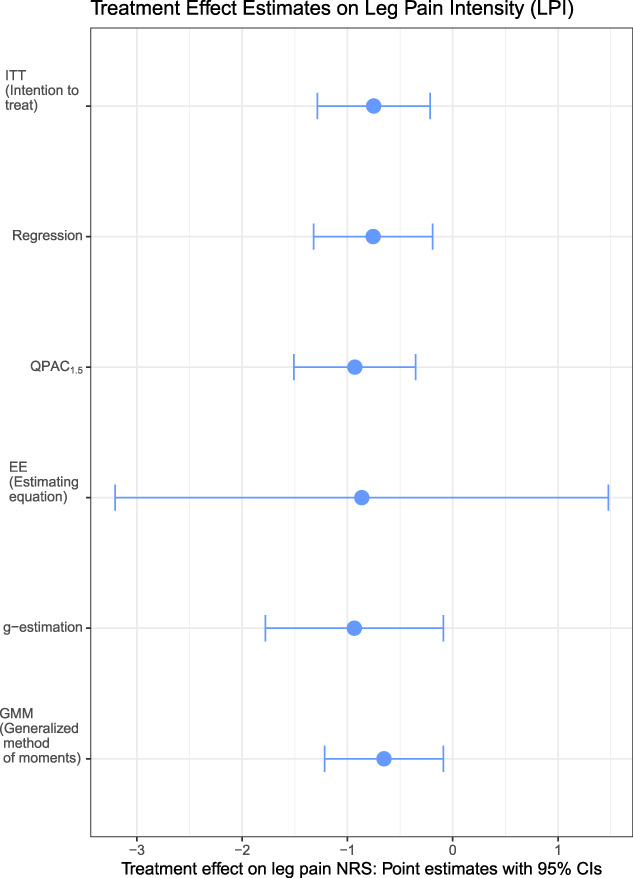
Results: The treatment effect of ESI on leg pain intensity using strict ITT was -0.751 numeric rating scale points (95% confidence interval [CI]: -1.287 to -0.214). Estimates for the attributable to ESI estimand were -0.864 (95% CI: -3.207 to 1.478) for estimating equations, -0.935 (95% CI: -1.779 to 0.090) for g-estimation, -0.653 (95% CI: -1.218 to -0.089) for generalized method of moments, and -0.930 (95% CI: -1.508 to -0.352) for the QPAC1.5.
Discussion: We illustrate how contemporary causal inference methods and alternative estimands can be used to account for concurrent analgesic use in pain RCTs in a manner that may result in larger treatment effects.



 求助内容:
求助内容: 应助结果提醒方式:

 京公网安备 11010802042870号


