{"title":"The influence of hate speech on adolescents' bystander intention and TNB aggression.","authors":"Naiara Gorostiaga-Marcos, Nerea Cortazar-Enciondo, Esther Calvete","doi":"10.1111/jora.70170","DOIUrl":null,"url":null,"abstract":"<p><p>Although the visibility of trans and non-binary (TNB) individuals has increased in recent years, gender identity-based discrimination remains a significant social issue. However, there is an important gap in the research examining the mechanisms involved in TNB aggression. This study longitudinally analyzed the relationship between exposure to hate speech across different contexts and bystander intentions and aggression toward TNB individuals. Additionally, gender invariance was tested. A total of 755 adolescents aged 14 to 18 years (M<sub>age</sub> = 16.28; SD = 0.88; 50.8% identified as girls, 48.7% as boys, and 0.3% as non-binary) completed measures assessing exposure to hate speech in several contexts, behavioral intentions when witnessing aggression, and TNB aggression at baseline. Behavioral intentions and aggression were assessed again three months later. Cross-sectional results indicated that hate speech in all contexts was associated with higher levels of aggression, with small to moderate effects. Longitudinal analyses showed that only hate speech among friends predicted aggression, with small effects. Regarding bystander intentions, none of the hate speech contexts were associated with bystander intentions either cross-sectionally or longitudinally, except for hate speech among friends, which predicted higher helping intentions with small effects. Furthermore, a bidirectional relationship was observed between bystander intentions and aggressive behaviors with small to moderate effects. Finally, the model was invariant across gender. Overall, these findings highlight the need to address adolescents' exposure to hate speech and to develop preventive strategies to reduce violence against TNB individuals, focusing on the bystander's role to promote safer and more inclusive adolescent environments.</p>","PeriodicalId":17026,"journal":{"name":"Journal of Research on Adolescence","volume":"36 1","pages":"e70170"},"PeriodicalIF":3.5000,"publicationDate":"2026-03-01","publicationTypes":"Journal Article","fieldsOfStudy":null,"isOpenAccess":false,"openAccessPdf":"https://www.ncbi.nlm.nih.gov/pmc/articles/PMC12982623/pdf/","citationCount":"0","resultStr":null,"platform":"Semanticscholar","paperid":null,"PeriodicalName":"Journal of Research on Adolescence","FirstCategoryId":"102","ListUrlMain":"https://doi.org/10.1111/jora.70170","RegionNum":2,"RegionCategory":"心理学","ArticlePicture":[],"TitleCN":null,"AbstractTextCN":null,"PMCID":null,"EPubDate":"","PubModel":"","JCR":"Q1","JCRName":"FAMILY STUDIES","Score":null,"Total":0}
引用次数: 0
Abstract
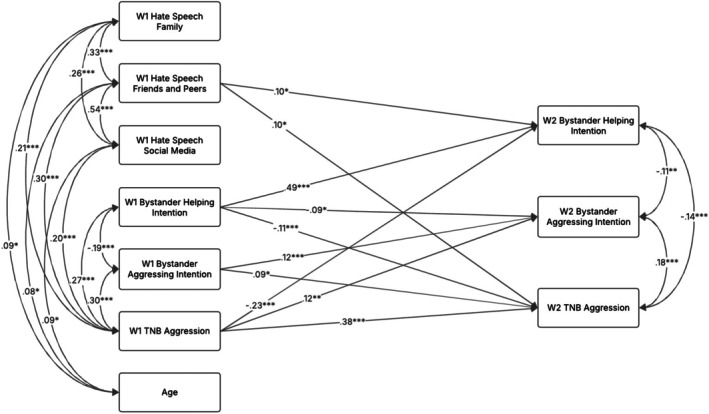
Although the visibility of trans and non-binary (TNB) individuals has increased in recent years, gender identity-based discrimination remains a significant social issue. However, there is an important gap in the research examining the mechanisms involved in TNB aggression. This study longitudinally analyzed the relationship between exposure to hate speech across different contexts and bystander intentions and aggression toward TNB individuals. Additionally, gender invariance was tested. A total of 755 adolescents aged 14 to 18 years (Mage = 16.28; SD = 0.88; 50.8% identified as girls, 48.7% as boys, and 0.3% as non-binary) completed measures assessing exposure to hate speech in several contexts, behavioral intentions when witnessing aggression, and TNB aggression at baseline. Behavioral intentions and aggression were assessed again three months later. Cross-sectional results indicated that hate speech in all contexts was associated with higher levels of aggression, with small to moderate effects. Longitudinal analyses showed that only hate speech among friends predicted aggression, with small effects. Regarding bystander intentions, none of the hate speech contexts were associated with bystander intentions either cross-sectionally or longitudinally, except for hate speech among friends, which predicted higher helping intentions with small effects. Furthermore, a bidirectional relationship was observed between bystander intentions and aggressive behaviors with small to moderate effects. Finally, the model was invariant across gender. Overall, these findings highlight the need to address adolescents' exposure to hate speech and to develop preventive strategies to reduce violence against TNB individuals, focusing on the bystander's role to promote safer and more inclusive adolescent environments.
期刊介绍:
Multidisciplinary and international in scope, the Journal of Research on Adolescence (JRA) significantly advances knowledge in the field of adolescent research. Employing a diverse array of methodologies, this compelling journal publishes original research and integrative reviews of the highest level of scholarship. Featured studies include both quantitative and qualitative methodologies applied to cognitive, physical, emotional, and social development and behavior. Articles pertinent to the variety of developmental patterns inherent throughout adolescence are featured, including cross-national and cross-cultural studies. Attention is given to normative patterns of behavior as well as individual differences rooted in personal or social and cultural factors.


 求助内容:
求助内容: 应助结果提醒方式:

 京公网安备 11010802042870号


