
Targeting focal adhesion kinase: from molecular mechanisms to next-generation cancer therapeutics
IF 21.1
1区 综合性期刊
Q1 MULTIDISCIPLINARY SCIENCES
引用次数: 0
Abstract
Focal adhesion kinase (FAK) is a key cytoplasmic tyrosine kinase that transmits signals from integrins and growth factors to control cell migration, metastasis, growth and survival. FAK can modulate prominent oncogenic pathways, such as the phosphatidylinositol 3 kinase/protein kinase B (PI3K/AKT) and Rat Sarcoma virus/extracellular signal-regulated kinase (Ras/ERK) pathway, through autophosphorylation at Y397 and subsequent conformational activation. Notably, FAK is overexpressed and activated in many solid tumors. Its expression levels are correlated with tumor stage, lymph node metastasis, and poor prognosis. Moreover, FAK promotes tumor malignancy by inducing epithelial-mesenchymal transition (EMT), chemoresistance, and stemness properties. However, targeting FAK is considerably challenging owing to signal complexity. To date, only eight small-molecule FAK inhibitors have reached the clinical trial stage, mainly in combination with chemotherapy, targeted therapy, or immunotherapy. Recent advances, such as proteolysis-targeting chimeras (PROTACs) degraders, protein-protein interaction (PPI) blockers, allosteric inhibitors, and natural products, offer promising opportunities to overcome current therapeutic challenges. The present review provides a comprehensive discussion of FAK, ranging from its structure and regulatory mechanisms to its central role in tumor malignancy and the current status of inhibitor development, aiming to inform future translational efforts in solid tumors.
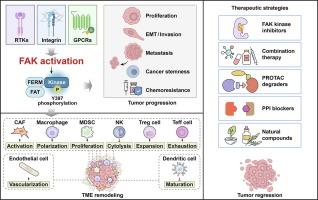
靶向黏附激酶:从分子机制到下一代癌症治疗。
局灶黏附激酶(Focal adhesion kinase, FAK)是一种重要的细胞质酪氨酸激酶,可传递整合素和生长因子的信号,控制细胞的迁移、转移、生长和存活。FAK可以通过Y397位点的自磷酸化和随后的构象激活,调节重要的致癌途径,如磷脂酰肌醇3激酶/蛋白激酶B (PI3K/AKT)和大鼠肉瘤病毒/细胞外信号调节激酶(Ras/ERK)途径。值得注意的是,FAK在许多实体瘤中过度表达和激活。其表达水平与肿瘤分期、淋巴结转移及预后不良有关。此外,FAK通过诱导上皮-间质转化(EMT)、化疗耐药和干细胞特性促进肿瘤恶性。然而,由于信号的复杂性,瞄准FAK是相当具有挑战性的。迄今为止,只有8种小分子FAK抑制剂进入临床试验阶段,主要与化疗、靶向治疗或免疫治疗联合使用。最近的进展,如蛋白水解靶向嵌合体(PROTACs)降解剂、蛋白蛋白相互作用(PPI)阻滞剂、变构抑制剂和天然产物,为克服当前的治疗挑战提供了有希望的机会。本文综述了FAK的结构、调控机制、在恶性肿瘤中的核心作用以及抑制剂开发的现状,旨在为未来在实体肿瘤中的转化工作提供信息。
本文章由计算机程序翻译,如有差异,请以英文原文为准。
求助全文
约1分钟内获得全文
求助全文
来源期刊
Science Bulletin
MULTIDISCIPLINARY SCIENCES-
CiteScore
24.60
自引率
2.10%
发文量
8092
期刊介绍:
Science Bulletin (Sci. Bull., formerly known as Chinese Science Bulletin) is a multidisciplinary academic journal supervised by the Chinese Academy of Sciences (CAS) and co-sponsored by the CAS and the National Natural Science Foundation of China (NSFC). Sci. Bull. is a semi-monthly international journal publishing high-caliber peer-reviewed research on a broad range of natural sciences and high-tech fields on the basis of its originality, scientific significance and whether it is of general interest. In addition, we are committed to serving the scientific community with immediate, authoritative news and valuable insights into upcoming trends around the globe.
 求助内容:
求助内容: 应助结果提醒方式:

 京公网安备 11010802042870号


