Viviane Philipps, Laurence Freedman, Veronika Deffner, Catherine Helmer, Hélène Jacqmin-Gadda, Hendriek Boshuizen, Anne Cm Thiébaut, Cécile Proust-Lima
{"title":"Including an infrequently measured time-varying error-prone covariate in survival analyses: a simulation-based comparison of methods.","authors":"Viviane Philipps, Laurence Freedman, Veronika Deffner, Catherine Helmer, Hélène Jacqmin-Gadda, Hendriek Boshuizen, Anne Cm Thiébaut, Cécile Proust-Lima","doi":"10.1093/aje/kwag059","DOIUrl":null,"url":null,"abstract":"<p><p>Epidemiologic studies often evaluate the association between an exposure and an event risk. When time-varying, exposures are usually updated at discrete visits although changes are in continuous time and survival models require values to be constantly known. Moreover, exposures are likely measured with error, and their observation truncated at the event time. We aimed to quantify in a Cox regression the bias in the association resulting from intermittent measurements of an error-prone exposure. Using simulations under various scenarios, we compared five methods: last observation carried-forward (LOCF), classical two-stage regression calibration using measurements up to the event (RC) or also after (PE-RC), multiple imputation (MI) and joint modeling of the exposure and the event (JM). The LOCF, and to a lesser extent the classical RC, showed substantial bias in almost all 45 scenarios. The RC bias was avoided when considering post-event information. The MI performed relatively well, as did the JM. Illustrations exploring the association of Body Mass Index and Executive Functioning with dementia risk showed consistent conclusions. Accounting for measurement error and discrete updates is critical when studying time-varying exposures. MI and JM techniques may be applied in this context, while classical RC should be avoided due to the informative truncation.</p>","PeriodicalId":7472,"journal":{"name":"American journal of epidemiology","volume":" ","pages":"2622-2631"},"PeriodicalIF":4.1000,"publicationDate":"2026-10-07","publicationTypes":"Journal Article","fieldsOfStudy":null,"isOpenAccess":false,"openAccessPdf":"","citationCount":"0","resultStr":null,"platform":"Semanticscholar","paperid":null,"PeriodicalName":"American journal of epidemiology","FirstCategoryId":"3","ListUrlMain":"https://doi.org/10.1093/aje/kwag059","RegionNum":2,"RegionCategory":"医学","ArticlePicture":[],"TitleCN":null,"AbstractTextCN":null,"PMCID":null,"EPubDate":"","PubModel":"","JCR":"Q1","JCRName":"PUBLIC, ENVIRONMENTAL & OCCUPATIONAL HEALTH","Score":null,"Total":0}
引用次数: 0
Abstract
Epidemiologic studies often evaluate the association between an exposure and an event risk. When time-varying, exposures are usually updated at discrete visits although changes are in continuous time and survival models require values to be constantly known. Moreover, exposures are likely measured with error, and their observation truncated at the event time. We aimed to quantify in a Cox regression the bias in the association resulting from intermittent measurements of an error-prone exposure. Using simulations under various scenarios, we compared five methods: last observation carried-forward (LOCF), classical two-stage regression calibration using measurements up to the event (RC) or also after (PE-RC), multiple imputation (MI) and joint modeling of the exposure and the event (JM). The LOCF, and to a lesser extent the classical RC, showed substantial bias in almost all 45 scenarios. The RC bias was avoided when considering post-event information. The MI performed relatively well, as did the JM. Illustrations exploring the association of Body Mass Index and Executive Functioning with dementia risk showed consistent conclusions. Accounting for measurement error and discrete updates is critical when studying time-varying exposures. MI and JM techniques may be applied in this context, while classical RC should be avoided due to the informative truncation.
期刊介绍:
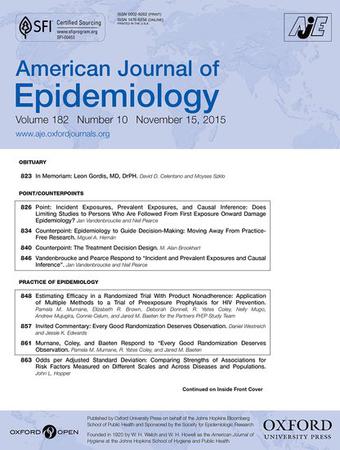
The American Journal of Epidemiology is the oldest and one of the premier epidemiologic journals devoted to the publication of empirical research findings, opinion pieces, and methodological developments in the field of epidemiologic research.
It is a peer-reviewed journal aimed at both fellow epidemiologists and those who use epidemiologic data, including public health workers and clinicians.

 求助内容:
 应助结果提醒方式:


 京公网安备 11010802042870号


