Macarena Chacón-Docampo, Ángela Asensio-Martínez, David Liñares, Luis-Javier Márquez-Álvarez, Marina Feijoo Barbeito, Ana Clavería
{"title":"Burnout During Residency: A Thematic Analysis of Stressors, Coping, and Organisational Challenges Among Nursing Residents.","authors":"Macarena Chacón-Docampo, Ángela Asensio-Martínez, David Liñares, Luis-Javier Márquez-Álvarez, Marina Feijoo Barbeito, Ana Clavería","doi":"10.1177/23333936261426859","DOIUrl":null,"url":null,"abstract":"<p><p>Burnout is a pervasive challenge among healthcare professionals in training, with significant implications for both well-being and quality of care. This qualitative study, using a phenomenological design, explored the experiences of nursing residents regarding sources of stress, coping strategies, and organisational challenges, and how these factors contribute to the development of burnout. Three focus groups were conducted with 24 nursing residents. Data were analysed using reflexive thematic analysis. Five themes were constructed: peer solidarity as a protective shield, navigating institutional abandonment, the crushing weight of unmanaged demands, the \"lottery of learning,\" and the sacrifice of personal identity. Participants described residency as a demanding and disorganised stage, characterised by heavy workloads, inconsistent educational opportunities, and scarce institutional support. These conditions fostered emotional exhaustion and frustration, but peer networks were identified as a crucial protective factor, providing informal learning, solidarity, and resilience. The findings highlight the need for organisational reform in residency programmes, including greater educational equity, improved leadership, and spaces for dialogue and mentoring. Recognising the role of peer support alongside institutional responsibility can contribute to building more humane, sustainable, and ethically grounded training environments.</p>","PeriodicalId":45940,"journal":{"name":"Global Qualitative Nursing Research","volume":"13 ","pages":"23333936261426859"},"PeriodicalIF":2.1000,"publicationDate":"2026-03-09","publicationTypes":"Journal Article","fieldsOfStudy":null,"isOpenAccess":false,"openAccessPdf":"https://www.ncbi.nlm.nih.gov/pmc/articles/PMC12972549/pdf/","citationCount":"0","resultStr":null,"platform":"Semanticscholar","paperid":null,"PeriodicalName":"Global Qualitative Nursing Research","FirstCategoryId":"1085","ListUrlMain":"https://doi.org/10.1177/23333936261426859","RegionNum":0,"RegionCategory":null,"ArticlePicture":[],"TitleCN":null,"AbstractTextCN":null,"PMCID":null,"EPubDate":"2026/1/1 0:00:00","PubModel":"eCollection","JCR":"Q1","JCRName":"NURSING","Score":null,"Total":0}
引用次数: 0
Abstract
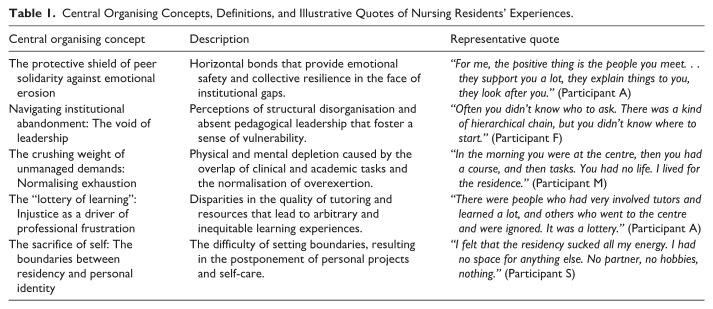
Burnout is a pervasive challenge among healthcare professionals in training, with significant implications for both well-being and quality of care. This qualitative study, using a phenomenological design, explored the experiences of nursing residents regarding sources of stress, coping strategies, and organisational challenges, and how these factors contribute to the development of burnout. Three focus groups were conducted with 24 nursing residents. Data were analysed using reflexive thematic analysis. Five themes were constructed: peer solidarity as a protective shield, navigating institutional abandonment, the crushing weight of unmanaged demands, the "lottery of learning," and the sacrifice of personal identity. Participants described residency as a demanding and disorganised stage, characterised by heavy workloads, inconsistent educational opportunities, and scarce institutional support. These conditions fostered emotional exhaustion and frustration, but peer networks were identified as a crucial protective factor, providing informal learning, solidarity, and resilience. The findings highlight the need for organisational reform in residency programmes, including greater educational equity, improved leadership, and spaces for dialogue and mentoring. Recognising the role of peer support alongside institutional responsibility can contribute to building more humane, sustainable, and ethically grounded training environments.
期刊介绍:
Global Qualitative Nursing Research (GQNR) is a ground breaking, international, peer-reviewed, open-access journal focusing on qualitative research in fields relevant to nursing and other health professionals world-wide. The journal specializes in topics related to nursing practice, responses to health and illness, health promotion, and health care delivery. GQNR will publish research articles using qualitative methods and qualitatively-driven mixed-method designs as well as meta-syntheses and articles focused on methodological development. Special sections include Ethics, Methodological Development, Advancing Theory/Metasynthesis, Establishing Evidence, and Application to Practice.



 求助内容:
求助内容: 应助结果提醒方式:

 京公网安备 11010802042870号


