Ayanda Myaka-Gama, Sibongile Mbatha, Sarah Lowick, Kebashni Thandrayen, Firdose L Nakwa
{"title":"Developmental profiles of infants with hypoxic ischaemic encephalopathy at a tertiary hospital in South Africa.","authors":"Ayanda Myaka-Gama, Sibongile Mbatha, Sarah Lowick, Kebashni Thandrayen, Firdose L Nakwa","doi":"10.4102/ajod.v15i0.1729","DOIUrl":null,"url":null,"abstract":"<p><strong>Background: </strong>Hypoxic ischaemic encephalopathy (HIE) is a common cause of neonatal death and severe neurological deficit in children, contributing to medico-legal litigation.</p><p><strong>Objectives: </strong>To describe the neurodevelopmental outcomes of infants with moderate and severe HIE at Chris Hani Baragwanath Academic Hospital and the proportions with neurodevelopmental impairment (NDI) and complications. To explore the effect of HIE severity and therapeutic hypothermia (TH) on neurodevelopmental outcome.</p><p><strong>Method: </strong>A retrospective, descriptive study at the Neonatal Neurodevelopmental Clinic included 239 infants with moderate and severe HIE, between 2015 and 2020. Neurodevelopmental outcomes were assessed by using the Griffiths Mental Developmental Scales at 1 year. General Quotient (GQ) scores defined NDI. Clinical and investigation criteria determined those with neurological complications.</p><p><strong>Results: </strong>Of the 239 infants, 211 (88.3%) and 28 (11.7%) had moderate HIE and severe HIE, respectively. Cerebral palsy (CP) was diagnosed in 9.2% and NDI in 17.1%. Severe HIE infants had significantly higher rates of NDI and CP, 50% (14) and 21.4% (6) respectively, as compared to those of moderate HIE infants, who had 12.7% (27) NDI and 7.6% (16) CP; 152(72%) moderate and 14 (50%) severe HIE infants received TH. Those who received TH were less likely to have NDI (<i>p</i> = 0.005), CP (<i>p</i> = 0.002), epilepsy and visual impairment.</p><p><strong>Conclusion: </strong>Developmental scores at 1 year of age were in the average range for the cohort, with equivalent profiles across domains. Those with severe HIE had the worst outcomes. Therapeutic hypothermia was associated with decreased CP and NDI in both groups.</p><p><strong>Contribution: </strong>This report supports the use of TH as a neuroprotective strategy in stage 2 and 3 HIE, highlighting the need for neurodevelopmental assessments at 2 years and beyond to determine longer-term outcomes and subtle deficits.</p>","PeriodicalId":45606,"journal":{"name":"African Journal of Disability","volume":"15 ","pages":"1729"},"PeriodicalIF":1.5000,"publicationDate":"2026-02-23","publicationTypes":"Journal Article","fieldsOfStudy":null,"isOpenAccess":false,"openAccessPdf":"https://www.ncbi.nlm.nih.gov/pmc/articles/PMC12969479/pdf/","citationCount":"0","resultStr":null,"platform":"Semanticscholar","paperid":null,"PeriodicalName":"African Journal of Disability","FirstCategoryId":"1085","ListUrlMain":"https://doi.org/10.4102/ajod.v15i0.1729","RegionNum":0,"RegionCategory":null,"ArticlePicture":[],"TitleCN":null,"AbstractTextCN":null,"PMCID":null,"EPubDate":"2026/1/1 0:00:00","PubModel":"eCollection","JCR":"Q4","JCRName":"HEALTH CARE SCIENCES & SERVICES","Score":null,"Total":0}
引用次数: 0
Abstract
Background: Hypoxic ischaemic encephalopathy (HIE) is a common cause of neonatal death and severe neurological deficit in children, contributing to medico-legal litigation.
Objectives: To describe the neurodevelopmental outcomes of infants with moderate and severe HIE at Chris Hani Baragwanath Academic Hospital and the proportions with neurodevelopmental impairment (NDI) and complications. To explore the effect of HIE severity and therapeutic hypothermia (TH) on neurodevelopmental outcome.
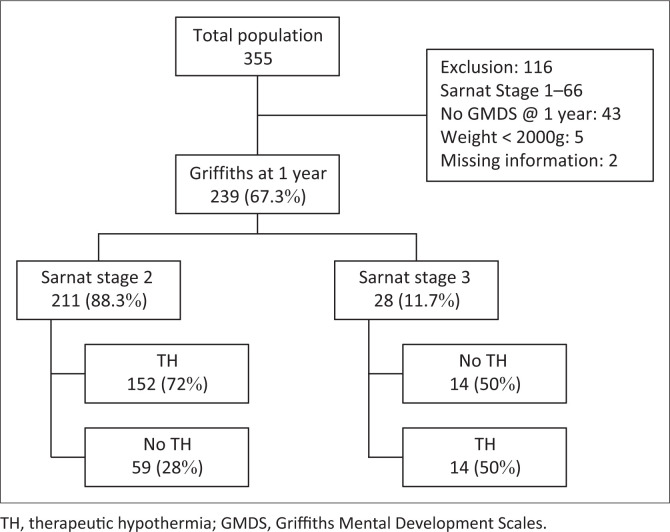
Method: A retrospective, descriptive study at the Neonatal Neurodevelopmental Clinic included 239 infants with moderate and severe HIE, between 2015 and 2020. Neurodevelopmental outcomes were assessed by using the Griffiths Mental Developmental Scales at 1 year. General Quotient (GQ) scores defined NDI. Clinical and investigation criteria determined those with neurological complications.
Results: Of the 239 infants, 211 (88.3%) and 28 (11.7%) had moderate HIE and severe HIE, respectively. Cerebral palsy (CP) was diagnosed in 9.2% and NDI in 17.1%. Severe HIE infants had significantly higher rates of NDI and CP, 50% (14) and 21.4% (6) respectively, as compared to those of moderate HIE infants, who had 12.7% (27) NDI and 7.6% (16) CP; 152(72%) moderate and 14 (50%) severe HIE infants received TH. Those who received TH were less likely to have NDI (p = 0.005), CP (p = 0.002), epilepsy and visual impairment.
Conclusion: Developmental scores at 1 year of age were in the average range for the cohort, with equivalent profiles across domains. Those with severe HIE had the worst outcomes. Therapeutic hypothermia was associated with decreased CP and NDI in both groups.
Contribution: This report supports the use of TH as a neuroprotective strategy in stage 2 and 3 HIE, highlighting the need for neurodevelopmental assessments at 2 years and beyond to determine longer-term outcomes and subtle deficits.
期刊介绍:
The African Journal of Disability, the official journal of CRS, AfriNEAD and CEDRES, introduce and discuss issues and experiences relating to and supporting the act of better understanding the interfaces between disability, poverty and practices of exclusion and marginalisation. Its articles yield new insight into established human development practices, evaluate new educational techniques and disability research, examine current cultural and social discrimination, and bring serious critical analysis to bear on problems shared across the African continent. Emphasis is on all aspects of disability particularity in the developing African context. This includes, amongst others: -disability studies as an emerging field of public health enquiry -rehabilitation, including vocational and community-based rehabilitation -community development and medical issues related to disability and poverty -disability-related stigma and discrimination -inclusive education -legal, policy, human rights and advocacy issues related to disability -the role of arts and media in relation to disability -disability as part of global Sustainable Development Goals transformation agendas -disability and postcolonial issues -globalisation and cultural change in relation to disability -environmental and climate-related issues linked to disability -disability, diversity and intersections of identity -disability and the promotion of human development.



 求助内容:
求助内容: 应助结果提醒方式:

 京公网安备 11010802042870号


