Luca Improta, Gianluca Stanzani, Valeria Vitale, Marco Yusef, Simone Tinghino, Augusto Lombardi
{"title":"Palpable <i>vs</i> non-palpable breast cancers in screened populations: Clinicopathological features and prognostic implications.","authors":"Luca Improta, Gianluca Stanzani, Valeria Vitale, Marco Yusef, Simone Tinghino, Augusto Lombardi","doi":"10.5306/wjco.v17.i2.115245","DOIUrl":null,"url":null,"abstract":"<p><strong>Background: </strong>Despite widespread mammographic screening, a substantial proportion of breast cancers are still diagnosed as palpable lesions, frequently self-detected by the patient. Prior studies have investigated palpability as a prognostic factor, but few have incorporated contemporary staging systems or focused on clinically homogeneous, screening-eligible populations. In high-resource settings with equal access to screening, it remains unclear whether palpability reflects intrinsic tumor aggressiveness rather than delayed detection. This study evaluates whether palpable tumors exhibit distinct clinicopathological characteristics and worse outcomes in a screening-eligible population, hypothesizing that palpability may reflect aggressive tumor biology and potentially influence prognosis even when screening programs are accessible.</p><p><strong>Aim: </strong>To compare clinicopathological features and survival outcomes of palpable <i>vs</i> non-palpable breast cancers in a screened population.</p><p><strong>Methods: </strong>We retrospectively analyzed 2110 women with clinically node-negative, localized breast cancer treated surgically between 2004 and 2024. Palpability at diagnosis was used to classify tumors as palpable (<i>n</i> = 1234) or non-palpable (<i>n</i> = 876). Endpoints included tumor size, grade, subtype, Ki-67 index, nodal status, overall survival, and breast cancer-specific survival. Statistical analyses included <i>χ</i> <sup>2</sup> and <i>t</i>-tests and Kaplan-Meier estimates, with significance set at <i>P</i> < 0.05.</p><p><strong>Results: </strong>Palpable tumors were significantly larger (17.5 mm ± 8.6 <i>vs</i> 11.0 ± 6.7 mm, <i>P</i> < 0.001), more often high-grade (G3: 33% <i>vs</i> 16.3%, <i>P</i> < 0.001), and more frequently of luminal B or triple-negative subtype (37.1% <i>vs</i> 20.6%, <i>P</i> < 0.001). Ki-67 proliferation index was markedly higher in palpable tumors (24.7% ± 11.9% <i>vs</i> 15.1% ± 9.4%, <i>P</i> < 0.001). Sentinel lymph node positivity was increased (27.6% <i>vs</i> 16.7%, <i>P</i> < 0.001). While 10-year overall survival was similar (92% palpable <i>vs</i> 95% non-palpable, <i>P</i> = 0.56), breast cancer-specific survival showed a trend toward worse survival in palpable cases (96% <i>vs</i> 99%, <i>P</i> = 0.1).</p><p><strong>Conclusion: </strong>Palpable tumors display faster growth kinetics and aggressive features, potentially shortening the preclinical window. Palpability may indicate biologically aggressive disease, warranting individualized management despite access to routine screening.</p>","PeriodicalId":23802,"journal":{"name":"World journal of clinical oncology","volume":"17 2","pages":"115245"},"PeriodicalIF":3.2000,"publicationDate":"2026-02-24","publicationTypes":"Journal Article","fieldsOfStudy":null,"isOpenAccess":false,"openAccessPdf":"https://www.ncbi.nlm.nih.gov/pmc/articles/PMC12968550/pdf/","citationCount":"0","resultStr":null,"platform":"Semanticscholar","paperid":null,"PeriodicalName":"World journal of clinical oncology","FirstCategoryId":"1085","ListUrlMain":"https://doi.org/10.5306/wjco.v17.i2.115245","RegionNum":0,"RegionCategory":null,"ArticlePicture":[],"TitleCN":null,"AbstractTextCN":null,"PMCID":null,"EPubDate":"","PubModel":"","JCR":"Q3","JCRName":"ONCOLOGY","Score":null,"Total":0}
引用次数: 0
Abstract
Background: Despite widespread mammographic screening, a substantial proportion of breast cancers are still diagnosed as palpable lesions, frequently self-detected by the patient. Prior studies have investigated palpability as a prognostic factor, but few have incorporated contemporary staging systems or focused on clinically homogeneous, screening-eligible populations. In high-resource settings with equal access to screening, it remains unclear whether palpability reflects intrinsic tumor aggressiveness rather than delayed detection. This study evaluates whether palpable tumors exhibit distinct clinicopathological characteristics and worse outcomes in a screening-eligible population, hypothesizing that palpability may reflect aggressive tumor biology and potentially influence prognosis even when screening programs are accessible.
Aim: To compare clinicopathological features and survival outcomes of palpable vs non-palpable breast cancers in a screened population.
Methods: We retrospectively analyzed 2110 women with clinically node-negative, localized breast cancer treated surgically between 2004 and 2024. Palpability at diagnosis was used to classify tumors as palpable (n = 1234) or non-palpable (n = 876). Endpoints included tumor size, grade, subtype, Ki-67 index, nodal status, overall survival, and breast cancer-specific survival. Statistical analyses included χ2 and t-tests and Kaplan-Meier estimates, with significance set at P < 0.05.
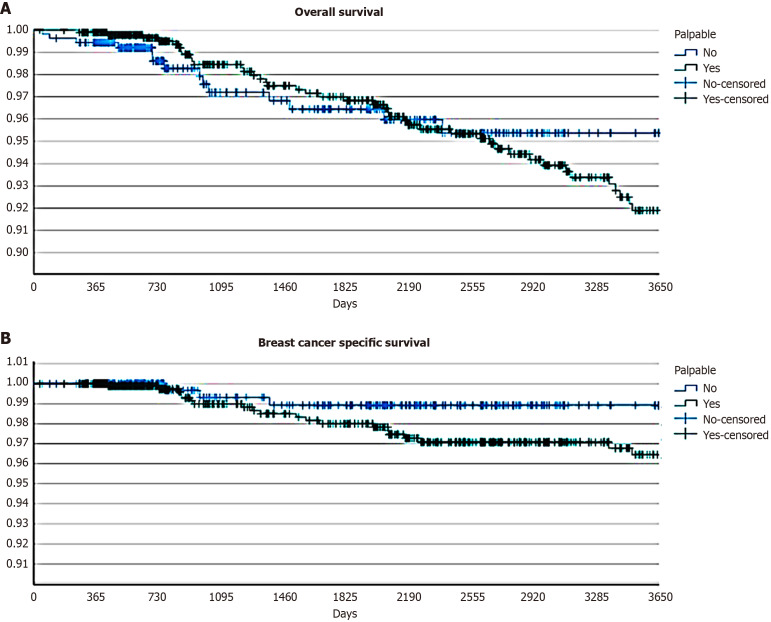
Results: Palpable tumors were significantly larger (17.5 mm ± 8.6 vs 11.0 ± 6.7 mm, P < 0.001), more often high-grade (G3: 33% vs 16.3%, P < 0.001), and more frequently of luminal B or triple-negative subtype (37.1% vs 20.6%, P < 0.001). Ki-67 proliferation index was markedly higher in palpable tumors (24.7% ± 11.9% vs 15.1% ± 9.4%, P < 0.001). Sentinel lymph node positivity was increased (27.6% vs 16.7%, P < 0.001). While 10-year overall survival was similar (92% palpable vs 95% non-palpable, P = 0.56), breast cancer-specific survival showed a trend toward worse survival in palpable cases (96% vs 99%, P = 0.1).
Conclusion: Palpable tumors display faster growth kinetics and aggressive features, potentially shortening the preclinical window. Palpability may indicate biologically aggressive disease, warranting individualized management despite access to routine screening.
背景:尽管广泛的乳房x线摄影筛查,很大一部分乳腺癌仍然被诊断为可触及的病变,通常由患者自我检测。先前的研究已经将可触性作为预后因素进行了调查,但很少有研究结合了当代分期系统,或者关注于临床均质、符合筛查条件的人群。在资源丰富、筛查机会均等的环境中,可触及性是否反映了肿瘤的内在侵袭性,而不是延迟检测,仍不清楚。本研究评估可触性肿瘤是否在符合筛查条件的人群中表现出明显的临床病理特征和较差的结果,假设可触性可能反映了肿瘤的侵袭性生物学,并且即使在筛查程序可及的情况下也可能影响预后。目的:比较筛查人群中可触及与不可触及乳腺癌的临床病理特征和生存结局。方法:回顾性分析2004年至2024年间2110例经手术治疗的临床淋巴结阴性局限性乳腺癌患者。诊断时的可触及性将肿瘤分为可触及(n = 1234)和不可触及(n = 876)。终点包括肿瘤大小、分级、亚型、Ki-67指数、淋巴结状态、总生存期和乳腺癌特异性生存期。统计分析包括χ 2、t检验和Kaplan-Meier估计,显著性设置为P < 0.05。结果:可触及肿瘤明显较大(17.5 mm±8.6 vs 11.0±6.7 mm, P < 0.001),高级别肿瘤多见(G3: 33% vs 16.3%, P < 0.001), B型或三阴性肿瘤多见(37.1% vs 20.6%, P < 0.001)。Ki-67增殖指数在可触及肿瘤中明显升高(24.7%±11.9% vs 15.1%±9.4%,P < 0.001)。前哨淋巴结阳性增加(27.6% vs 16.7%, P < 0.001)。虽然10年总生存率相似(92%可触及vs 95%不可触及,P = 0.56),但乳腺癌特异性生存率在可触及病例中显示出更差的生存率趋势(96% vs 99%, P = 0.1)。结论:可触及肿瘤具有更快的生长动力学和侵袭性特征,可能缩短临床前窗口期。触感可能表明疾病具有生物侵袭性,尽管可以进行常规筛查,但仍需要个性化管理。
期刊介绍:
The WJCO is a high-quality, peer reviewed, open-access journal. The primary task of WJCO is to rapidly publish high-quality original articles, reviews, editorials, and case reports in the field of oncology. In order to promote productive academic communication, the peer review process for the WJCO is transparent; to this end, all published manuscripts are accompanied by the anonymized reviewers’ comments as well as the authors’ responses. The primary aims of the WJCO are to improve diagnostic, therapeutic and preventive modalities and the skills of clinicians and to guide clinical practice in oncology. Scope: Art of Oncology, Biology of Neoplasia, Breast Cancer, Cancer Prevention and Control, Cancer-Related Complications, Diagnosis in Oncology, Gastrointestinal Cancer, Genetic Testing For Cancer, Gynecologic Cancer, Head and Neck Cancer, Hematologic Malignancy, Lung Cancer, Melanoma, Molecular Oncology, Neurooncology, Palliative and Supportive Care, Pediatric Oncology, Surgical Oncology, Translational Oncology, and Urologic Oncology.



 求助内容:
求助内容: 应助结果提醒方式:

 京公网安备 11010802042870号


