T cell exhaustion markers in hepatitis C virus-related hepatocellular carcinoma: Expression patterns and prognostic significance in an Egyptian cohort.
Asmaa M Hasan, Sara M F I Ghanem, Amira A A Othman, Mai Hamdy Rashad, Nahla Nosair, Rasha Elgamal
{"title":"T cell exhaustion markers in hepatitis C virus-related hepatocellular carcinoma: Expression patterns and prognostic significance in an Egyptian cohort.","authors":"Asmaa M Hasan, Sara M F I Ghanem, Amira A A Othman, Mai Hamdy Rashad, Nahla Nosair, Rasha Elgamal","doi":"10.5306/wjco.v17.i2.114622","DOIUrl":null,"url":null,"abstract":"<p><strong>Background: </strong>Hepatocellular carcinoma (HCC) is a leading cause of cancer-related mortality, particularly in Egypt, where hepatitis C virus (HCV) prevalence is high. T cell exhaustion markers such as programmed death 1 (PD-1), T cell immunoglobulin and ITIM domain, and T cell immunoglobulin and mucin domain-containing protein 3 (TIM-3) play a crucial role in HCC immune evasion; however, their expression patterns in Egyptian patients remain underexplored.</p><p><strong>Aim: </strong>To characterize the expression of PD-1, T cell immunoglobulin and ITIM domain, and TIM-3 on CD4+ and CD8+ T cells across HCV-related liver disease stages and to determine their association with disease severity and survival in an Egyptian cohort.</p><p><strong>Methods: </strong>This prospective case-control study included 200 Egyptian participants: 50 with HCV-related HCC, 50 with HCV-related cirrhosis, 50 with chronic HCV infection, and 50 healthy controls (HCV-negative by polymerase chain reaction). Flow cytometry quantified immune exhaustion markers, and clinical data were analyzed using multivariate and survival modeling frameworks, adjusting for key confounders.</p><p><strong>Results: </strong>HCC patients showed significantly higher expression of all T-cell exhaustion markers than other groups (<i>P</i> < 0.001). Alpha-fetoprotein (AFP) levels were markedly elevated in HCC (median 13210 ng/mL, <i>P</i> < 0.001). Marker expression showed strong positive correlations with Child-Pugh class, AFP, and Barcelona Clinic Liver Cancer stage, and a negative correlation with model for end-stage liver disease score (all <i>P</i> < 0.001). Non-survivors (34%) had higher marker expression and AFP levels than survivors (<i>P</i> < 0.001). Receiver operating characteristic analysis demonstrated excellent mortality prediction for CD4/PD-1 [area under the curve (AUC) = 0.92] and AFP (AUC = 0.89), while combining AFP with CD8/TIM-3 achieved the best accuracy (AUC = 0.95). Cox regression identified high CD8/TIM-3 expression and Barcelona Clinic Liver Cancer stage D as independent mortality predictors, and CD4/PD-1 partially mediated AFP's effect on mortality (<i>β</i> = 0.45, <i>P</i> < 0.001).</p><p><strong>Conclusion: </strong>Elevated T cell exhaustion markers were linked to advanced disease and poor survival in Egyptian patients with HCV-related HCC. Machine learning and mediation analyses identified CD4/PD-1 and CD8/TIM-3 as independent prognostic biomarkers, reinforcing their potential as therapeutic targets. These findings provide novel insights from a high-HCV-prevalence setting, supporting the integration of immune exhaustion profiling into risk stratification for HCC.</p>","PeriodicalId":23802,"journal":{"name":"World journal of clinical oncology","volume":"17 2","pages":"114622"},"PeriodicalIF":3.2000,"publicationDate":"2026-02-24","publicationTypes":"Journal Article","fieldsOfStudy":null,"isOpenAccess":false,"openAccessPdf":"https://www.ncbi.nlm.nih.gov/pmc/articles/PMC12968547/pdf/","citationCount":"0","resultStr":null,"platform":"Semanticscholar","paperid":null,"PeriodicalName":"World journal of clinical oncology","FirstCategoryId":"1085","ListUrlMain":"https://doi.org/10.5306/wjco.v17.i2.114622","RegionNum":0,"RegionCategory":null,"ArticlePicture":[],"TitleCN":null,"AbstractTextCN":null,"PMCID":null,"EPubDate":"","PubModel":"","JCR":"Q3","JCRName":"ONCOLOGY","Score":null,"Total":0}
引用次数: 0
Abstract
Background: Hepatocellular carcinoma (HCC) is a leading cause of cancer-related mortality, particularly in Egypt, where hepatitis C virus (HCV) prevalence is high. T cell exhaustion markers such as programmed death 1 (PD-1), T cell immunoglobulin and ITIM domain, and T cell immunoglobulin and mucin domain-containing protein 3 (TIM-3) play a crucial role in HCC immune evasion; however, their expression patterns in Egyptian patients remain underexplored.
Aim: To characterize the expression of PD-1, T cell immunoglobulin and ITIM domain, and TIM-3 on CD4+ and CD8+ T cells across HCV-related liver disease stages and to determine their association with disease severity and survival in an Egyptian cohort.
Methods: This prospective case-control study included 200 Egyptian participants: 50 with HCV-related HCC, 50 with HCV-related cirrhosis, 50 with chronic HCV infection, and 50 healthy controls (HCV-negative by polymerase chain reaction). Flow cytometry quantified immune exhaustion markers, and clinical data were analyzed using multivariate and survival modeling frameworks, adjusting for key confounders.
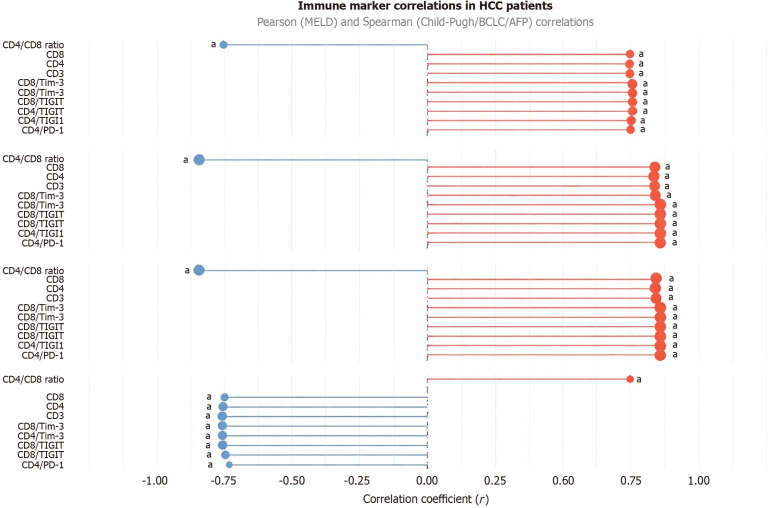
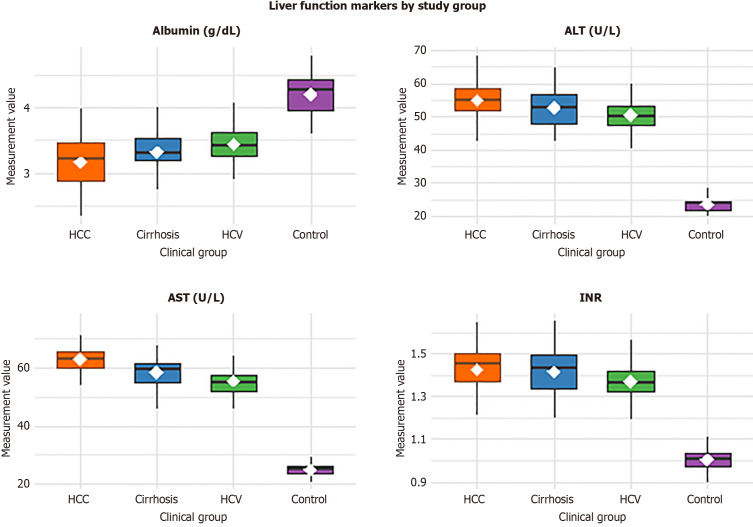
Results: HCC patients showed significantly higher expression of all T-cell exhaustion markers than other groups (P < 0.001). Alpha-fetoprotein (AFP) levels were markedly elevated in HCC (median 13210 ng/mL, P < 0.001). Marker expression showed strong positive correlations with Child-Pugh class, AFP, and Barcelona Clinic Liver Cancer stage, and a negative correlation with model for end-stage liver disease score (all P < 0.001). Non-survivors (34%) had higher marker expression and AFP levels than survivors (P < 0.001). Receiver operating characteristic analysis demonstrated excellent mortality prediction for CD4/PD-1 [area under the curve (AUC) = 0.92] and AFP (AUC = 0.89), while combining AFP with CD8/TIM-3 achieved the best accuracy (AUC = 0.95). Cox regression identified high CD8/TIM-3 expression and Barcelona Clinic Liver Cancer stage D as independent mortality predictors, and CD4/PD-1 partially mediated AFP's effect on mortality (β = 0.45, P < 0.001).
Conclusion: Elevated T cell exhaustion markers were linked to advanced disease and poor survival in Egyptian patients with HCV-related HCC. Machine learning and mediation analyses identified CD4/PD-1 and CD8/TIM-3 as independent prognostic biomarkers, reinforcing their potential as therapeutic targets. These findings provide novel insights from a high-HCV-prevalence setting, supporting the integration of immune exhaustion profiling into risk stratification for HCC.
期刊介绍:
The WJCO is a high-quality, peer reviewed, open-access journal. The primary task of WJCO is to rapidly publish high-quality original articles, reviews, editorials, and case reports in the field of oncology. In order to promote productive academic communication, the peer review process for the WJCO is transparent; to this end, all published manuscripts are accompanied by the anonymized reviewers’ comments as well as the authors’ responses. The primary aims of the WJCO are to improve diagnostic, therapeutic and preventive modalities and the skills of clinicians and to guide clinical practice in oncology. Scope: Art of Oncology, Biology of Neoplasia, Breast Cancer, Cancer Prevention and Control, Cancer-Related Complications, Diagnosis in Oncology, Gastrointestinal Cancer, Genetic Testing For Cancer, Gynecologic Cancer, Head and Neck Cancer, Hematologic Malignancy, Lung Cancer, Melanoma, Molecular Oncology, Neurooncology, Palliative and Supportive Care, Pediatric Oncology, Surgical Oncology, Translational Oncology, and Urologic Oncology.


 求助内容:
求助内容: 应助结果提醒方式:

 京公网安备 11010802042870号


