Marcin Masalski, Jakub Kurasz, Aleksandra Kosiorowska, Aleksander Mateja, Krzysztof Morawski
{"title":"Intranasal Oxymetazoline and Xylometazoline Use in Patients With Deviated Nasal Septum: A Cross-Sectional Telephone Survey.","authors":"Marcin Masalski, Jakub Kurasz, Aleksandra Kosiorowska, Aleksander Mateja, Krzysztof Morawski","doi":"10.1002/oto2.70216","DOIUrl":null,"url":null,"abstract":"<p><strong>Objective: </strong>To assess the pattern of oxymetazoline and xylometazoline (OXM) use in patients with deviated nasal septum (DNS).</p><p><strong>Study design: </strong>A retrospective Computer-Assisted Telephone Interviewing survey.</p><p><strong>Setting: </strong>Patients who underwent septoplasty in University Clinical Hospital in Opole, Poland.</p><p><strong>Methods: </strong>A retrospective Computer-Assisted Telephone Interviewing (CATI) survey was conducted among patients who underwent septoplasty between 2018 and 2024. The questionnaire included inquiries about the frequency of OXM use, awareness of the consequences of long-term OXM application, and alternative treatment options, all prior to septoplasty.</p><p><strong>Results: </strong>The study was conducted on 159 of 305 (52.1%) patients identified in the hospital database. Approximately one-third of respondents (55 of 159, 34.6%) denied using OXM, about one-third had used OXM for no more than 7 days (52 of 159, 32.7%), and the remaining one-third (52 of 159, 32.7%) admitted to OXM overuse. Lack of awareness of the consequences of chronic OXM use was associated with a 6.5-fold increased risk of addiction (OR = 6.5, 95% CI: 1.2-33.6, <i>P</i> = .02). Furthermore, 16 of 52 (30.8%) respondents were unaware of intranasal steroid therapy in the preoperative period.</p><p><strong>Conclusions: </strong>DNS may increase the risk of OXM dependence; however, further controlled studies are needed. Increasing awareness about the risks of OXM overuse substantially reduces this risk.</p>","PeriodicalId":19697,"journal":{"name":"OTO Open","volume":"10 1","pages":"e70216"},"PeriodicalIF":1.6000,"publicationDate":"2026-03-09","publicationTypes":"Journal Article","fieldsOfStudy":null,"isOpenAccess":false,"openAccessPdf":"https://www.ncbi.nlm.nih.gov/pmc/articles/PMC12969495/pdf/","citationCount":"0","resultStr":null,"platform":"Semanticscholar","paperid":null,"PeriodicalName":"OTO Open","FirstCategoryId":"1085","ListUrlMain":"https://doi.org/10.1002/oto2.70216","RegionNum":0,"RegionCategory":null,"ArticlePicture":[],"TitleCN":null,"AbstractTextCN":null,"PMCID":null,"EPubDate":"2026/1/1 0:00:00","PubModel":"eCollection","JCR":"Q2","JCRName":"OTORHINOLARYNGOLOGY","Score":null,"Total":0}
引用次数: 0
Abstract
Objective: To assess the pattern of oxymetazoline and xylometazoline (OXM) use in patients with deviated nasal septum (DNS).
Study design: A retrospective Computer-Assisted Telephone Interviewing survey.
Setting: Patients who underwent septoplasty in University Clinical Hospital in Opole, Poland.
Methods: A retrospective Computer-Assisted Telephone Interviewing (CATI) survey was conducted among patients who underwent septoplasty between 2018 and 2024. The questionnaire included inquiries about the frequency of OXM use, awareness of the consequences of long-term OXM application, and alternative treatment options, all prior to septoplasty.
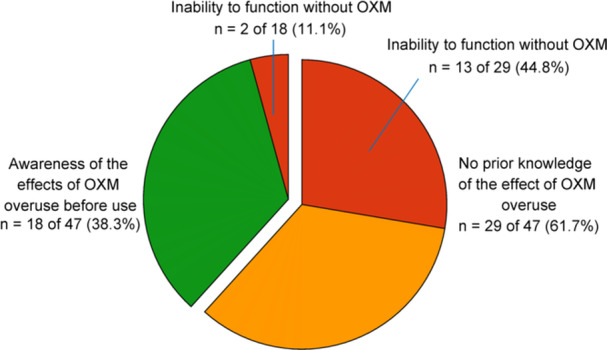
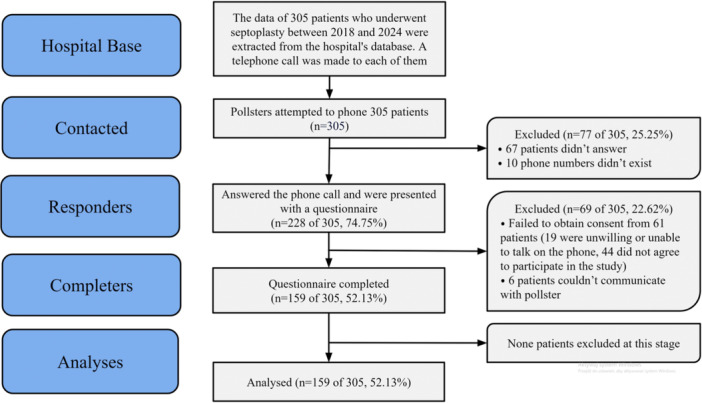
Results: The study was conducted on 159 of 305 (52.1%) patients identified in the hospital database. Approximately one-third of respondents (55 of 159, 34.6%) denied using OXM, about one-third had used OXM for no more than 7 days (52 of 159, 32.7%), and the remaining one-third (52 of 159, 32.7%) admitted to OXM overuse. Lack of awareness of the consequences of chronic OXM use was associated with a 6.5-fold increased risk of addiction (OR = 6.5, 95% CI: 1.2-33.6, P = .02). Furthermore, 16 of 52 (30.8%) respondents were unaware of intranasal steroid therapy in the preoperative period.
Conclusions: DNS may increase the risk of OXM dependence; however, further controlled studies are needed. Increasing awareness about the risks of OXM overuse substantially reduces this risk.



 求助内容:
求助内容: 应助结果提醒方式:

 京公网安备 11010802042870号


