Detection of non-tuberculous mycobacteria and other bacterial pathogens in dental unit waterlines, 2024, Germany: a microbiological single-centre study.
IF 1.6 Q3 PUBLIC, ENVIRONMENTAL & OCCUPATIONAL HEALTH
Lea-Elisa Heinz, Matthias Hannig, Stefan Rupf, Madline P Gund, Barbara C Gärtner, Sören L Becker, Uwe Schlotthauer
{"title":"Detection of non-tuberculous mycobacteria and other bacterial pathogens in dental unit waterlines, 2024, Germany: a microbiological single-centre study.","authors":"Lea-Elisa Heinz, Matthias Hannig, Stefan Rupf, Madline P Gund, Barbara C Gärtner, Sören L Becker, Uwe Schlotthauer","doi":"10.3205/dgkh000623","DOIUrl":null,"url":null,"abstract":"<p><strong>Background: </strong>Dental unit waterlines (DUWL) might pose infection risks due to the presence of biofilms. A global outbreak of <i>Mycobacterium (M.) chimaera</i> through water-carrying medical devices in cardiac surgery highlighted the importance of water for pathogen transmission. We aimed to assess the presence of non-tuberculous mycobacteria (NTM), <i>Legionella</i> spp., and <i>Pseudomonas (P.)</i> spp. in DUWLs in one tertiary medical centre in Germany to evaluate their potential role as causative agents of infections linked to dental procedures.</p><p><strong>Methods: </strong>We conducted a cross-sectional, microbiological single-centre study at Saarland University Medical Centre in Homburg, Germany from May to July 2024. We examined 42 DUWLs once before the daily patient care started. After DUWL flushing, 500 mL water samples were collected. <i>Legionella</i> spp. were detected after up to 10 days of incubation, <i>Pseudomonas (P.)</i> spp. via membrane filtration and 48-hour incubation, and NTM using liquid and solid cultures with up to eight weeks of incubation. Clinically relevant NTM species such as <i>M. chimaera</i> and <i>M. chelonae</i> were identified using a GenoType line probe assay. We calculated frequencies and proportions of positive samples.</p><p><strong>Results: </strong>Bacterial growth was detected in 36 of 42 water samples. A total of 43 NTM species were detected in 35 (83%) water samples. The most common species was <i>M. chimaera</i> (n=27), followed by <i>M. chelonae</i> (n=7), <i>M. gordonae</i> (n=4), <i>M. interjectum</i> (n=4), and <i>M. mucogenicum</i> (n=1). Multiple NTM species were detected in five samples, including one with four distinct species. One specimen contained only <i>Legionella</i> spp., while two of the samples harbored two pathogens each: <i>P. aeruginosa</i> with <i>M. chimaera</i>, and <i>Legionella</i> spp. with <i>M. chelonae</i>.</p><p><strong>Conclusion: </strong>The large proportion of NTM detection highlights the importance of frequent bacterial monitoring in DUWLs for enhanced water quality control, which is not commonly implemented. Further research is needed to address the clinical relevance of NTM in DUWL and to evaluate measures to improve patient safety, such as the use of various disinfectant methods to sustainably reduce NTM concentrations.</p>","PeriodicalId":12738,"journal":{"name":"GMS Hygiene and Infection Control","volume":"21 ","pages":"Doc14"},"PeriodicalIF":1.6000,"publicationDate":"2026-02-09","publicationTypes":"Journal Article","fieldsOfStudy":null,"isOpenAccess":false,"openAccessPdf":"https://www.ncbi.nlm.nih.gov/pmc/articles/PMC12973376/pdf/","citationCount":"0","resultStr":null,"platform":"Semanticscholar","paperid":null,"PeriodicalName":"GMS Hygiene and Infection Control","FirstCategoryId":"1085","ListUrlMain":"https://doi.org/10.3205/dgkh000623","RegionNum":0,"RegionCategory":null,"ArticlePicture":[],"TitleCN":null,"AbstractTextCN":null,"PMCID":null,"EPubDate":"2026/1/1 0:00:00","PubModel":"eCollection","JCR":"Q3","JCRName":"PUBLIC, ENVIRONMENTAL & OCCUPATIONAL HEALTH","Score":null,"Total":0}
引用次数: 0
Abstract
Background: Dental unit waterlines (DUWL) might pose infection risks due to the presence of biofilms. A global outbreak of Mycobacterium (M.) chimaera through water-carrying medical devices in cardiac surgery highlighted the importance of water for pathogen transmission. We aimed to assess the presence of non-tuberculous mycobacteria (NTM), Legionella spp., and Pseudomonas (P.) spp. in DUWLs in one tertiary medical centre in Germany to evaluate their potential role as causative agents of infections linked to dental procedures.
Methods: We conducted a cross-sectional, microbiological single-centre study at Saarland University Medical Centre in Homburg, Germany from May to July 2024. We examined 42 DUWLs once before the daily patient care started. After DUWL flushing, 500 mL water samples were collected. Legionella spp. were detected after up to 10 days of incubation, Pseudomonas (P.) spp. via membrane filtration and 48-hour incubation, and NTM using liquid and solid cultures with up to eight weeks of incubation. Clinically relevant NTM species such as M. chimaera and M. chelonae were identified using a GenoType line probe assay. We calculated frequencies and proportions of positive samples.
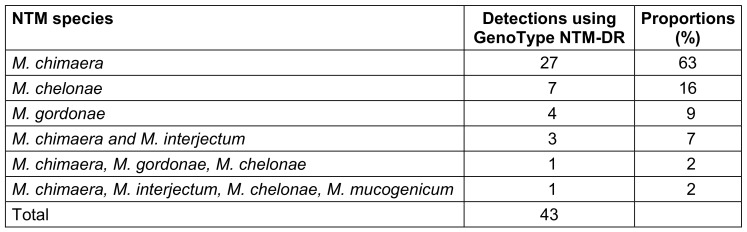
Results: Bacterial growth was detected in 36 of 42 water samples. A total of 43 NTM species were detected in 35 (83%) water samples. The most common species was M. chimaera (n=27), followed by M. chelonae (n=7), M. gordonae (n=4), M. interjectum (n=4), and M. mucogenicum (n=1). Multiple NTM species were detected in five samples, including one with four distinct species. One specimen contained only Legionella spp., while two of the samples harbored two pathogens each: P. aeruginosa with M. chimaera, and Legionella spp. with M. chelonae.
Conclusion: The large proportion of NTM detection highlights the importance of frequent bacterial monitoring in DUWLs for enhanced water quality control, which is not commonly implemented. Further research is needed to address the clinical relevance of NTM in DUWL and to evaluate measures to improve patient safety, such as the use of various disinfectant methods to sustainably reduce NTM concentrations.



 求助内容:
求助内容: 应助结果提醒方式:

 京公网安备 11010802042870号


