Ecological Momentary Assessment of Person-Reported Outcomes in Diabetes: Unlocking Insights with Continuous Glucose Monitoring and the Potential for Precision Medicine.
Dominic Ehrmann, Norbert Hermanns, Andreas Schmitt, Laura Y Klinker, Bernhard Kulzer
{"title":"Ecological Momentary Assessment of Person-Reported Outcomes in Diabetes: Unlocking Insights with Continuous Glucose Monitoring and the Potential for Precision Medicine.","authors":"Dominic Ehrmann, Norbert Hermanns, Andreas Schmitt, Laura Y Klinker, Bernhard Kulzer","doi":"10.1007/s11892-026-01618-5","DOIUrl":null,"url":null,"abstract":"<p><p>PURPOSE OF REVIEW: Diabetes self-management is accompanied by time-varying emotional and motivational challenges that impact mental health. These day-to-day fluctuations can be assessed via ecological momentary assessment (EMA), that allows the repeated sampling of psychosocial variables in everyday life. The benefits of EMA over questionnaires mirror the benefits of continuous glucose monitoring (CGM) over HbA1c. We describe the insights generated by combining EMA and CGM and highlight its potential. RECENT FINDINGS: Research shows that glucose levels can influence subsequent mood, stress, cognitive functioning, and symptom reporting, with nocturnal hypoglycemia and overnight glucose being particularly relevant. Studies demonstrated the importance of differentiating between subjective person-interpreted and objectively sensor-assessed glucose levels. N-of-1 analyses revealed relevant intraindividual differences in the association between glycemic and psychosocial parameters. Combining EMA and CGM can enhance our understanding of the dynamic relationship between glycemic and psychosocial variables, supporting precision medicine approaches for mental health in diabetes. </p>","PeriodicalId":10898,"journal":{"name":"Current Diabetes Reports","volume":"26 1","pages":""},"PeriodicalIF":7.2000,"publicationDate":"2026-03-10","publicationTypes":"Journal Article","fieldsOfStudy":null,"isOpenAccess":false,"openAccessPdf":"https://www.ncbi.nlm.nih.gov/pmc/articles/PMC12975859/pdf/","citationCount":"0","resultStr":null,"platform":"Semanticscholar","paperid":null,"PeriodicalName":"Current Diabetes Reports","FirstCategoryId":"3","ListUrlMain":"https://doi.org/10.1007/s11892-026-01618-5","RegionNum":2,"RegionCategory":"医学","ArticlePicture":[],"TitleCN":null,"AbstractTextCN":null,"PMCID":null,"EPubDate":"","PubModel":"","JCR":"Q1","JCRName":"ENDOCRINOLOGY & METABOLISM","Score":null,"Total":0}
引用次数: 0
Abstract
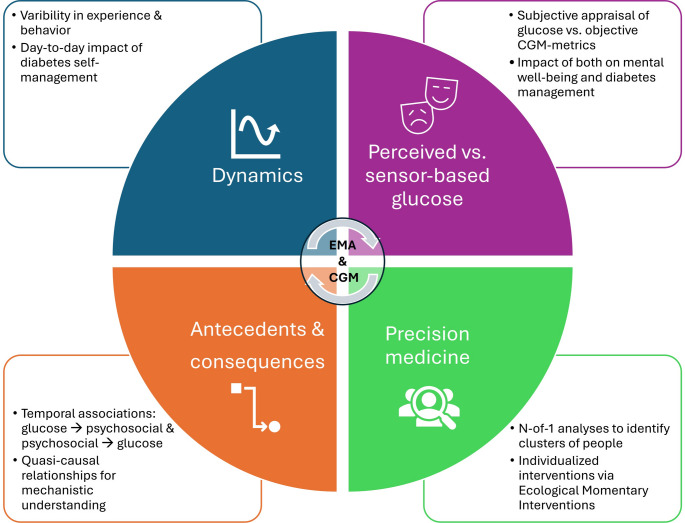
PURPOSE OF REVIEW: Diabetes self-management is accompanied by time-varying emotional and motivational challenges that impact mental health. These day-to-day fluctuations can be assessed via ecological momentary assessment (EMA), that allows the repeated sampling of psychosocial variables in everyday life. The benefits of EMA over questionnaires mirror the benefits of continuous glucose monitoring (CGM) over HbA1c. We describe the insights generated by combining EMA and CGM and highlight its potential. RECENT FINDINGS: Research shows that glucose levels can influence subsequent mood, stress, cognitive functioning, and symptom reporting, with nocturnal hypoglycemia and overnight glucose being particularly relevant. Studies demonstrated the importance of differentiating between subjective person-interpreted and objectively sensor-assessed glucose levels. N-of-1 analyses revealed relevant intraindividual differences in the association between glycemic and psychosocial parameters. Combining EMA and CGM can enhance our understanding of the dynamic relationship between glycemic and psychosocial variables, supporting precision medicine approaches for mental health in diabetes.
期刊介绍:
The goal of this journal is to publish cutting-edge reviews on subjects pertinent to all aspects of diabetes epidemiology, pathophysiology, and management. We aim to provide incisive, insightful, and balanced contributions from leading experts in each relevant domain that will be of immediate interest to a wide readership of clinicians, basic scientists, and translational investigators.
We accomplish this aim by appointing major authorities to serve as Section Editors in key subject areas across the discipline. Section Editors select topics to be reviewed by leading experts who emphasize recent developments and highlight important papers published over the past year on their topics, in a crisp and readable format. We also provide commentaries from well-known figures in the field, and an Editorial Board of internationally diverse members suggests topics of special interest to their country/region and ensures that topics are current and include emerging research.

 求助内容:
 应助结果提醒方式:


 京公网安备 11010802042870号


