Mosa Altassan, Ruwaida Z Alshali, Osamah Abdulelah Alsulimani, Shooq Alharbi, Bashayer Murdi Alzaharni, Abdullah Fouad Abukhudhayr, Abdulmajeed Ghazi Alghanemi
{"title":"Comparative Evaluation of Fracture Resistance and Failure Patterns Among All-Resin Post and Core Designs: In vitro Study.","authors":"Mosa Altassan, Ruwaida Z Alshali, Osamah Abdulelah Alsulimani, Shooq Alharbi, Bashayer Murdi Alzaharni, Abdullah Fouad Abukhudhayr, Abdulmajeed Ghazi Alghanemi","doi":"10.2147/CCIDE.S560921","DOIUrl":null,"url":null,"abstract":"<p><strong>Purpose: </strong>This in vitro study evaluated the fracture resistance of dual-cure resin cement and core build-up material (Core-X<sup>®</sup> Flow) used as all-resin posts of two different lengths, compared with conventional fiber-reinforced posts, and to analyze failure patterns.</p><p><strong>Material and methods: </strong>Thirty extracted human single-rooted mature teeth (premolars, canines, and maxillary central incisors) were endodontically treated and randomly assigned to three groups (n=10). Group A received a 10 mm fiber post with Core-X Flow, Group B received a 10 mm all-resin post with Core-X flow, and Group C received a 5 mm all-resin post with Core-X flow. Fracture resistance was evaluated under compressive loading using a universal testing machine, at a crosshead speed of 1 mm/min, and the failure patterns were assessed using a digital stereomicroscope. Data were analyzed using a one-way ANOVA (p>0.05).</p><p><strong>Results: </strong>Fracture resistance did not differ significantly among the three groups (p>0.05). Mean values were 430.28 N for Group A, 422.16 N for Group B, and 434.56 N for Group C. Failure mode analysis showed that Group C (5 mm all-resin posts) exhibited the highest number of favorable (repairable) fractures, followed by Group A (fiber posts) and Group B (10 mm all-resin posts).</p><p><strong>Conclusion: </strong>All-resin posts demonstrated fracture resistance comparable to fiber-reinforced posts. Shorter all-resin posts produced more favorable failure outcomes, suggesting that they may offer a conservative and clinically viable option for restoring endodontically treated teeth. These findings should be interpreted within the limitations of an in vitro design and small sample size.</p>","PeriodicalId":10445,"journal":{"name":"Clinical, Cosmetic and Investigational Dentistry","volume":"18 ","pages":"560921"},"PeriodicalIF":1.8000,"publicationDate":"2026-03-05","publicationTypes":"Journal Article","fieldsOfStudy":null,"isOpenAccess":false,"openAccessPdf":"https://www.ncbi.nlm.nih.gov/pmc/articles/PMC12970035/pdf/","citationCount":"0","resultStr":null,"platform":"Semanticscholar","paperid":null,"PeriodicalName":"Clinical, Cosmetic and Investigational Dentistry","FirstCategoryId":"1085","ListUrlMain":"https://doi.org/10.2147/CCIDE.S560921","RegionNum":0,"RegionCategory":null,"ArticlePicture":[],"TitleCN":null,"AbstractTextCN":null,"PMCID":null,"EPubDate":"2026/1/1 0:00:00","PubModel":"eCollection","JCR":"Q3","JCRName":"DENTISTRY, ORAL SURGERY & MEDICINE","Score":null,"Total":0}
引用次数: 0
Abstract
Purpose: This in vitro study evaluated the fracture resistance of dual-cure resin cement and core build-up material (Core-X® Flow) used as all-resin posts of two different lengths, compared with conventional fiber-reinforced posts, and to analyze failure patterns.
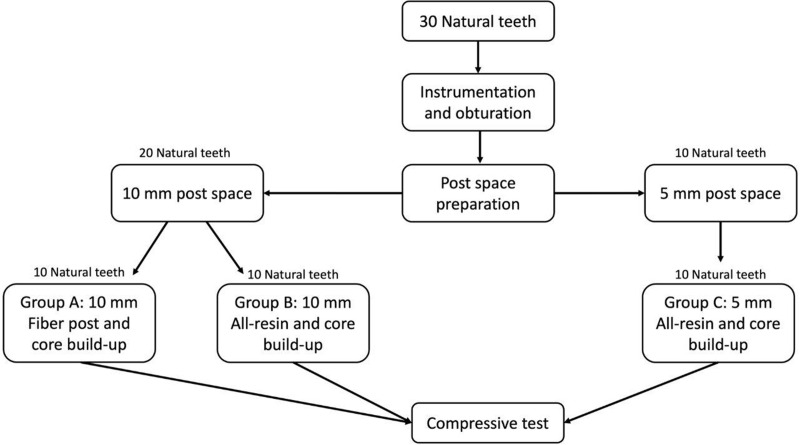
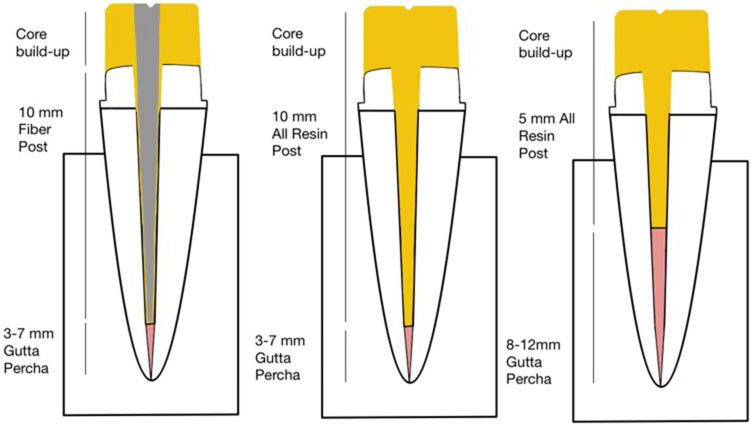
Material and methods: Thirty extracted human single-rooted mature teeth (premolars, canines, and maxillary central incisors) were endodontically treated and randomly assigned to three groups (n=10). Group A received a 10 mm fiber post with Core-X Flow, Group B received a 10 mm all-resin post with Core-X flow, and Group C received a 5 mm all-resin post with Core-X flow. Fracture resistance was evaluated under compressive loading using a universal testing machine, at a crosshead speed of 1 mm/min, and the failure patterns were assessed using a digital stereomicroscope. Data were analyzed using a one-way ANOVA (p>0.05).
Results: Fracture resistance did not differ significantly among the three groups (p>0.05). Mean values were 430.28 N for Group A, 422.16 N for Group B, and 434.56 N for Group C. Failure mode analysis showed that Group C (5 mm all-resin posts) exhibited the highest number of favorable (repairable) fractures, followed by Group A (fiber posts) and Group B (10 mm all-resin posts).
Conclusion: All-resin posts demonstrated fracture resistance comparable to fiber-reinforced posts. Shorter all-resin posts produced more favorable failure outcomes, suggesting that they may offer a conservative and clinically viable option for restoring endodontically treated teeth. These findings should be interpreted within the limitations of an in vitro design and small sample size.



 求助内容:
求助内容: 应助结果提醒方式:

 京公网安备 11010802042870号


