
Young adulthood adiposity in relation to all-cause and cause-specific mortality: a prospective study of 0.5 million Chinese adults
IF 21.1
1区 综合性期刊
Q1 MULTIDISCIPLINARY SCIENCES
引用次数: 0
Abstract
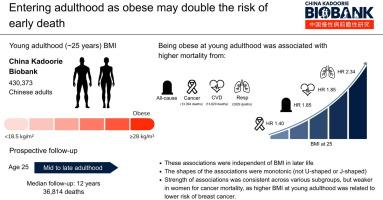
Obesity is a well-established risk factor for early death, but the exact shapes of associations between young adulthood body mass index (BMI) and mortality in later life were not well characterised. Using data from the prospective China Kadoorie Biobank study of 430,373 participants (∼57% being women, with a median follow-up duration of 12 years), Cox regression analysis was performed to yield adjusted hazard ratios (HRs) relating BMI at ∼25 years old (BMI25) with different mortality outcomes including total mortality (n = 36,814), cardiovascular mortality (n = 13,620), cancer mortality (n = 13,394) and respiratory mortality (n = 2929). Mean BMI25 of participants was 21.9 (SD = 2.5) kg/m2, and 1.9% participants were obese at young adulthood (i.e., BMI25 ≥28.0 kg/m2). Independent of baseline BMI, higher BMI25 was associated with much higher levels of blood glucose and diabetes prevalence at baseline. After adjusting for potential confounders e.g., age, smoking, and baseline measured BMI, BMI25 had a strong positive log-linear association with all above-mentioned mortality outcomes, those being obese at young adulthood had a HR of 1.85 (95% CI: 1.75–1.95), 1.85 (1.71–2.00), 1.40 (1.26–1.56) and 2.34 (1.96–2.81), respectively, compared with participants having BMI25 of 18.5–20.0 kg/m2. The association with cancer mortality was more pronounced in men than in women, but no such heterogeneity was observed for total, cardiovascular diseases (CVD), and respiratory mortality. To conclude, the observed strong monotonically positive associations between young adulthood BMI and various mortality outcomes, independent of BMI in later life, support the need for early and stringent body weight control to prevent early death.
青年肥胖与全因和特定原因死亡率的关系:一项50万中国成年人的前瞻性研究。
肥胖是早逝的一个公认的危险因素,但青年期体重指数(BMI)与晚年死亡率之间的确切关系尚未得到很好的表征。使用来自中国嘉道里生物银行前瞻性研究的数据,纳入430,373名参与者(~ 57%为女性,中位随访时间为12年),进行Cox回归分析,得出与25岁时BMI (BMI25)相关的校正风险比(hr),不同的死亡结局包括总死亡率(n = 36,814)、心血管死亡率(n = 13,620)、癌症死亡率(n = 13,394)和呼吸系统死亡率(n = 2929)。参与者的平均BMI25为21.9 (SD = 2.5) kg/m2, 1.9%的参与者在青年期肥胖(即BMI25≥28.0 kg/m2)。与基线BMI无关,较高的BMI25与基线时较高的血糖水平和糖尿病患病率相关。在调整了潜在的混杂因素,如年龄、吸烟和基线测量的BMI后,BMI25与上述所有死亡率结果有很强的正对数线性关联,与BMI25为18.5-20.0 kg/m2的参与者相比,年轻时肥胖的人的风险比分别为1.85 (95% CI: 1.75-1.95)、1.85(1.71-2.00)、1.40(1.26-1.56)和2.34(1.96-2.81)。与癌症死亡率的相关性在男性中比在女性中更明显,但在总体、心血管疾病(CVD)和呼吸系统疾病死亡率中没有观察到这种异质性。综上所述,观察到的青年期BMI与各种死亡率结果之间的强单调正相关,独立于晚年的BMI,支持早期和严格控制体重以预防早期死亡的必要性。
本文章由计算机程序翻译,如有差异,请以英文原文为准。
求助全文
约1分钟内获得全文
求助全文
来源期刊
Science Bulletin
MULTIDISCIPLINARY SCIENCES-
CiteScore
24.60
自引率
2.10%
发文量
8092
期刊介绍:
Science Bulletin (Sci. Bull., formerly known as Chinese Science Bulletin) is a multidisciplinary academic journal supervised by the Chinese Academy of Sciences (CAS) and co-sponsored by the CAS and the National Natural Science Foundation of China (NSFC). Sci. Bull. is a semi-monthly international journal publishing high-caliber peer-reviewed research on a broad range of natural sciences and high-tech fields on the basis of its originality, scientific significance and whether it is of general interest. In addition, we are committed to serving the scientific community with immediate, authoritative news and valuable insights into upcoming trends around the globe.
 求助内容:
求助内容: 应助结果提醒方式:

 京公网安备 11010802042870号


