
Phenolic contaminants generate persistent phenoxyl radicals to accelerate antibiotic degradation
IF 14.3
1区 环境科学与生态学
Q1 ENVIRONMENTAL SCIENCES
Environmental Science and Ecotechnology
Pub Date : 2026-03-01
Epub Date: 2026-02-27
DOI:10.1016/j.ese.2026.100680
引用次数: 0
Abstract
Water pollution by coexisting multiple contaminants presents escalating challenges to environmental remediation and public health protection. In advanced oxidation processes, contaminant interactions are invariably regarded as detrimental, introducing competitive reactions and matrix interferences that diminish treatment efficiency. However, phenolic compounds—a prevalent class of recalcitrant water pollutants—possess latent oxidative capabilities that remain strategically unexploited. Whether their reactivity can be harnessed to accelerate, rather than impede, the removal of priority contaminants remains fundamentally unclear. Here we show that in the permanganate/chlorite (Mn(VII)/ClO2−) system, phenolic compounds undergo a counterintuitive transformation into persistent phenoxyl radicals that enhance sulfamethoxazole degradation by 3.5- to 20-fold. Mechanistic investigations reveal that these radicals exhibit exceptional stability and selectivity, preferentially attacking target pollutants while demonstrating robust resistance to common matrix interferences—properties unattainable with conventional oxidants alone. Quantitative structure-activity relationships provide predictive frameworks for optimizing this contaminant-assisted oxidation strategy across diverse chemical scenarios. This contaminant-mediated oxidation strategy inverts the traditional paradigm of mutual interference, transforming recalcitrant phenolics from obstacles into powerful mediators. The findings open new avenues for self-adaptive remediation of multi-pollutant systems and suggest broader applications in environmental cleanup where contaminant interactions can be strategically exploited.
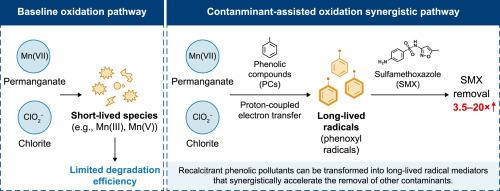
酚类污染物产生持久的苯氧基,加速抗生素的降解
多种污染物并存的水污染对环境修复和公众健康保护提出了越来越大的挑战。在高级氧化过程中,污染物相互作用总是被认为是有害的,引入竞争反应和基质干扰,降低处理效率。然而,酚类化合物——一种普遍存在的顽固性水污染物——具有潜在的氧化能力,在战略上尚未被开发。它们的反应性是否能被利用来加速而不是阻碍优先污染物的去除,从根本上来说仍然不清楚。研究表明,在高锰酸盐/亚氯酸盐(Mn(VII)/ClO2−)体系中,酚类化合物会发生反直觉的转化,转化为持久的苯氧基自由基,从而使磺胺甲恶唑的降解能力提高3.5至20倍。机理研究表明,这些自由基表现出特殊的稳定性和选择性,优先攻击目标污染物,同时表现出对普通基质干扰的强大抵抗力,这是传统氧化剂单独无法实现的特性。定量的构效关系为在不同的化学场景中优化这种污染物辅助氧化策略提供了预测框架。这种污染物介导的氧化策略颠覆了传统的相互干扰模式,将顽固的酚类物质从障碍转化为强大的介质。研究结果为多污染物系统的自适应修复开辟了新的途径,并建议在环境清理中更广泛地应用污染物相互作用可以战略性地利用。
本文章由计算机程序翻译,如有差异,请以英文原文为准。
求助全文
约1分钟内获得全文
求助全文
来源期刊
Environmental Science and Ecotechnology
Multiple-
CiteScore
20.40
自引率
6.30%
发文量
11
审稿时长
18 days
期刊介绍:
Environmental Science & Ecotechnology (ESE) is an international, open-access journal publishing original research in environmental science, engineering, ecotechnology, and related fields. Authors publishing in ESE can immediately, permanently, and freely share their work. They have license options and retain copyright. Published by Elsevier, ESE is co-organized by the Chinese Society for Environmental Sciences, Harbin Institute of Technology, and the Chinese Research Academy of Environmental Sciences, under the supervision of the China Association for Science and Technology.
 求助内容:
求助内容: 应助结果提醒方式:

 京公网安备 11010802042870号


