
Rhizosphere accelerates breakdown of large biodegradable microplastics in soil
IF 14.3
1区 环境科学与生态学
Q1 ENVIRONMENTAL SCIENCES
Environmental Science and Ecotechnology
Pub Date : 2026-03-01
Epub Date: 2026-02-23
DOI:10.1016/j.ese.2026.100678
引用次数: 0
Abstract
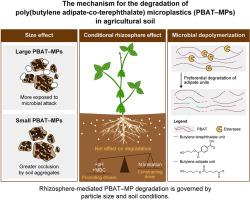
The expanding deployment of biodegradable mulch films in global agriculture aims to mitigate persistent plastic pollution, yet the fate of resulting biodegradable microplastics (BMPs) in soil ecosystems remains poorly characterized. Although these materials are engineered for mineralization, their breakdown rates under realistic field conditions vary substantially, and plant roots fundamentally alter soil biogeochemistry through rhizodeposition and microbial recruitment. Whether the biochemically complex rhizosphere environment accelerates or retards BMP degradation, and how degradation byproducts accumulate, represents a critical knowledge gap for assessing the environmental safety of biodegradable agricultural plastics. Here we show that the soybean rhizosphere exhibits size-selective effects on poly(butylene adipate-co-terephthalate) microplastic (PBAT–MP) degradation. Large particles (998.7 ± 74.6 μm) degrade significantly faster than in bulk soil, whereas small particles (145.6 ± 3.1 μm) remain largely protected within soil aggregates over a 70-day growth cycle. Advanced quantitative proton nuclear magnetic resonance analysis reveals preferential hydrolysis of aliphatic adipate units, resulting in greater accumulation of degradation monomers in the rhizosphere than in bulk soil. Microbial community profiling identifies enrichment of Proteobacteria—particularly Bradyrhizobium and Ramlibacter genera—linked to PBAT hydrolysis and metabolite utilization, alongside increased microbial biomass and altered soil carbon pools. These findings challenge the prevailing assumption that biodegradable mulches degrade uniformly and benignly under agricultural conditions. Rhizosphere-relevant assessment criteria are essential for evaluating the true environmental safety of biodegradable plastics in agricultural systems, with broader implications for sustainable soil management and plastic pollution mitigation strategies worldwide.
根际加速土壤中大型可生物降解微塑料的分解
生物可降解地膜在全球农业中的广泛应用旨在减轻持续的塑料污染,但由此产生的生物可降解微塑料(BMPs)在土壤生态系统中的命运仍然缺乏特征。虽然这些材料是为矿化而设计的,但它们在实际野外条件下的分解率差异很大,植物根系通过根沉积和微生物补充从根本上改变了土壤的生物地球化学。生物化学复杂的根际环境是否加速或阻碍BMP的降解,以及降解副产物如何积累,是评估可生物降解农用塑料环境安全性的关键知识缺口。本研究表明,大豆根际对聚己二酸丁烯-对苯二甲酸酯(PBAT-MP)微塑料(PBAT-MP)降解表现出尺寸选择效应。大颗粒(998.7±74.6 μm)的降解速度明显快于普通土壤,而小颗粒(145.6±3.1 μm)在70天的生长周期内基本上被保护在土壤团聚体中。先进的定量质子核磁共振分析揭示了脂肪族己二酸单位的优先水解,导致根际中降解单体的积累比散装土壤中更多。微生物群落分析发现,变形菌的富集——尤其是慢生根瘤菌和拉姆利杆菌属——与PBAT水解和代谢物利用有关,同时微生物生物量增加,土壤碳库改变。这些发现挑战了生物可降解地膜在农业条件下均匀和良性降解的普遍假设。与根际相关的评估标准对于评价农业系统中可生物降解塑料的真正环境安全性至关重要,对全球可持续土壤管理和塑料污染缓解战略具有更广泛的影响。
本文章由计算机程序翻译,如有差异,请以英文原文为准。
求助全文
约1分钟内获得全文
求助全文
来源期刊
Environmental Science and Ecotechnology
Multiple-
CiteScore
20.40
自引率
6.30%
发文量
11
审稿时长
18 days
期刊介绍:
Environmental Science & Ecotechnology (ESE) is an international, open-access journal publishing original research in environmental science, engineering, ecotechnology, and related fields. Authors publishing in ESE can immediately, permanently, and freely share their work. They have license options and retain copyright. Published by Elsevier, ESE is co-organized by the Chinese Society for Environmental Sciences, Harbin Institute of Technology, and the Chinese Research Academy of Environmental Sciences, under the supervision of the China Association for Science and Technology.
 求助内容:
求助内容: 应助结果提醒方式:

 京公网安备 11010802042870号


