
A QSAR-machine learning hybrid model for predicting the ecotoxicity of soil organic compounds and deriving thresholds
IF 10
1区 环境科学与生态学
Q1 ENGINEERING, ENVIRONMENTAL
Journal of Cleaner Production
Pub Date : 2026-03-10
Epub Date: 2026-02-26
DOI:10.1016/j.jclepro.2026.147869
引用次数: 0
Abstract
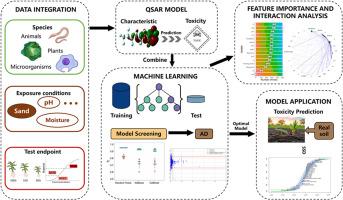
Soil organic pollution threatens the integrity of ecosystems. Traditional ecotoxicity assessments face data scarcity and are also limited by linear models. This study developed a machine learning-quantitative structure-activity relationship (ML-QSAR) model, which integrated 2108 toxicity data points (77 species, 305 compounds) and incorporated molecular descriptors derived from density functional theory (DFT). The ecological thresholds were derived via species sensitivity distribution (SSD). The results indicated that the Random Forest (RF) algorithm outperformed XGBoost and CatBoost, with a training/test R2 of 0.968/0.824. The external validation showed that 95.9% of the predictions error were within 1.5-fold error. Global feature analysis identified entropy, dipole moment (μ), and soil moisture as core driving features. Entropy regulated toxicity via a threshold effect of 744.5 J/(mol·K), and it increased toxicity by 2.3 times in low entropy ranges. There is a significant interaction between dipole moment (μ) and soil moisture. The toxicity increased by 2.3 times under combined conditions of μ > 4.4 Debye and soil moisture >31.7%. Toxicity is modulated by the interaction of soil silt content and 22 parameters. The goodness-of-fit value of the SSD curve constructed from model predictions exceeded 0.91. The derived ecological safety threshold (PNEC) for dinitrotoluene was 5.498 mg/kg, which is far lower than that for anthracene oil, hexabromocyclododecane, and perfluorooctanoic acid, and is therefore considered the highest risk pollutant. This framework overcomes linear limitations of traditional QSAR models, and provides a high-throughput tool for soil contaminant risk screening.
qsar -机器学习混合模型预测土壤有机化合物的生态毒性并推导阈值
土壤有机污染威胁着生态系统的完整性。传统的生态毒性评估面临数据匮乏和线性模型的限制。本研究建立了一个机器学习-定量构效关系(ML-QSAR)模型,该模型集成了2108个毒性数据点(77种,305种化合物),并结合了来自密度泛函理论(DFT)的分子描述符。通过物种敏感性分布(SSD)得到生态阈值。结果表明Random Forest (RF)算法优于XGBoost和CatBoost,训练/检验R2为0.968/0.824。外部验证结果表明,95.9%的预测误差在1.5倍误差以内。全局特征分析将熵、偶极矩和土壤湿度作为核心驱动特征。熵通过744.5 J/(mol·K)的阈值效应调控毒力,在低熵范围内毒力增加2.3倍。偶极矩(μ)与土壤湿度之间存在显著的相互作用。在μ >; 4.4德拜和土壤湿度>;31.7%的组合条件下,毒力增加了2.3倍。毒性受土壤粉砂含量和22个参数的相互作用调节。由模型预测构建的SSD曲线的拟合优度值超过0.91。二硝基甲苯的衍生生态安全阈值(PNEC)为5.498 mg/kg,远低于蒽油、六溴环十二烷和全氟辛酸的衍生生态安全阈值,被认为是风险最高的污染物。该框架克服了传统QSAR模型的线性限制,为土壤污染物风险筛选提供了一个高通量的工具。
本文章由计算机程序翻译,如有差异,请以英文原文为准。
求助全文
约1分钟内获得全文
求助全文
来源期刊
Journal of Cleaner Production
环境科学-工程:环境
CiteScore
20.40
自引率
9.00%
发文量
4720
审稿时长
111 days
期刊介绍:
The Journal of Cleaner Production is an international, transdisciplinary journal that addresses and discusses theoretical and practical Cleaner Production, Environmental, and Sustainability issues. It aims to help societies become more sustainable by focusing on the concept of 'Cleaner Production', which aims at preventing waste production and increasing efficiencies in energy, water, resources, and human capital use. The journal serves as a platform for corporations, governments, education institutions, regions, and societies to engage in discussions and research related to Cleaner Production, environmental, and sustainability practices.
 求助内容:
求助内容: 应助结果提醒方式:

 京公网安备 11010802042870号


