
Performance degradation and mitigation strategies of hydrogel-based zinc-ion batteries: A review

IF 13.8
材料导报:能源(英文) Pub Date : 2026-02-01 Epub Date: 2025-12-11 DOI:10.1016/j.matre.2025.100397
Xinren Zhang, Tianyue Liang, Yile Lu, Haowei Jia, Linghui Meng, Yifan Hu, Fandi Chen, Beining Dong, Jie Dong, Yu Yuan, Peiyuan Guan, Lu Zhou, Yingze Zhou, Zhi Li, Dewei Chu
{"title":"Performance degradation and mitigation strategies of hydrogel-based zinc-ion batteries: A review","authors":"Xinren Zhang,&nbsp;Tianyue Liang,&nbsp;Yile Lu,&nbsp;Haowei Jia,&nbsp;Linghui Meng,&nbsp;Yifan Hu,&nbsp;Fandi Chen,&nbsp;Beining Dong,&nbsp;Jie Dong,&nbsp;Yu Yuan,&nbsp;Peiyuan Guan,&nbsp;Lu Zhou,&nbsp;Yingze Zhou,&nbsp;Zhi Li,&nbsp;Dewei Chu","doi":"10.1016/j.matre.2025.100397","DOIUrl":null,"url":null,"abstract":"<div><div>Hydrogel zinc ion batteries (HZIBs) represent a cutting-edge advancement in energy storage systems, leveraging the exceptional properties of hydrogels, including superior mechanical flexibility and robust structural stability. Despite their promising attributes, HZIBs face persistent challenges that hinder their practical deployment, notably performance degradation during long-term cycling. In this review, we provide a comprehensive explanation of the fundamental structure and working principles of HZIBs, analyzing the roles of each component. We then systematically explore these degradation mechanisms and comprehensively summarize the key influencing factors, including zinc dendrite formation, hydrogel matrix degradation, electrolyte depletion, and interfacial instability. The role of environmental and operational factors, such as temperature fluctuations and humidity variations, in exacerbating these degradation processes is also highlighted. Recent material engineering strategies to mitigate these issues are summarized: 1) the development of structurally reinforced hydrogel electrolytes; 2) the use of functional additives for ion transport regulation; and 3) interfacial engineering for uniform zinc deposition. Moreover, emerging fabrication techniques, such as nanoscale structural design and additive manufacturing, are discussed for their potential to optimize the mechanical robustness and electrochemical performance of HZIBs. This review integrates fundamental insights with advanced engineering approaches to provide practical guidance for the scalable development of high performance HZIBs for flexible and wearable applications.</div></div>","PeriodicalId":61638,"journal":{"name":"材料导报:能源(英文)","volume":"6 1","pages":"Article 100397"},"PeriodicalIF":13.8000,"publicationDate":"2026-02-01","publicationTypes":"Journal Article","fieldsOfStudy":null,"isOpenAccess":false,"openAccessPdf":"","citationCount":"0","resultStr":null,"platform":"Semanticscholar","paperid":null,"PeriodicalName":"材料导报:能源(英文)","FirstCategoryId":"1087","ListUrlMain":"https://www.sciencedirect.com/science/article/pii/S2666935825000850","RegionNum":0,"RegionCategory":null,"ArticlePicture":[],"TitleCN":null,"AbstractTextCN":null,"PMCID":null,"EPubDate":"2025/12/11 0:00:00","PubModel":"Epub","JCR":"","JCRName":"","Score":null,"Total":0}
引用次数: 0

Abstract

Hydrogel zinc ion batteries (HZIBs) represent a cutting-edge advancement in energy storage systems, leveraging the exceptional properties of hydrogels, including superior mechanical flexibility and robust structural stability. Despite their promising attributes, HZIBs face persistent challenges that hinder their practical deployment, notably performance degradation during long-term cycling. In this review, we provide a comprehensive explanation of the fundamental structure and working principles of HZIBs, analyzing the roles of each component. We then systematically explore these degradation mechanisms and comprehensively summarize the key influencing factors, including zinc dendrite formation, hydrogel matrix degradation, electrolyte depletion, and interfacial instability. The role of environmental and operational factors, such as temperature fluctuations and humidity variations, in exacerbating these degradation processes is also highlighted. Recent material engineering strategies to mitigate these issues are summarized: 1) the development of structurally reinforced hydrogel electrolytes; 2) the use of functional additives for ion transport regulation; and 3) interfacial engineering for uniform zinc deposition. Moreover, emerging fabrication techniques, such as nanoscale structural design and additive manufacturing, are discussed for their potential to optimize the mechanical robustness and electrochemical performance of HZIBs. This review integrates fundamental insights with advanced engineering approaches to provide practical guidance for the scalable development of high performance HZIBs for flexible and wearable applications.

Abstract Image

水凝胶基锌离子电池性能退化及缓解策略综述
水凝胶锌离子电池(HZIBs)代表了储能系统的前沿进步,利用了水凝胶的特殊性能,包括卓越的机械灵活性和强大的结构稳定性。尽管具有很好的特性,但hzbs仍面临着阻碍其实际应用的持续挑战,特别是在长期循环过程中性能下降。本文全面介绍了hzbs的基本结构和工作原理,并分析了各组成部分的作用。然后,我们系统地探索了这些降解机制,并综合总结了锌枝晶形成、水凝胶基质降解、电解质耗尽和界面不稳定性等关键影响因素。还强调了环境和操作因素,如温度波动和湿度变化,在加剧这些降解过程中的作用。本文总结了缓解这些问题的最新材料工程策略:1)结构增强水凝胶电解质的发展;2)使用功能性添加剂调控离子输运;3)均匀锌沉积界面工程。此外,还讨论了新兴的制造技术,如纳米结构设计和增材制造,以优化HZIBs的机械稳健性和电化学性能。本综述将基本见解与先进的工程方法相结合,为灵活可穿戴应用的高性能hzbs的可扩展开发提供实用指导。
本文章由计算机程序翻译,如有差异,请以英文原文为准。
求助全文
约1分钟内获得全文 求助全文
来源期刊
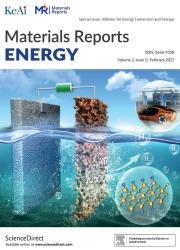
材料导报:能源(英文)
材料导报:能源(英文) Renewable Energy, Sustainability and the Environment, Nanotechnology
CiteScore
13.00
自引率
0.00%
发文量
0
审稿时长
50 days

×
引用
GB/T 7714-2015
复制
MLA
复制
APA
复制
导出至
BibTeX EndNote RefMan NoteFirst NoteExpress
×
提示
您的信息不完整,为了账户安全,请先补充。
现在去补充
×
提示
您因"违规操作"
具体请查看互助需知
我知道了
×
提示
确定
请完成安全验证×
copy
已复制链接
快去分享给好友吧!
我知道了
右上角分享
点击右上角分享
0
联系我们:info@booksci.cn Book学术提供免费学术资源搜索服务,方便国内外学者检索中英文文献。致力于提供最便捷和优质的服务体验。 Copyright © 2023 布克学术 All rights reserved.
京ICP备2023020795号-1
ghs 京公网安备 11010802042870号
Book学术文献互助
Book学术文献互助群
群 号:604180095
Book学术官方微信
小红书


