
Design and optimization of polyherbal tablets for anti-inflammatory therapy: A design of experiment approach with in vitro and in vivo evaluation
Journal of Holistic Integrative Pharmacy
Pub Date : 2026-03-01
Epub Date: 2026-03-04
DOI:10.1016/j.jhip.2026.02.006
引用次数: 0
Abstract
Objective
To develop and optimize polyherbal tablets containing Terminalia chebula, Moringa oleifera, and Ocimum sanctum as a multi-targeted therapeutic approach for the management of chronic inflammatory disorders.
Methods
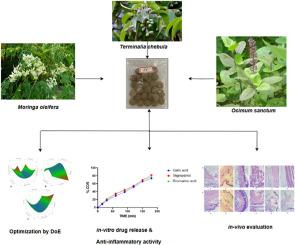
Polyherbal tablets were formulated and optimized using a 32 central composite design within a Quality by Design framework. The optimized formulation (F-11) was evaluated for physicomechanical properties, stability under ambient and accelerated conditions for 60 days, in vitro drug release of key phytoconstituents (gallic acid, stigmasterol, and rosmarinic acid), in vitro anti-inflammatory activity using the human red blood cell (HRBC) membrane stabilization assay, and in vivo anti-inflammatory efficacy using the carrageenan-induced paw edema model in Wistar rats.
Results
The optimized formulation (F-11) exhibited acceptable physicomechanical characteristics and remained stable over 60 days under both storage conditions. Sustained in vitro release was observed, with cumulative releases of gallic acid (72.47%), stigmasterol (81.20%), and rosmarinic acid (76.21%) within 180 min. The formulation demonstrated strong in vitro anti-inflammatory activity, achieving 83.63% inhibition of hemolysis at 500 μg/mL, exceeding that of diclofenac sodium. In vivo studies revealed a significant, dose-dependent reduction in paw edema comparable to the standard drug.
Conclusion
The developed polyherbal tablets demonstrated promising anti-inflammatory efficacy, sustained phytoconstituent release, and short-term stability, supporting their potential for further development as an alternative therapeutic option for inflammatory conditions.
复方消炎片的设计与优化:体外、体内评价的实验设计
目的研制并优化含麻黄、辣木、桑麻的复方中药片剂,作为治疗慢性炎症性疾病的多靶点治疗方法。方法在质量设计框架下,采用32个中心设计对复方多药片进行配方优化。对优化后的配方(F-11)进行了60天的物理力学性能、环境和加速条件下的稳定性、关键植物成分(没食子酸、豆甾醇和迷迭香酸)的体外药物释放、人红细胞(HRBC)膜稳定实验的体外抗炎活性和卡拉胶诱导的Wistar大鼠足部水肿模型的体内抗炎功效评估。结果优化后的配方(F-11)在两种贮存条件下均表现出良好的物理力学特性,并在60 d内保持稳定。体外持续释放,未食子酸(72.47%)、豆甾醇(81.20%)和迷迭香酸(76.21%)在180 min内累积释放。体外抗炎活性强,500 μg/mL时溶血抑制率达83.63%,超过双氯芬酸钠。体内研究显示,与标准药物相比,脚掌水肿有显著的剂量依赖性减少。结论所研制的多药片剂具有良好的抗炎作用,植物成分持续释放,短期稳定性好,具有进一步开发作为炎性疾病替代治疗方案的潜力。
本文章由计算机程序翻译,如有差异,请以英文原文为准。
求助全文
约1分钟内获得全文
求助全文

 求助内容:
求助内容: 应助结果提醒方式:

 京公网安备 11010802042870号


