
Gut–brain axis in neurological disorders: mechanistic links and regulatory role of Chinese herbal medicines

Journal of Holistic Integrative Pharmacy Pub Date : 2026-03-01 Epub Date: 2026-03-04 DOI:10.1016/j.jhip.2026.02.004
Seema Sharma, Sampat Singh Tanwar
{"title":"Gut–brain axis in neurological disorders: mechanistic links and regulatory role of Chinese herbal medicines","authors":"Seema Sharma,&nbsp;Sampat Singh Tanwar","doi":"10.1016/j.jhip.2026.02.004","DOIUrl":null,"url":null,"abstract":"<div><div>The gut–brain axis (GBA) is a bidirectional communication network integrating neural, immune, endocrine, and metabolic pathways that link the gastrointestinal tract and the central nervous system. Increasing evidence implicates gut microbiota dysbiosis in the pathogenesis of neurological disorders, including Alzheimer's disease, Parkinson's disease, multiple sclerosis, autism spectrum disorders, depression, and schizophrenia. This review synthesizes preclinical and clinical evidence to elucidate GBA-mediated mechanisms of neurological dysfunction and critically evaluates the therapeutic potential of Traditional Chinese herbal medicines (TCHMs). We highlight how dysbiosis disrupts immune signaling, microbial metabolite production, intestinal and blood–brain barrier integrity, and neurotransmitter pathways involving serotonin, dopamine, γ-aminobutyric acid, and glutamate, thereby driving neuroinflammation, oxidative stress, and neuronal injury. Particular emphasis is placed on the ability of TCHMs to restore microbial homeostasis, enhance short-chain fatty acid production, strengthen gut barrier function, and regulate neuroendocrine pathways, notably the hypothalamic–pituitary–adrenal and hypothalamic–pituitary–gonadal axes. These multi-target actions are consistently associated with improved cognitive, behavioral, and neuroinflammatory outcomes across experimental models. The review further identifies emerging synergistic strategies combining TCHMs with microbiota-targeted interventions, such as probiotics and dietary modulation, which enhance correction of dysbiosis and attenuation of neuroinflammatory cascades. Nonetheless, heterogeneity in study design, herbal formulations, and microbiome profiling limits clinical translation. Future progress will require standardized methodologies, multi-omics integration, and precision-based approaches. Overall, this review positions Chinese herbal medicines as promising systems-level modulators of the gut–brain axis for neurological disease management.</div></div>","PeriodicalId":100787,"journal":{"name":"Journal of Holistic Integrative Pharmacy","volume":"7 1","pages":"Pages 66-90"},"PeriodicalIF":0.0000,"publicationDate":"2026-03-01","publicationTypes":"Journal Article","fieldsOfStudy":null,"isOpenAccess":false,"openAccessPdf":"","citationCount":"0","resultStr":null,"platform":"Semanticscholar","paperid":null,"PeriodicalName":"Journal of Holistic Integrative Pharmacy","FirstCategoryId":"1085","ListUrlMain":"https://www.sciencedirect.com/science/article/pii/S2707368826000142","RegionNum":0,"RegionCategory":null,"ArticlePicture":[],"TitleCN":null,"AbstractTextCN":null,"PMCID":null,"EPubDate":"2026/3/4 0:00:00","PubModel":"Epub","JCR":"","JCRName":"","Score":null,"Total":0}
引用次数: 0

Abstract

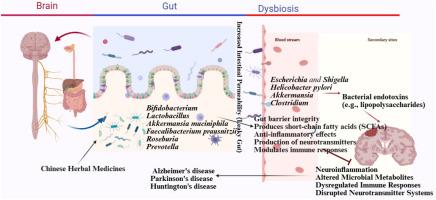
The gut–brain axis (GBA) is a bidirectional communication network integrating neural, immune, endocrine, and metabolic pathways that link the gastrointestinal tract and the central nervous system. Increasing evidence implicates gut microbiota dysbiosis in the pathogenesis of neurological disorders, including Alzheimer's disease, Parkinson's disease, multiple sclerosis, autism spectrum disorders, depression, and schizophrenia. This review synthesizes preclinical and clinical evidence to elucidate GBA-mediated mechanisms of neurological dysfunction and critically evaluates the therapeutic potential of Traditional Chinese herbal medicines (TCHMs). We highlight how dysbiosis disrupts immune signaling, microbial metabolite production, intestinal and blood–brain barrier integrity, and neurotransmitter pathways involving serotonin, dopamine, γ-aminobutyric acid, and glutamate, thereby driving neuroinflammation, oxidative stress, and neuronal injury. Particular emphasis is placed on the ability of TCHMs to restore microbial homeostasis, enhance short-chain fatty acid production, strengthen gut barrier function, and regulate neuroendocrine pathways, notably the hypothalamic–pituitary–adrenal and hypothalamic–pituitary–gonadal axes. These multi-target actions are consistently associated with improved cognitive, behavioral, and neuroinflammatory outcomes across experimental models. The review further identifies emerging synergistic strategies combining TCHMs with microbiota-targeted interventions, such as probiotics and dietary modulation, which enhance correction of dysbiosis and attenuation of neuroinflammatory cascades. Nonetheless, heterogeneity in study design, herbal formulations, and microbiome profiling limits clinical translation. Future progress will require standardized methodologies, multi-omics integration, and precision-based approaches. Overall, this review positions Chinese herbal medicines as promising systems-level modulators of the gut–brain axis for neurological disease management.
Abstract Image

神经系统疾病的肠脑轴:中草药的机制联系和调节作用
肠脑轴(GBA)是连接胃肠道和中枢神经系统的双向通讯网络,整合了神经、免疫、内分泌和代谢途径。越来越多的证据表明,肠道微生物群失调与神经系统疾病的发病机制有关,包括阿尔茨海默病、帕金森病、多发性硬化症、自闭症谱系障碍、抑郁症和精神分裂症。本文综合了临床前和临床证据来阐明gba介导的神经功能障碍机制,并对中药的治疗潜力进行了批判性评价。我们强调了生态失调如何破坏免疫信号、微生物代谢物的产生、肠道和血脑屏障的完整性,以及涉及血清素、多巴胺、γ-氨基丁酸和谷氨酸的神经递质通路,从而驱动神经炎症、氧化应激和神经元损伤。特别强调的是中药恢复微生物稳态、增强短链脂肪酸生成、增强肠道屏障功能和调节神经内分泌通路的能力,特别是下丘脑-垂体-肾上腺轴和下丘脑-垂体-性腺轴。在实验模型中,这些多靶点作用始终与改善的认知、行为和神经炎症结果相关。该综述进一步确定了将中药与微生物群靶向干预相结合的新兴协同策略,如益生菌和饮食调节,可增强生态失调的纠正和神经炎症级联的衰减。然而,研究设计、草药配方和微生物组分析的异质性限制了临床翻译。未来的进展将需要标准化的方法、多组学集成和基于精确的方法。总的来说,这篇综述将中草药定位为有前途的肠脑轴系统级调节剂,用于神经系统疾病的治疗。
本文章由计算机程序翻译,如有差异,请以英文原文为准。
求助全文
约1分钟内获得全文 求助全文
来源期刊
自引率
0.00%
发文量
0
×
引用
GB/T 7714-2015
复制
MLA
复制
APA
复制
导出至
BibTeX EndNote RefMan NoteFirst NoteExpress
×
提示
您的信息不完整,为了账户安全,请先补充。
现在去补充
×
提示
您因"违规操作"
具体请查看互助需知
我知道了
×
提示
确定
请完成安全验证×
copy
已复制链接
快去分享给好友吧!
我知道了
右上角分享
点击右上角分享
0
联系我们:info@booksci.cn Book学术提供免费学术资源搜索服务,方便国内外学者检索中英文文献。致力于提供最便捷和优质的服务体验。 Copyright © 2023 布克学术 All rights reserved.
京ICP备2023020795号-1
ghs 京公网安备 11010802042870号
Book学术文献互助
Book学术文献互助群
群 号:604180095
Book学术官方微信
小红书



