
Shugan Paidu Decoction promotes cuproptosis of hepatoma cells by downregulating STAT3 levels
Journal of Holistic Integrative Pharmacy
Pub Date : 2026-03-01
Epub Date: 2026-03-04
DOI:10.1016/j.jhip.2026.02.001
引用次数: 0
Abstract
Objective
Shugan Paidu Decoction (SGPDT) is a traditional Chinese medicine (TCM) formula clinically used to treat Wilson's disease. Through network pharmacology analysis, we predicted that SGPDT might also be effective in treating liver cancer. However, the active compounds in SGPDT and their underlying mechanisms remain unknown. This study aimed to elucidate the molecular mechanisms by which SGPDT exerts the therapeutic effects on liver cancer.
Methods
The correlation between SGPDT and liver cancer was analyzed using network pharmacology based on publicly available databases. The inhibitory effects of SGPDT on in vitro cell proliferation and migration were validated using CCK-8, colony formation, wound healing, and transwell assays. Intracellular copper ion concentrations were measured, and the mRNA levels of cuproptosis-related genes (CRGs) were assessed by RT-qPCR. The roles of STAT3 in SGPDT-induced cuproptosis were further investigated by evaluating the effects of STAT3 depletion on copper ion concentrations, the levels of key cuproptosis-associated protein DLAT and the mRNA of CRGs.
Results
Network pharmacology analysis identified STAT3 as one of the top genes associated with SGPDT's anti-liver cancer effects. SGPDT inhibited the proliferation and migration of liver cancer cells but did not show a significant impact on normal liver cells. SGPDT induced liver cancer cell death by downregulating STAT3 levels. Furthermore, SGPDT decreased STAT3 levels and induced cuproptosis by elevating intracellular copper ion concentrations. Knockdown of STAT3 altered cellular copper metabolism and induced cuproptosis in liver cancer cells, while overexpression of STAT3 reduced drug sensitivity to SGPDT in hepatocellular carcinoma (HCC) cells.
Conclusion
SGPDT induces cuproptosis by downregulating STAT3 levels, highlighting its inhibitory effect on hepatocellular carcinoma cell proliferation and migration, as well as its potential therapeutic value for liver cancer.
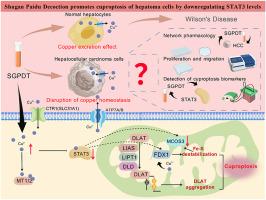
疏肝排毒汤通过下调STAT3水平促进肝癌细胞铜增生
目的疏肝排毒汤是临床治疗肝豆状核变性的中药方剂。通过网络药理学分析,我们预测SGPDT可能对肝癌也有治疗效果。然而,SGPDT中的活性化合物及其潜在机制尚不清楚。本研究旨在阐明SGPDT对肝癌治疗作用的分子机制。方法基于公开数据库,采用网络药理学方法分析SGPDT与肝癌的相关性。通过CCK-8、菌落形成、伤口愈合和transwell实验验证了SGPDT对体外细胞增殖和迁移的抑制作用。检测细胞内铜离子浓度,采用RT-qPCR技术检测铜噬相关基因(cuprotoisisrgs) mRNA表达水平。通过评估STAT3缺失对铜离子浓度、铜中毒相关蛋白DLAT和CRGs mRNA水平的影响,进一步研究STAT3在sgpdt诱导的铜中毒中的作用。结果网络药理学分析发现STAT3是SGPDT抗肝癌作用的重要基因之一。SGPDT能抑制肝癌细胞的增殖和迁移,但对正常肝细胞无明显影响。SGPDT通过下调STAT3水平诱导肝癌细胞死亡。此外,SGPDT通过提高细胞内铜离子浓度降低STAT3水平并诱导铜还原。在肝癌细胞中,STAT3的敲低改变了细胞铜代谢并诱导铜沉积,而STAT3的过表达降低了肝细胞癌(HCC)细胞对SGPDT的药物敏感性。结论sgpdt通过下调STAT3水平诱导cuprotosis,突出了其对肝癌细胞增殖和迁移的抑制作用,以及对肝癌的潜在治疗价值。
本文章由计算机程序翻译,如有差异,请以英文原文为准。
求助全文
约1分钟内获得全文
求助全文

 求助内容:
求助内容: 应助结果提醒方式:

 京公网安备 11010802042870号


