
A mixed-charged monomer approach to robust protein-resistant polyurethane coatings
IF 6
2区 材料科学
Q1 MATERIALS SCIENCE, CHARACTERIZATION & TESTING
Polymer Testing
Pub Date : 2026-03-01
Epub Date: 2026-03-05
DOI:10.1016/j.polymertesting.2026.109137
引用次数: 0
Abstract
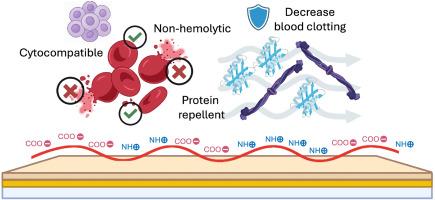
Durable protein-resistant materials that perform reliably under physiological conditions are essential for medical and marine applications, where surface interactions with the fouling environment determine functionality. While zwitterionic polymers have shown excellent antifouling properties, their widespread application is limited by high cost, poor mechanical durability, and complex synthesis. In this study, we present a new class of polyurethane (PU) coatings incorporating a mixture of commercially available ionic chain extenders—2,2-bis(hydroxymethyl)propionic acid (DMPA) and N-methyldiethanolamine (MDEA)—as a durable and cost-effective alternative. By introducing equal amounts of positively and negatively charged monomers as separate functional groups, rather than covalently linked zwitterionic units, we demonstrate a simple and effective strategy for designing biocompatible and antifouling coatings. Mixing independent ionic monomers as separate groups (rather than covalently linked zwitterionic units) represents a new design concept that has not been systematically explored for either thermoplastic or thermoset PUs. The resulting uniform distribution of charged groups enables hydration-driven surface rearrangement that minimizes protein adsorption while preserving mechanical integrity. Polyurethanes with 10% charged-group content, optimized in both thermoplastic and thermoset architectures, exhibit excellent biocompatibility, enhanced mechanical performance, and reduced material cost compared to zwitterionic systems. Spectroscopic (ATR-FTIR, NMR) and morphological (AFM) analyses confirm the uniform integration of charged groups, promoting hydration-driven surface rearrangement. Thermoset PUs, in particular, combine high tensile strength (>12 MPa), remarkable flexibility (>900% elongation), and low water uptake (<5 wt%). Both material types exhibit strong biocompatibility, hemocompatibility, and excellent protein adsorption resistance (∼95% decrease). This work provides a simple yet effective approach for developing robust, biocompatible materials for protein-resistant coatings.
一种混合带电单体方法制备坚固的耐蛋白聚氨酯涂料
耐用的抗蛋白质材料在生理条件下表现可靠,这对于医疗和海洋应用至关重要,在这些应用中,表面与污染环境的相互作用决定了其功能。两性离子聚合物具有优异的防污性能,但成本高、机械耐久性差、合成复杂等限制了其广泛应用。在这项研究中,我们提出了一种新型的聚氨酯(PU)涂料,它包含了市售的离子扩链剂- 2,2-双(羟甲基)丙酸(DMPA)和n -甲基二乙醇胺(MDEA)的混合物,作为一种耐用和经济的替代品。通过引入等量的带正电荷和负电荷的单体作为单独的官能团,而不是共价连接的两性离子单元,我们展示了一种简单而有效的设计生物相容性和防污涂料的策略。混合独立的离子单体作为单独的基团(而不是共价连接的两性离子单位)代表了一个新的设计概念,尚未系统地探索热塑性或热固性pu。由此产生的带电基团的均匀分布使水合驱动的表面重排能够最大限度地减少蛋白质吸附,同时保持机械完整性。与两性离子体系相比,含10%带电基团的聚氨酯在热塑性和热固性体系中都得到了优化,具有出色的生物相容性,增强的机械性能和降低的材料成本。光谱(ATR-FTIR, NMR)和形态(AFM)分析证实了带电基团的均匀整合,促进了水合驱动的表面重排。特别是热固性pu,结合了高抗拉强度(>12 MPa),卓越的柔韧性(>;900%伸长率)和低吸水率(<5 wt%)。两种材料类型都具有很强的生物相容性、血液相容性和优异的蛋白质吸附阻力(减少95%)。这项工作提供了一种简单而有效的方法来开发坚固的、生物相容性的抗蛋白质涂层材料。
本文章由计算机程序翻译,如有差异,请以英文原文为准。
求助全文
约1分钟内获得全文
求助全文
来源期刊
Polymer Testing
工程技术-材料科学:表征与测试
CiteScore
10.70
自引率
5.90%
发文量
328
审稿时长
44 days
期刊介绍:
Polymer Testing focuses on the testing, analysis and characterization of polymer materials, including both synthetic and natural or biobased polymers. Novel testing methods and the testing of novel polymeric materials in bulk, solution and dispersion is covered. In addition, we welcome the submission of the testing of polymeric materials for a wide range of applications and industrial products as well as nanoscale characterization.
The scope includes but is not limited to the following main topics:
Novel testing methods and Chemical analysis
• mechanical, thermal, electrical, chemical, imaging, spectroscopy, scattering and rheology
Physical properties and behaviour of novel polymer systems
• nanoscale properties, morphology, transport properties
Degradation and recycling of polymeric materials when combined with novel testing or characterization methods
• degradation, biodegradation, ageing and fire retardancy
Modelling and Simulation work will be only considered when it is linked to new or previously published experimental results.
 求助内容:
求助内容: 应助结果提醒方式:

 京公网安备 11010802042870号


