
Bacillus velezensis BN suppresses Fusarium tricinctum-induced lily wilt disease through multiple biocontrol mechanisms
IF 3.4
2区 农林科学
Q2 BIOTECHNOLOGY & APPLIED MICROBIOLOGY
引用次数: 0
Abstract
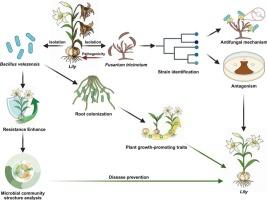
Lily wilt caused by Fusarium tricinctum severely constrains the production of lily (Lilium davidii var. unicolor), and effective, sustainable control strategies are urgently needed. In this study, Bacillus velezensis strain BN was shown to suppress lily wilt disease through multiple biocontrol mechanisms. In vitro, cell-free filtrates of BN exhibited strong antifungal activity by significantly inhibiting mycelial growth and spore germination, with conidial germination inhibition reaching 87.6% at a filtrate concentration of 50% (v/v), while also inducing hyphal swelling and lysis and disrupting membrane integrity. Under greenhouse conditions, preventive application of BN provided more effective disease suppression than curative treatment. GFP labeling confirmed that BN could stably colonize lily roots, supporting its persistence in the rhizosphere. In addition, BN treatment significantly enhanced host defense responses, as evidenced by increased activities of catalase (CAT), peroxidase (POD), polyphenol oxidase (PPO), and phenylalanine ammonia-lyase (PAL). Metagenomic analysis further revealed that BN application reshaped the rhizosphere microbial community, enriching beneficial bacterial taxa and functional pathways related to carbon metabolism, secondary metabolite biosynthesis, and plant–microbe interactions. Together, these results indicate B. velezensis BN functions as a multifaceted biocontrol agent by simultaneously antagonizing the pathogen, enhancing host immune responses, and modulating a disease-suppressive rhizosphere microbiome, highlighting its potential for sustainable management of lily wilt disease.
velezensis BN通过多种生物防治机制抑制赤霉病诱导的百合枯萎病
赤霉病(Fusarium tricinctum)引起的百合枯萎病严重制约了百合的生产,迫切需要有效、可持续的防治策略。本研究表明,velezensis芽孢杆菌BN通过多种生物防治机制抑制百合枯萎病。在体外,BN无细胞滤液通过显著抑制菌丝生长和孢子萌发表现出较强的抗真菌活性,在滤液浓度为50% (v/v)时,分生孢子萌发抑制率达到87.6%,同时还能诱导菌丝肿胀和裂解,破坏膜的完整性。在温室条件下,氮化硼的防治效果优于治疗效果。GFP标记证实了BN可以稳定定殖在百合根中,支持其在根际的持久性。此外,BN处理显著增强了宿主的防御反应,过氧化氢酶(CAT)、过氧化物酶(POD)、多酚氧化酶(PPO)和苯丙氨酸解氨酶(PAL)活性增加。宏基因组分析进一步表明,氮化硼的应用重塑了根际微生物群落,丰富了有益细菌类群和与碳代谢、次生代谢物生物合成和植物-微生物相互作用相关的功能途径。总之,这些结果表明,B. velezensis BN作为一种多方面的生物防治剂,同时拮抗病原体,增强宿主免疫反应,调节疾病抑制根际微生物群,突出了其可持续管理百合枯萎病的潜力。
本文章由计算机程序翻译,如有差异,请以英文原文为准。
求助全文
约1分钟内获得全文
求助全文
来源期刊
Biological Control
生物-昆虫学
CiteScore
7.40
自引率
7.10%
发文量
220
审稿时长
63 days
期刊介绍:
Biological control is an environmentally sound and effective means of reducing or mitigating pests and pest effects through the use of natural enemies. The aim of Biological Control is to promote this science and technology through publication of original research articles and reviews of research and theory. The journal devotes a section to reports on biotechnologies dealing with the elucidation and use of genes or gene products for the enhancement of biological control agents.
The journal encompasses biological control of viral, microbial, nematode, insect, mite, weed, and vertebrate pests in agriculture, aquatic, forest, natural resource, stored product, and urban environments. Biological control of arthropod pests of human and domestic animals is also included. Ecological, molecular, and biotechnological approaches to the understanding of biological control are welcome.
 求助内容:
求助内容: 应助结果提醒方式:

 京公网安备 11010802042870号


