
Autonomous oil spill response through liquid neural trajectory modeling and coordinated marine robotics

IF 4.4 2区 工程技术 Q1 ENGINEERING, OCEAN
Applied Ocean Research Pub Date : 2026-03-01 Epub Date: 2026-02-19 DOI:10.1016/j.apor.2026.104981
Hadas C. Kuzmenko, David Ehevich, Oren Gal
{"title":"Autonomous oil spill response through liquid neural trajectory modeling and coordinated marine robotics","authors":"Hadas C. Kuzmenko,&nbsp;David Ehevich,&nbsp;Oren Gal","doi":"10.1016/j.apor.2026.104981","DOIUrl":null,"url":null,"abstract":"<div><div>Marine oil spills pose grave environmental and economic risks, threatening marine ecosystems, coastlines, and dependent industries. Predicting and managing oil spill trajectories is highly complex, due to the interplay of physical, chemical, and environmental factors such as wind, currents, and temperature, which makes timely and effective response challenging. Accurate real-time trajectory forecasting and coordinated mitigation are vital for minimizing the impact of these disasters. This study introduces an integrated framework combining Liquid Time-Constant Networks (LTCNs) with multi-agent swarm robotics for real-time oil spill trajectory prediction and coordinated response. Our approach implements three complementary LTC solver variants optimized for different operational scenarios: RK4 for critical emergency response, Explicit for operational monitoring, and Euler for large-scale surveillance. The framework is validated using Deepwater Horizon satellite observations under moderate sea state conditions where Loop Current advection and wind forcing dominated transport. Results demonstrate superior spatial prediction accuracy (IoU 0.82-0.84), significantly surpassing Transformer (0.71) and LSTM (0.68) baselines. Crucially, the LTC model maintains realistic irregular boundary geometries (64+ vertices, complexity ratios 0.89-0.96) compared to oversimplified baseline predictions (5-12 vertices, complexity 0.48-0.61) that exhibit unrealistic circular approximations. The framework’s integration with MOOS-IvP enables autonomous fleet coordination, demonstrating scalable, fault-tolerant response capabilities. This work advances physics-based environmental prediction while providing operational flexibility through solver-specific deployment strategies.</div></div>","PeriodicalId":8261,"journal":{"name":"Applied Ocean Research","volume":"168 ","pages":"Article 104981"},"PeriodicalIF":4.4000,"publicationDate":"2026-03-01","publicationTypes":"Journal Article","fieldsOfStudy":null,"isOpenAccess":false,"openAccessPdf":"","citationCount":"0","resultStr":null,"platform":"Semanticscholar","paperid":null,"PeriodicalName":"Applied Ocean Research","FirstCategoryId":"5","ListUrlMain":"https://www.sciencedirect.com/science/article/pii/S0141118726000647","RegionNum":2,"RegionCategory":"工程技术","ArticlePicture":[],"TitleCN":null,"AbstractTextCN":null,"PMCID":null,"EPubDate":"2026/2/19 0:00:00","PubModel":"Epub","JCR":"Q1","JCRName":"ENGINEERING, OCEAN","Score":null,"Total":0}
引用次数: 0

Abstract

Marine oil spills pose grave environmental and economic risks, threatening marine ecosystems, coastlines, and dependent industries. Predicting and managing oil spill trajectories is highly complex, due to the interplay of physical, chemical, and environmental factors such as wind, currents, and temperature, which makes timely and effective response challenging. Accurate real-time trajectory forecasting and coordinated mitigation are vital for minimizing the impact of these disasters. This study introduces an integrated framework combining Liquid Time-Constant Networks (LTCNs) with multi-agent swarm robotics for real-time oil spill trajectory prediction and coordinated response. Our approach implements three complementary LTC solver variants optimized for different operational scenarios: RK4 for critical emergency response, Explicit for operational monitoring, and Euler for large-scale surveillance. The framework is validated using Deepwater Horizon satellite observations under moderate sea state conditions where Loop Current advection and wind forcing dominated transport. Results demonstrate superior spatial prediction accuracy (IoU 0.82-0.84), significantly surpassing Transformer (0.71) and LSTM (0.68) baselines. Crucially, the LTC model maintains realistic irregular boundary geometries (64+ vertices, complexity ratios 0.89-0.96) compared to oversimplified baseline predictions (5-12 vertices, complexity 0.48-0.61) that exhibit unrealistic circular approximations. The framework’s integration with MOOS-IvP enables autonomous fleet coordination, demonstrating scalable, fault-tolerant response capabilities. This work advances physics-based environmental prediction while providing operational flexibility through solver-specific deployment strategies.
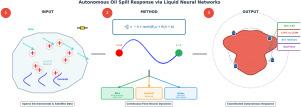
Abstract Image

基于液体神经轨迹建模和协调海洋机器人的自主溢油响应
海洋石油泄漏造成了严重的环境和经济风险,威胁着海洋生态系统、海岸线和依赖的工业。由于物理、化学和环境因素(如风、海流和温度)的相互作用,预测和管理溢油轨迹非常复杂,这使得及时有效的响应具有挑战性。准确的实时轨迹预测和协调的减灾对于尽量减少这些灾害的影响至关重要。本研究引入了一种将液体时间常数网络(LTCNs)与多智能体群机器人相结合的集成框架,用于实时溢油轨迹预测和协调响应。我们的方法实现了三种互补的LTC求解器变体,针对不同的操作场景进行了优化:RK4用于关键紧急响应,Explicit用于操作监控,Euler用于大规模监控。在环流平流和风强迫主导运输的中等海况条件下,使用深水地平线卫星观测对该框架进行了验证。结果表明,空间预测精度(IoU 0.82-0.84)明显优于Transformer(0.71)和LSTM(0.68)基线。至关重要的是,与过度简化的基线预测(5-12个顶点,复杂性0.48-0.61)相比,LTC模型保持了现实的不规则边界几何(64+顶点,复杂性比0.89-0.96),表现出不切实际的圆形近似值。该框架与MOOS-IvP的集成实现了自主车队协调,展示了可扩展的容错响应能力。这项工作推进了基于物理的环境预测,同时通过求解器特定的部署策略提供了操作灵活性。
本文章由计算机程序翻译,如有差异,请以英文原文为准。
求助全文
约1分钟内获得全文 求助全文
来源期刊
Applied Ocean Research
Applied Ocean Research 地学-工程:大洋
CiteScore
8.70
自引率
7.00%
发文量
316
审稿时长
59 days
期刊介绍: The aim of Applied Ocean Research is to encourage the submission of papers that advance the state of knowledge in a range of topics relevant to ocean engineering.

×
引用
GB/T 7714-2015
复制
MLA
复制
APA
复制
导出至
BibTeX EndNote RefMan NoteFirst NoteExpress
×
提示
您的信息不完整,为了账户安全,请先补充。
现在去补充
×
提示
您因"违规操作"
具体请查看互助需知
我知道了
×
提示
确定
请完成安全验证×
copy
已复制链接
快去分享给好友吧!
我知道了
右上角分享
点击右上角分享
0
联系我们:info@booksci.cn Book学术提供免费学术资源搜索服务,方便国内外学者检索中英文文献。致力于提供最便捷和优质的服务体验。 Copyright © 2023 布克学术 All rights reserved.
京ICP备2023020795号-1
ghs 京公网安备 11010802042870号
Book学术文献互助
Book学术文献互助群
群 号:604180095
Book学术官方微信
小红书


