
One-pot thermal polycondensation to synthesize sulfur-doped g-C₃N₄ for efficient photocatalytic degradation
IF 4.7
3区 材料科学
Q2 CHEMISTRY, PHYSICAL
Colloid and Interface Science Communications
Pub Date : 2026-03-01
Epub Date: 2026-02-03
DOI:10.1016/j.colcom.2026.100873
引用次数: 0
Abstract
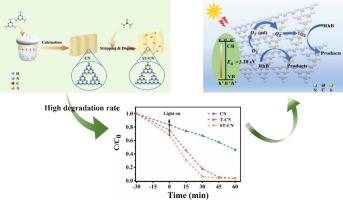
Developing high-performance photocatalysts is an economical and effective way for organic pollutant degradation. In this study, sulfur-doped graphitic carbon nitride (ST-CN) nanosheets with a highly exfoliated structure were synthesized via a simple one-pot thermal polycondensation procedure. After sulfur doping, ST-CN was provided with significantly enlarged specific surface area and improved charge separation efficiency. ST-CN displayed obviously enhanced degradation property for rhodamine B with an efficiency of 96.6% under visible light irradiation, much higher than pristine g-C3N4 (53.9%). More importantly, the unabated degradation efficiency of ST-CN occurred for rhodamine B even in some complex water matrixes with various ions (Cl−, CO32−, NO3−, and SO42−) and different pH values. During the photocatalytic degradation process, ST-CN produced abundant superoxide radicals (•O2−), which played a dominant role of the pollutant's elimination. In short, this work offers a simple and efficient strategy to modify carbon nitride for enhancing the photocatalytic performance.
一锅热缩聚合成硫掺杂g-C₃N₄进行高效光催化降解
开发高性能光催化剂是一种经济有效的降解有机污染物的途径。在本研究中,通过简单的单锅热缩聚工艺合成了具有高度剥离结构的硫掺杂石墨氮化碳纳米片。硫掺杂后,ST-CN的比表面积显著增大,电荷分离效率显著提高。ST-CN在可见光照射下对罗丹明B的降解效率为96.6%,远高于原始g-C3N4的53.9%。更重要的是,即使在具有不同离子(Cl−,CO32−,NO3−和SO42−)和不同pH值的复杂水基质中,ST-CN对罗丹明B的降解效率也不降低。在光催化降解过程中,ST-CN产生了丰富的超氧自由基(•O2−),对污染物的消除起主导作用。总之,这项工作提供了一种简单有效的策略来修饰氮化碳以提高光催化性能。
本文章由计算机程序翻译,如有差异,请以英文原文为准。
求助全文
约1分钟内获得全文
求助全文
来源期刊
Colloid and Interface Science Communications
Materials Science-Materials Chemistry
CiteScore
9.40
自引率
6.70%
发文量
125
审稿时长
43 days
期刊介绍:
Colloid and Interface Science Communications provides a forum for the highest visibility and rapid publication of short initial reports on new fundamental concepts, research findings, and topical applications at the forefront of the increasingly interdisciplinary area of colloid and interface science.
 求助内容:
求助内容: 应助结果提醒方式:

 京公网安备 11010802042870号


