
Resolving nanoparticle collision reactivity via simultaneous current and fluorescence detection
IF 4.2
3区 工程技术
Q2 ELECTROCHEMISTRY
Electrochemistry Communications
Pub Date : 2026-03-01
Epub Date: 2026-02-20
DOI:10.1016/j.elecom.2026.108125
引用次数: 0
Abstract
Operando analysis enables real-time monitoring of chemical processes, with spectroelectrochemical methods offering direct mechanistic insight. Here, we present an electrochemical-fluorescence approach that couples time-resolved fluorescence detection with nanoparticle collision electrochemistry. Fluorescein-functionalized silver nanoparticles (AgNPs) serve as dual probes, providing simultaneous picoampere-level current and fluorescence readouts. At low electrode potentials, weak electrostatic attraction limits oxidation, yielding few correlated current-fluorescence events. Increasing the potential enhances both collision frequency and electron transfer, producing more coincident spikes. In contrast, fluorescence spikes without current signals were suggested to be associated with 11-Mercapto-1-undecanol (MUD) functionalization that may reduce electron transfer. By correlating electrochemical and optical outputs, this strategy distinguishes reactive from nonreactive collisions. More broadly, it establishes a versatile platform for resolving single-nanoparticle reactivity beyond electrochemistry alone, with implications for catalysis, biosensing, and nanoparticle tracking in complex media.
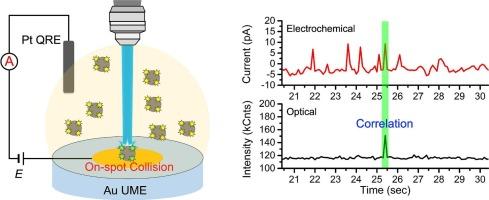
通过同步电流和荧光检测解决纳米粒子碰撞反应性
Operando分析能够实时监测化学过程,光谱电化学方法提供直接的机制洞察。在这里,我们提出了一种电化学-荧光方法,将时间分辨荧光检测与纳米粒子碰撞电化学结合起来。荧光素功能化的银纳米颗粒(AgNPs)作为双探针,同时提供皮安级电流和荧光读数。在低电极电位下,弱静电吸引限制氧化,产生很少的相关电流-荧光事件。增加电势可以提高碰撞频率和电子转移,产生更多的一致尖峰。相反,没有电流信号的荧光峰被认为与11-巯基-1-十一醇(MUD)功能化有关,这可能会减少电子转移。通过关联电化学和光学输出,该策略区分了反应性和非反应性碰撞。更广泛地说,它建立了一个多功能平台,用于解决单纳米颗粒的反应性,而不仅仅是电化学,这对催化、生物传感和复杂介质中的纳米颗粒跟踪具有重要意义。
本文章由计算机程序翻译,如有差异,请以英文原文为准。
求助全文
约1分钟内获得全文
求助全文
来源期刊
Electrochemistry Communications
工程技术-电化学
CiteScore
8.50
自引率
3.70%
发文量
160
审稿时长
1.2 months
期刊介绍:
Electrochemistry Communications is an open access journal providing fast dissemination of short communications, full communications and mini reviews covering the whole field of electrochemistry which merit urgent publication. Short communications are limited to a maximum of 20,000 characters (including spaces) while full communications and mini reviews are limited to 25,000 characters (including spaces). Supplementary information is permitted for full communications and mini reviews but not for short communications. We aim to be the fastest journal in electrochemistry for these types of papers.
 求助内容:
求助内容: 应助结果提醒方式:

 京公网安备 11010802042870号


