
Human–animal interfaces and zoonotic disease risks in China: a review of contact behaviors and risk communication

Science in One Health Pub Date : 2026-01-01 Epub Date: 2026-02-17 DOI:10.1016/j.soh.2026.100153
Hongying Li , Siyeun Kim , Catherine Machalaba
{"title":"Human–animal interfaces and zoonotic disease risks in China: a review of contact behaviors and risk communication","authors":"Hongying Li ,&nbsp;Siyeun Kim ,&nbsp;Catherine Machalaba","doi":"10.1016/j.soh.2026.100153","DOIUrl":null,"url":null,"abstract":"<div><div>Zoonotic diseases continue to present health, social, and economic challenges in China. While the country has demonstrated strong outbreak response capabilities, current efforts remain reactive and top-down. Shifting toward primary prevention at the human–animal–environment interface with enhanced risk communication offers a more sustainable approach to reducing zoonotic disease risks. This review synthesized peer-reviewed and gray literature in English and Chinese to characterize human–animal contact behaviors associated with 93 zoonotic diseases monitored by China’s public health, agricultural, and forestry sectors. It examined contact pathways across key animal groups known to carry zoonotic pathogens, identified human populations at risk, and analyzed the demographic, socio-cultural, and ecological factors shaping these contacts. Focusing on four major human–animal interfaces, the review further identified lessons and best practices for effective risk communications. Findings reveal that human–animal contact in China is diverse and embedded in daily routines, cultural practices, and economic activities, with distinct risk profiles presented across animal groups and socio-ecological settings. Populations such as smallholder farmers, herders, rural residents, market vendors, and workers in informal sectors face higher exposure risk, influenced by socio-economic conditions and ecological changes. Gaps remain in surveillance of informal practices, emerging pathogens, and behavioral data. Evidence from global and local experiences highlights the value of behavior-centered, community-engaged communication grounded in One Health principles, emphasizing participatory design, culturally relevant education, local leadership, and integration with public service systems. Overall, this review provides an integrated understanding of zoonotic disease risks and prevention opportunities from social-behavioral and communication perspectives. It identified priority populations, settings, and best practices for targeted and effective strategies, underscoring the need for coordinated One Health efforts to address complex human–animal–environment interactions and promote proactive zoonotic disease prevention in China and beyond.</div></div>","PeriodicalId":101146,"journal":{"name":"Science in One Health","volume":"5 ","pages":"Article 100153"},"PeriodicalIF":0.0000,"publicationDate":"2026-01-01","publicationTypes":"Journal Article","fieldsOfStudy":null,"isOpenAccess":false,"openAccessPdf":"","citationCount":"0","resultStr":null,"platform":"Semanticscholar","paperid":null,"PeriodicalName":"Science in One Health","FirstCategoryId":"1085","ListUrlMain":"https://www.sciencedirect.com/science/article/pii/S2949704326000089","RegionNum":0,"RegionCategory":null,"ArticlePicture":[],"TitleCN":null,"AbstractTextCN":null,"PMCID":null,"EPubDate":"2026/2/17 0:00:00","PubModel":"Epub","JCR":"","JCRName":"","Score":null,"Total":0}
引用次数: 0

Abstract

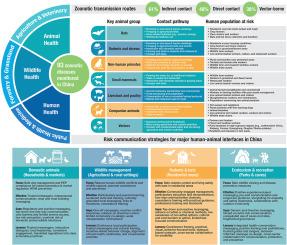
Zoonotic diseases continue to present health, social, and economic challenges in China. While the country has demonstrated strong outbreak response capabilities, current efforts remain reactive and top-down. Shifting toward primary prevention at the human–animal–environment interface with enhanced risk communication offers a more sustainable approach to reducing zoonotic disease risks. This review synthesized peer-reviewed and gray literature in English and Chinese to characterize human–animal contact behaviors associated with 93 zoonotic diseases monitored by China’s public health, agricultural, and forestry sectors. It examined contact pathways across key animal groups known to carry zoonotic pathogens, identified human populations at risk, and analyzed the demographic, socio-cultural, and ecological factors shaping these contacts. Focusing on four major human–animal interfaces, the review further identified lessons and best practices for effective risk communications. Findings reveal that human–animal contact in China is diverse and embedded in daily routines, cultural practices, and economic activities, with distinct risk profiles presented across animal groups and socio-ecological settings. Populations such as smallholder farmers, herders, rural residents, market vendors, and workers in informal sectors face higher exposure risk, influenced by socio-economic conditions and ecological changes. Gaps remain in surveillance of informal practices, emerging pathogens, and behavioral data. Evidence from global and local experiences highlights the value of behavior-centered, community-engaged communication grounded in One Health principles, emphasizing participatory design, culturally relevant education, local leadership, and integration with public service systems. Overall, this review provides an integrated understanding of zoonotic disease risks and prevention opportunities from social-behavioral and communication perspectives. It identified priority populations, settings, and best practices for targeted and effective strategies, underscoring the need for coordinated One Health efforts to address complex human–animal–environment interactions and promote proactive zoonotic disease prevention in China and beyond.
Abstract Image

中国人-动物界面和人畜共患疾病风险:接触行为和风险沟通综述
人畜共患疾病继续给中国的健康、社会和经济带来挑战。虽然该国已显示出强大的疫情应对能力,但目前的努力仍然是被动的和自上而下的。转向人-动物-环境界面的初级预防,加强风险沟通,是减少人畜共患疾病风险的更可持续的方法。本综述综合了同行评议的英文和中文灰色文献,对中国公共卫生、农业和林业部门监测的93种人畜共患疾病相关的人兽接触行为进行了描述。它检查了已知携带人畜共患病原体的主要动物群体之间的接触途径,确定了处于危险中的人群,并分析了影响这些接触的人口统计学、社会文化和生态因素。该审查侧重于四个主要的人与动物界面,进一步确定了有效风险沟通的经验教训和最佳做法。研究结果表明,在中国,人与动物的接触是多种多样的,存在于日常生活、文化习俗和经济活动中,在不同的动物群体和社会生态环境中呈现出不同的风险特征。受社会经济条件和生态变化的影响,小农、牧民、农村居民、市场摊贩和非正规部门工人等人群面临更高的暴露风险。在非正式做法、新出现的病原体和行为数据的监测方面仍然存在差距。来自全球和地方经验的证据突出了基于“同一个健康”原则的以行为为中心、社区参与的沟通的价值,强调参与性设计、与文化相关的教育、地方领导以及与公共服务系统的整合。总的来说,这篇综述从社会行为和传播的角度提供了对人畜共患疾病风险和预防机会的综合理解。它确定了有针对性和有效战略的重点人群、环境和最佳做法,强调需要协调一致的“同一个健康”努力,以解决复杂的人-动物-环境相互作用问题,并在中国及其他地区促进主动预防人畜共患疾病。
本文章由计算机程序翻译,如有差异,请以英文原文为准。
求助全文
约1分钟内获得全文 求助全文
来源期刊
自引率
0.00%
发文量
0
×
引用
GB/T 7714-2015
复制
MLA
复制
APA
复制
导出至
BibTeX EndNote RefMan NoteFirst NoteExpress
×
提示
您的信息不完整,为了账户安全,请先补充。
现在去补充
×
提示
您因"违规操作"
具体请查看互助需知
我知道了
×
提示
确定
请完成安全验证×
copy
已复制链接
快去分享给好友吧!
我知道了
右上角分享
点击右上角分享
0
联系我们:info@booksci.cn Book学术提供免费学术资源搜索服务,方便国内外学者检索中英文文献。致力于提供最便捷和优质的服务体验。 Copyright © 2023 布克学术 All rights reserved.
京ICP备2023020795号-1
ghs 京公网安备 11010802042870号
Book学术文献互助
Book学术文献互助群
群 号:604180095
Book学术官方微信
小红书



