
Application of MXene-based nanocomposites in electrochemical biosensors
IF 8.7
Q1 CHEMISTRY, PHYSICAL
Applied Surface Science Advances
Pub Date : 2026-03-01
Epub Date: 2026-02-26
DOI:10.1016/j.apsadv.2026.100959
引用次数: 0
Abstract
MXene is among the most attractive two-dimensional (2D) nanomaterials for construction of advanced electrochemical biosensors owing to their superior electrical and mechanical properties, tunable hydrophilicity, large surface-to-volume ratio, excellent electrochemical properties, facile functionalization, and good biocompatibility. Furthermore, MXene nanomaterials possess excellent conductivity, facilitating the electrical signal transmission in biosensors. They also offer a large surface area, providing active sites for interactions with biomolecules, thereby enhanced detection of various analytes contributing to the sensitive and precise construction of biosensors. In this review, recent breakthroughs in the concept, development, and bio-sensing applications of various MXene-based electrochemical biosensors have been summarized. More specifically, this review attempts to detail the MXene nanocomposites and MXene hydrogels as the most effective strategies to make full use of the electrochemical performance of MXene as well as the reports where MXene nanocomposites have been used in electrochemical biosensors, so that the future prospect of these cutting-edge 2D materials can be analyzed. This will help in developing innovative MXene-based biosensing platforms towards advancing the application of such devices in point-of-care (POC) diagnosis.
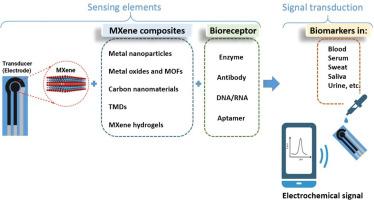
mxene基纳米复合材料在电化学生物传感器中的应用
MXene具有优异的电学和力学性能、可调的亲水性、大的表面体积比、优异的电化学性能、易于功能化和良好的生物相容性,是构建先进电化学生物传感器最具吸引力的二维纳米材料之一。此外,MXene纳米材料具有优异的导电性,有利于生物传感器中的电信号传输。它们还提供了较大的表面积,为与生物分子的相互作用提供了活性位点,从而增强了对各种分析物的检测,有助于灵敏和精确地构建生物传感器。本文综述了近年来基于mxene的电化学生物传感器在概念、发展和生物传感应用方面的最新进展。更具体地说,本文试图详细介绍MXene纳米复合材料和MXene水凝胶作为充分利用MXene电化学性能的最有效策略,以及MXene纳米复合材料在电化学生物传感器中的应用报道,从而分析这些前沿二维材料的未来前景。这将有助于开发创新的基于mxene的生物传感平台,以推进此类设备在护理点(POC)诊断中的应用。
本文章由计算机程序翻译,如有差异,请以英文原文为准。
求助全文
约1分钟内获得全文
求助全文

 求助内容:
求助内容: 应助结果提醒方式:

 京公网安备 11010802042870号


