
Protein, polyamine, phenolic composition and their correlations in Canadian barley grains for different end-use purposes

IF 3.7 2区 农林科学 Q2 FOOD SCIENCE & TECHNOLOGY
Journal of Cereal Science Pub Date : 2026-03-01 Epub Date: 2026-02-09 DOI:10.1016/j.jcs.2026.104397
Juan Wei , Wanqi Lu , Si Nhat Nguyen , Daniel Zogona , Ana Badea , Matthew G. Bakker , Trust Beta
{"title":"Protein, polyamine, phenolic composition and their correlations in Canadian barley grains for different end-use purposes","authors":"Juan Wei ,&nbsp;Wanqi Lu ,&nbsp;Si Nhat Nguyen ,&nbsp;Daniel Zogona ,&nbsp;Ana Badea ,&nbsp;Matthew G. Bakker ,&nbsp;Trust Beta","doi":"10.1016/j.jcs.2026.104397","DOIUrl":null,"url":null,"abstract":"<div><div>Barley is an important cereal grain in Canada, classified into food, malting, and general-purpose cultivars based on their end-use purposes. In this study, protein, polyamine, phenolic composition and content of 25 Canadian barley genotypes representing different end uses were analyzed on a dry base. The protein content was measured between 10.38% and 15.47%. Total polyamines (TPA) were found in the range of 64.62 to 135.11 μg/g. The free phenolic content (FPC) showed values from 761.46 to 1174.27 μg gallic acid equivalents (GAE)/g, and the bound phenolic content (BPC) ranged from 390.76 to 825.34 μg GAE/g. Putrescine (Put), spermidine (Spd), and spermine (Spm) were identified as the predominant polyamines, while ferulic acid (FA) was the most abundant phenolic acid, followed by <em>p</em>-coumaric acid (CA). Food barley exhibited the highest levels of protein, Put, Spd, Spm, and TPA, whereas malting and general-purpose barleys contained higher levels of BPC, FA and CA. Correlation analysis revealed strong positive relationships among protein, Put, Spd, Spm, and TPA, but negative correlations between these components and BPC, FA and CA. These findings provide new insights into the compositional characteristics of Canadian barley genotypes intended for different end uses and underscore the importance of considering quality and functional attributes when selecting barley varieties for food, malting, and feed applications.</div></div>","PeriodicalId":15285,"journal":{"name":"Journal of Cereal Science","volume":"128 ","pages":"Article 104397"},"PeriodicalIF":3.7000,"publicationDate":"2026-03-01","publicationTypes":"Journal Article","fieldsOfStudy":null,"isOpenAccess":false,"openAccessPdf":"","citationCount":"0","resultStr":null,"platform":"Semanticscholar","paperid":null,"PeriodicalName":"Journal of Cereal Science","FirstCategoryId":"97","ListUrlMain":"https://www.sciencedirect.com/science/article/pii/S0733521026000354","RegionNum":2,"RegionCategory":"农林科学","ArticlePicture":[],"TitleCN":null,"AbstractTextCN":null,"PMCID":null,"EPubDate":"2026/2/9 0:00:00","PubModel":"Epub","JCR":"Q2","JCRName":"FOOD SCIENCE & TECHNOLOGY","Score":null,"Total":0}
引用次数: 0

Abstract

Barley is an important cereal grain in Canada, classified into food, malting, and general-purpose cultivars based on their end-use purposes. In this study, protein, polyamine, phenolic composition and content of 25 Canadian barley genotypes representing different end uses were analyzed on a dry base. The protein content was measured between 10.38% and 15.47%. Total polyamines (TPA) were found in the range of 64.62 to 135.11 μg/g. The free phenolic content (FPC) showed values from 761.46 to 1174.27 μg gallic acid equivalents (GAE)/g, and the bound phenolic content (BPC) ranged from 390.76 to 825.34 μg GAE/g. Putrescine (Put), spermidine (Spd), and spermine (Spm) were identified as the predominant polyamines, while ferulic acid (FA) was the most abundant phenolic acid, followed by p-coumaric acid (CA). Food barley exhibited the highest levels of protein, Put, Spd, Spm, and TPA, whereas malting and general-purpose barleys contained higher levels of BPC, FA and CA. Correlation analysis revealed strong positive relationships among protein, Put, Spd, Spm, and TPA, but negative correlations between these components and BPC, FA and CA. These findings provide new insights into the compositional characteristics of Canadian barley genotypes intended for different end uses and underscore the importance of considering quality and functional attributes when selecting barley varieties for food, malting, and feed applications.
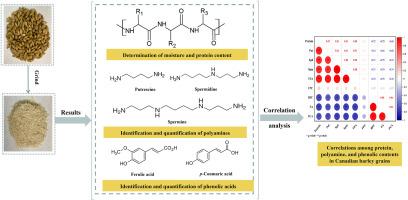
Abstract Image

不同最终用途的加拿大大麦籽粒中蛋白质、多胺、酚类成分及其相关性
大麦在加拿大是一种重要的谷类作物,根据其最终用途分为食用品种、麦芽品种和通用品种。本研究在干基质上分析了25种不同用途的加拿大大麦基因型的蛋白质、多胺、酚类成分及其含量。蛋白质含量在10.38% ~ 15.47%之间。总多胺含量在64.62 ~ 135.11 μg/g之间。游离酚含量(FPC)为761.46 ~ 1174.27 μg没食子酸当量(GAE)/g,结合酚含量(BPC)为390.76 ~ 825.34 μg GAE/g。腐胺(Put)、亚精胺(Spd)和精胺(Spm)是主要的多胺,阿魏酸(FA)是最丰富的酚酸,其次是对香豆酸(CA)。食用大麦中蛋白质、Put、Spd、Spm和TPA含量最高,而麦芽和通用大麦中BPC、FA和CA含量较高。相关分析表明,蛋白质、Put、Spd、Spm和TPA之间呈显著正相关,而这些成分与BPC之间呈负相关。这些发现为了解不同最终用途的加拿大大麦基因型的组成特征提供了新的见解,并强调了在选择用于食品、麦芽和饲料应用的大麦品种时考虑质量和功能属性的重要性。
本文章由计算机程序翻译,如有差异,请以英文原文为准。
求助全文
约1分钟内获得全文 求助全文
来源期刊
Journal of Cereal Science
Journal of Cereal Science 工程技术-食品科技
CiteScore
7.80
自引率
2.60%
发文量
163
审稿时长
38 days
期刊介绍: The Journal of Cereal Science was established in 1983 to provide an International forum for the publication of original research papers of high standing covering all aspects of cereal science related to the functional and nutritional quality of cereal grains (true cereals - members of the Poaceae family and starchy pseudocereals - members of the Amaranthaceae, Chenopodiaceae and Polygonaceae families) and their products, in relation to the cereals used. The journal also publishes concise and critical review articles appraising the status and future directions of specific areas of cereal science and short communications that present news of important advances in research. The journal aims at topicality and at providing comprehensive coverage of progress in the field.

×
引用
GB/T 7714-2015
复制
MLA
复制
APA
复制
导出至
BibTeX EndNote RefMan NoteFirst NoteExpress
×
提示
您的信息不完整,为了账户安全,请先补充。
现在去补充
×
提示
您因"违规操作"
具体请查看互助需知
我知道了
×
提示
确定
请完成安全验证×
copy
已复制链接
快去分享给好友吧!
我知道了
右上角分享
点击右上角分享
0
联系我们:info@booksci.cn Book学术提供免费学术资源搜索服务,方便国内外学者检索中英文文献。致力于提供最便捷和优质的服务体验。 Copyright © 2023 布克学术 All rights reserved.
京ICP备2023020795号-1
ghs 京公网安备 11010802042870号
Book学术文献互助
Book学术文献互助群
群 号:604180095
Book学术官方微信
小红书


